Troubleshooting guidance checked against current Ella's Bubbles support materials, KOHLER Walk-In Bath service guidance and American Standard walk-in bath owner documentation. Exact controls, pumps, drain systems and warranty procedures vary by model; the current manufacturer manual controls.
A walk-in tub combines plumbing, a watertight door and, on many models, electrical equipment in one compact installation. That makes troubleshooting different from fixing a standard bathtub.
The good news is that a symptom often tells you where to look. Water appearing only while the tub drains points to a different problem than water that appears as soon as the tub fills. A pump that is silent suggests a different set of checks than one that hums but does not move water.
This guide is organized around those symptoms. It focuses on what you can check safely, what information to gather for service, and where DIY troubleshooting should stop.
Walk-in tub troubleshooting at a glance
| Symptom | Safe first checks | When to stop and call service |
|---|---|---|
| Water at the door | Check level, clean gasket and frame, remove debris, inspect latch action | Torn seal, misaligned door, frame movement, leak continues after basic checks |
| Water underneath tub | Dry access area, note whether leak happens during fill, soaking, jets or drain | Leak from pump/heater union, drain fitting, supply line or hidden plumbing |
| Jets do not start | Correct water level, GFCI/breaker, normal control sequence | Repeated trips, pump hum, wiring issue, no response after basic checks |
| Pump hums but no jet flow | Confirm water level and visible intake is clear | Possible obstruction, air lock, pump or wet-end problem |
| Slow drain | Remove visible hair/debris, inspect stopper movement | Powered drain fails, persistent blockage, drain fitting leaks |
| GFCI keeps tripping | Stop using powered features | Immediately — electrician or qualified service technician |
| Noise after bathing | Check whether model has automatic air-line purge | Grinding, burning smell, leak, or noise not described by manufacturer |
First: identify the exact tub and therapy package
Before troubleshooting, find the model number, serial number and installed options.
A soaking-only tub has very little powered equipment. A combination therapy tub can have a water pump, air blower, inline heater, heated seat, microbubble system, electronic controls and a powered drain. Two tubs from the same brand can therefore have completely different troubleshooting paths.
Keep the owner’s manual and installation manual available. If you do not have them, use the manufacturer’s support site or customer service rather than relying on a generic diagram from another model.
If a GFCI will not reset, repeatedly trips, wiring looks damaged, a pump smells hot or burned, or water has reached electrical equipment, stop using the powered systems. Do not bypass a GFCI or keep resetting a breaker to “see if it holds.”
Problem 1: the walk-in tub door leaks
A leaking door does not automatically mean the gasket needs replacement.
Current Ella’s Bubbles support guidance puts leveling near the top of the diagnostic order. If one leveling foot loses firm contact with the floor, the tub frame can twist enough that the door no longer compresses the gasket evenly. Debris, soap film, a compressed seal or latch alignment can create the same symptom.
Check these in order
- Confirm where the water actually starts. Dry the door, frame and floor first.
- Check that the tub is level and stable. A rocking or twisted frame needs installer attention.
- Clean the gasket and mating surface. Remove hair, lint, soap film and grit using the cleaner approved by your manufacturer.
- Inspect the seal. Look for a tear, hardened section, section pulled from its channel or obvious permanent deformation.
- Watch the latch. The door should close squarely without needing to be forced.
- Run a controlled fill test only if the manufacturer permits it and the tub is otherwise safe to use.
Ella’s current support material also warns that a replacement seal is model- and door-specific. A generic gasket bought by profile or length may not compress correctly.
Do not caulk across the sealing face
Adding silicone over the face of a door gasket can make a leak worse by preventing the gasket from compressing evenly. If the gasket has come loose from its channel, follow the manufacturer’s repair instruction or contact service rather than coating the seal surface with caulk.
For a deeper explanation of inward-, outward- and transfer-door designs, see our walk-in tub door types guide.
Problem 2: water is underneath the tub, but the door is dry
Water under the tub should be diagnosed by when it appears.
Current Ella’s Bubbles troubleshooting identifies several common leak points inside the service cavity:
- pump or inline-heater unions and their O-rings;
- pump housing or threaded pump connections;
- air-jet fittings;
- drain elbow or drain gasket;
- faucet and supply connections;
- handshower-related plumbing.
A useful isolation method
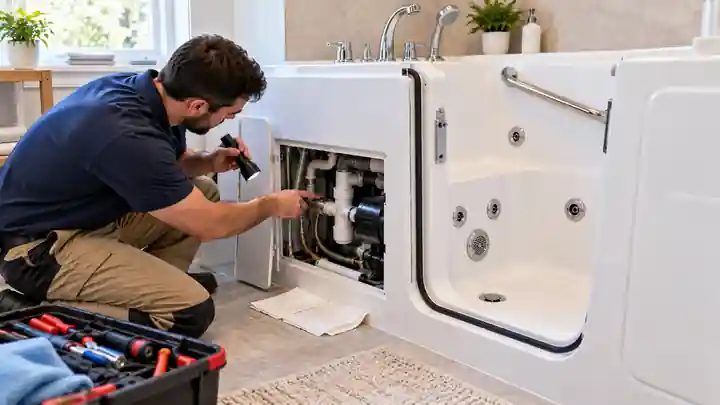
If the access panel can be removed safely without touching electrical equipment, a technician-style observation sequence can narrow the problem:
- Dry the cavity completely.
- Place dry paper towels below likely plumbing connections.
- Fill the tub with all therapy systems off and watch for drips.
- If dry, operate one water-based system at a time.
- Drain the tub and watch the drain fittings separately.
The goal is not to dismantle components. It is to identify whether the leak belongs to the fill plumbing, a pump/heater circuit, the drain system or another connection so the right professional arrives prepared.
If water is close to electrical components, switch the tub out of service and call a qualified professional. Do not use a towel-and-reset approach around powered equipment.
Problem 3: the jets will not turn on
Before assuming the pump has failed, check the basics that do not require opening electrical equipment.
- Water level: many whirlpool systems will not operate correctly if the tub is not filled above the required jet or suction level.
- GFCI and breaker: verify whether the protected circuit has tripped. If it trips again, stop troubleshooting and call an electrician or service technician.
- Control sequence: confirm that you are using the correct button for the installed therapy system.
- Visible intake: remove hair or debris only if your manual says the owner may clean that inlet or cover.
American Standard’s walk-in bath owner documentation lists loose control connections, open switches or relays, breaker issues and mechanical obstruction among potential causes of a pump that will not start. Those are technician-level checks once you move beyond the external controls and breaker.
Never run a water pump dry
Do not repeatedly press the jet button with an empty tub. Water-lubricated or water-cooled pump systems can be damaged when operated without the required water level.
Problem 4: the pump hums, but the jets are weak or there is no flow
A humming motor means the troubleshooting path is different from a completely silent system.
Manufacturer documentation commonly points to possibilities such as:
- insufficient water level;
- blocked suction or discharge path;
- debris at the pump wet end;
- air or loss of prime in the water path;
- incorrect voltage or another electrical problem;
- pump wear or mechanical binding.
A homeowner-safe check is limited to water level, visible debris and the approved cleaning routine. Opening a pump, loosening electrical connections or dismantling a wet end is service work.
If the jets gradually became weaker rather than failing suddenly, start with the approved maintenance steps in our walk-in tub maintenance and cleaning guide. Scale, residue and a dirty inlet can reduce performance without a failed motor.
Problem 5: the drain is slow
Drain speed matters more in a walk-in tub than in a conventional bathtub because the bather usually has to remain seated until the water falls below the door threshold.
Safe first checks
- remove visible hair or debris;
- check whether the stopper fully opens;
- confirm that a manual lever or control is moving through its normal range;
- if the tub has a powered quick-drain system, follow the model’s operating instructions;
- avoid aggressive drain chemicals unless the manufacturer specifically approves them.
A slow drain can also be caused by the home’s plumbing rather than the tub itself. Pipe diameter, venting, downstream restrictions and the installation layout all affect real drain time.
See our walk-in tub fill, water-heater and drain-time guide for the planning side of this issue.
Problem 6: the drain will not open or close
A mechanical drain that will not move may have a linkage or stopper problem. A powered drain adds controls and electrical equipment.
Do not force a stiff control. If the door cannot be opened because water remains in the footwell, keep the bather seated safely and use the manufacturer’s approved backup or manual-drain procedure if the model provides one.
If the mechanism itself has failed, this is normally a service call rather than a reason to dismantle the drain while the tub is occupied.
Problem 7: the GFCI or breaker keeps tripping
A repeated GFCI trip is not a nuisance to defeat.
Walk-in tubs can have one, two or more dedicated circuits depending on pumps, blowers, heaters and accessories. A trip can indicate a component fault, moisture, wiring problem or other condition that needs diagnosis.
- Stop using the affected powered feature.
- Do not substitute a non-GFCI outlet or extension cord.
- Do not repeatedly reset the breaker.
- Give the electrician or service technician the exact model and electrical diagram.
For circuit planning and GFCI details, see our walk-in tub electrical requirements guide.
Problem 8: the tub makes noise after the bath is over
Not every post-bath noise is a malfunction.
Some air-massage tubs run an automatic purge after the bath to blow residual moisture from the air lines. That delayed blower sound can be normal behavior.
Check the manual before switching power off immediately after every use. If the sound is described as an automatic purge and stops after the normal cycle, it usually does not need repair.
Call service if you hear grinding, repeated clicking, an electrical buzz accompanied by no operation, or any noise combined with a burning smell or leak.
Problem 9: the inline heater “doesn’t heat the bath”
Many walk-in tub inline heaters are designed primarily to maintain bathwater temperature while the therapy system is operating, not to heat a tub full of cold water to bathing temperature.
Before assuming the heater failed, check the model manual for:
- whether the heater operates automatically with the pump;
- whether a specific therapy mode must be running;
- the minimum water level;
- the expected function: maintain versus actively raise temperature.
If the water is entering the tub lukewarm from the start, the issue may be water-heater capacity or delivery rather than the tub’s inline heater.
Problem 10: the door handle or latch becomes difficult to operate
A door should close securely, but it should not require excessive force.
Difficulty can result from:
- tub movement or loss of level;
- door misalignment;
- debris on the seal or frame;
- a deformed gasket;
- wear in the latch mechanism.
Do not use the door as a grab bar and do not lean body weight onto it. That can change alignment on some designs.
If the handle feels substantially different from normal, have the mechanism inspected rather than compensating with more force.
Water on the floor is not always a tub leak
Before scheduling a door repair, reproduce the problem carefully.
Common non-door sources can include:
- handshower spray directed over the rim;
- a handshower hose or deck connection dripping behind the tub;
- water splashing from an improperly positioned shower attachment;
- condensation or water from another fixture;
- a supply connection that leaks only while filling;
- a drain fitting that leaks only while emptying.
Dry the room first, then observe when the water appears. Timing is one of the most useful diagnostic clues you can give a technician.
What to document before calling for repair
A good service request can save a second visit.
| Information | Why it helps |
|---|---|
| Brand, model and serial number | Identifies the correct pump, seal, drain and control parts |
| Approximate installation date | Helps with warranty and parts history |
| Photo of the full tub and access side | Shows orientation and installation layout |
| Close-up photo/video of symptom | Documents leak point, control response or unusual sound |
| When the problem occurs | Fill, soak, jet operation or drain narrows the cause |
| Which therapy system is running | Separates hydro pump, air blower, heater or other components |
| Any GFCI/breaker behavior | Important electrical diagnostic clue |
| Recent cleaning or repair work | Can reveal a disturbed fitting, seal or control |
Ella’s current support system, for example, uses model/serial information and photos to match parts such as door seals. KOHLER likewise directs owners of installed walk-in baths to its dedicated customer-service channel for repairs.
Who should repair a walk-in tub?
The right trade depends on the symptom.
| Problem | Best first contact |
|---|---|
| Door seal, latch, proprietary controls or therapy system | Manufacturer / authorized walk-in tub service |
| Supply-line or ordinary drain plumbing | Licensed plumber familiar with the tub |
| GFCI, breaker, dedicated circuit or wiring | Licensed electrician |
| Warranty claim | Manufacturer or installing dealer first |
| Structural movement / tub no longer level | Installer plus plumber/contractor as appropriate |
KOHLER’s current FAQ specifically directs owners who need assistance or repairs to its dedicated Walk-In Bath customer-service team rather than treating the product as a generic bathtub repair.
Repair or replace?
A failed pump or worn gasket does not automatically mean the entire tub should be replaced.
Repair usually makes sense when:
- the tub shell and frame are sound;
- the door opening still fits the user;
- replacement parts are available;
- the problem is isolated to a pump, blower, drain, control, gasket or fitting;
- the tub still meets the user’s mobility needs.
Replacement becomes more reasonable when:
- the shell or door frame has structural damage;
- multiple major systems repeatedly fail;
- parts are no longer supported;
- repair would require destructive removal of inaccessible equipment;
- the user’s mobility has changed and the door/seat/transfer layout no longer works safely.
Compare repair cost against the broader decision factors in our walk-in tub cost guide and Are Walk-In Tubs Worth It?.
Do not create a service problem during installation
Many expensive future repairs are really access problems.
Before installation is finished, make sure:
- pump and blower access panels remain removable;
- electrical controls can be reached safely;
- shutoff valves are accessible;
- GFCI protection can be tested and reset;
- the installer performs a static leak test and operates powered systems before closing access areas.
American Standard’s owner/installation documentation specifically requires service access for pump and motor components and warns that a tub not supported correctly on its leveling feet may drain poorly and can contribute to door leakage.
Repair checklist
- ☐ Find model and serial number.
- ☐ Check the owner’s manual before changing settings or chemicals.
- ☐ Identify exactly when the symptom occurs.
- ☐ For door leaks, clean the seal and verify level before assuming gasket failure.
- ☐ For under-tub leaks, separate fill, therapy and drain phases.
- ☐ For weak jets, check water level and visible intake debris.
- ☐ For repeated GFCI trips, stop use and call a professional.
- ☐ Do not run water pumps dry.
- ☐ Do not force the door latch or powered drain.
- ☐ Photograph the problem before calling service.
- ☐ Check warranty and authorized-service requirements before paying for third-party repair.
Frequently asked questions
Why is my walk-in tub leaking around the door?
Start with level, gasket cleanliness, debris and latch alignment. A failed gasket is only one possible cause. On some brands, a tub that has shifted out of level is a common reason the door stops compressing the seal evenly.
Can I replace a walk-in tub door seal myself?
Sometimes, but buy the exact seal specified for your model and door. Do not assume a universal gasket will work. If the door is misaligned or the tub is out of level, replacing the seal alone may not solve the leak.
Why do my walk-in tub jets hum but not work?
Check the required water level and visible intake first. A pump that hums but does not move water can have an obstruction, loss of prime, voltage issue or mechanical problem. Do not keep running it while dry or dismantle the pump unless you are qualified to service it.
Can a plumber repair a walk-in tub?
A plumber can handle many ordinary supply, drain and fitting problems, but proprietary doors, pumps, controls, warranty repairs and therapy systems may be better handled through the manufacturer or an authorized technician.
Why does my GFCI keep tripping?
A repeated trip can indicate moisture, a component fault or another electrical issue. Stop using the powered feature and have the circuit and tub equipment checked. Never bypass GFCI protection.
Is blower noise after the bath normal?
It can be. Some air-massage systems automatically purge moisture from their air lines after use. Check the manual for the expected delay and cycle length. Grinding, burning smells or abnormal repeated cycling are different and should be serviced.
How much does walk-in tub repair cost?
There is no useful universal price because a door adjustment, drain repair, pump replacement and electrical fault are very different jobs. Ask the service provider to separate the diagnostic/service-call fee, parts, labor and any travel charge, and check whether the component is still under warranty.
Official manufacturer resources used for this guide
- Ella’s Bubbles — Door seal and leak troubleshooting
- Ella’s Bubbles — Water leaking underneath a walk-in tub
- Ella’s Bubbles — Pump or massage system troubleshooting
- KOHLER Walk-In Bath — FAQs and repair contact guidance
- American Standard — Walk-in bath owner manual and troubleshooting guide
For broader purchase planning, continue with our walk-in tub buying guide, dimensions and bathroom-fit guide, and electrical requirements checklist.