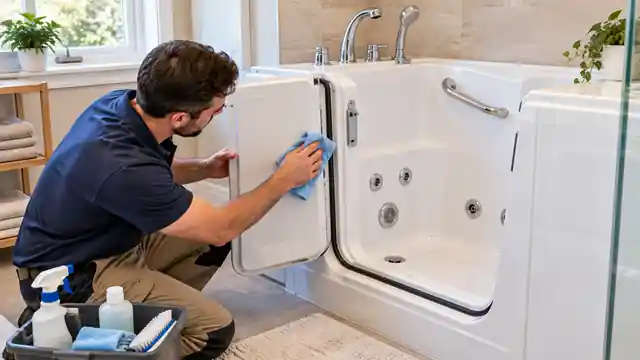
Maintenance guidance checked against current KOHLER Walk-In Bath, Safe Step, Ella's Bubbles and American Standard owner-care materials. Cleaning chemicals, flush frequency and door-seal instructions vary by manufacturer and model; the current owner's manual controls.
Walk-in tubs solve one problem by adding a door, a seat and easier entry. They also introduce a few components a standard bathtub does not have: a door gasket, a locking mechanism, service panels and, on many models, pumps, air blowers, heaters and internal plumbing lines.
That does not mean they are high-maintenance. It does mean that a good maintenance routine should match the actual tub you own. A plain soaker and a multi-system hydrotherapy tub should not be treated the same way.
This guide focuses on the parts that actually matter: the shell, door seal, drains, pump inlet, jet lines, hard-water deposits and service access. It also explains when a problem has moved beyond cleaning and needs a technician.
Walk-in tub maintenance at a glance
| Task | Simple soaker | Jetted / air / microbubble tub | Typical frequency |
|---|---|---|---|
| Rinse visible surfaces | Yes | Yes | After use or as needed |
| Wipe shell with non-abrasive cleaner | Yes | Yes | Weekly to twice monthly, brand-dependent |
| Clean door seal and frame | Yes | Yes | At least monthly; more often if residue appears |
| Clear drain hair/debris | Yes | Yes | Weekly or as needed |
| Clean pump inlet / suction cover | No pump | Usually yes | Monthly or per manual |
| Flush internal jet lines | No | Usually yes | Monthly or twice monthly, brand-dependent |
| Test GFCI | Only if powered equipment exists | Yes | Per manufacturer instructions |
| Inspect for leaks or loose fittings | Yes | Yes | Regularly |
Start by identifying what type of walk-in tub you have
Before choosing a cleaning routine, identify the equipment behind the shell.
- Soaking-only tub: no whirlpool pump, air blower or microbubble system.
- Whirlpool / hydrotherapy tub: circulates bath water through internal water lines and jets.
- Air massage tub: pushes air through a network of air lines and small outlets.
- Combination tub: can contain both water-jet and air systems.
- Microbubble system: uses additional pump/control equipment and may have its own cleaning procedure.
If you are not sure, find the model number and owner’s manual. The number of buttons on the deck is not a reliable substitute for the model documentation.
Manufacturers publish different chemicals and flush procedures. Using the wrong cleaner can damage acrylic, finishes, seals or internal equipment and may create a warranty problem.
The biggest difference: soaker vs jetted maintenance
A simple soaking tub is mechanically easier to own. There are fewer components to clean and fewer internal water paths where soap residue, body oils or mineral deposits can collect.
A jetted tub adds:
- pump inlet or suction cover;
- internal water or air lines;
- pump or blower;
- control box;
- possibly an inline heater;
- possibly ozone, auto-purge or microbubble equipment.
This is one reason maintenance belongs in the buying decision. If the user mainly wants safer entry and seated bathing, a simpler soaker may reduce long-term service burden. See our walk-in tub pros and cons guide and buying guide before choosing optional therapy systems.
Daily or after-use care
You do not need to deep-clean a walk-in tub after every bath.
A useful after-use routine is:
- Drain the tub fully.
- Use the handshower to rinse soap residue from the seat, floor, walls and door area.
- Remove visible hair from the drain or pump inlet.
- Wipe standing water from areas that remain wet.
- If your manufacturer recommends leaving the door open between uses, do so.
Safe Step currently recommends rinsing all surfaces with warm water after use. KOHLER also recommends routine wipe-downs and gentle cleaning to prevent soap deposits.
How to clean the acrylic or gelcoat shell
The safest general principle is simple: use a soft cloth or sponge and a non-abrasive cleaner approved for the tub material.
Avoid assuming that a cleaner safe on tile is safe on acrylic, gelcoat, metal trim or the door gasket.
Why abrasives are a problem
Scouring pads, wire brushes and aggressive powders can dull or scratch the finish. Once the surface becomes rougher, it can also become harder to keep clean because residue has more texture to cling to.
American Standard’s walk-in bath owner guidance warns against abrasive cleaners and harsh scraping tools. Safe Step similarly tells owners to avoid steel wool, wire brushes and other abrasive materials.
Door seal care is not optional
The watertight door is one of the defining components of a walk-in tub. The gasket or bulb seal must remain clean, flexible and properly aligned.
Residue on the seal or frame can create several problems:
- small leaks;
- the door sticking to the frame;
- uneven gasket compression;
- premature wear;
- false suspicion that the entire door mechanism has failed.
Safe Step’s current owner manual says residue buildup on the door bulb seal can cause leakage and instructs owners to wipe the seal regularly; its monthly routine uses a small amount of alcohol on a soft cloth. Ella’s Bubbles also publishes model-specific door-seal cleaning guidance and recommends leaving the door open between baths so the seal is not kept compressed.
Do not generalize either instruction to every brand. Some manufacturers may specify a different cleaner or storage position.
What to check while cleaning the seal
- soap film or mineral scale;
- hair or lint trapped on the sealing surface;
- cuts or tears;
- flattened sections;
- door misalignment;
- latch resistance that has changed from normal.
If cleaning the gasket does not stop a leak, do not keep tightening or forcing the door handle. Door adjustment and seal replacement are service jobs on many models.
Jet-line cleaning: why the brand manual matters
This is where generic advice becomes risky.
Current manufacturer instructions are not identical:
| Brand example | Published approach | Important point |
|---|---|---|
| Ella’s Bubbles | Monthly vinegar-based flush on current support pages | Also uses ozone and Auto Purge on applicable systems |
| Safe Step | Monthly system purge using regular liquid chlorine bleach plus powdered dishwasher soap | Manual distinguishes regular bleach from splashless bleach |
| KOHLER | Current jet-cleaning guidance uses a low-foam powdered dish detergent and household bleach | Separate surface-care guidance says not to use bleach on bath surfaces |
| American Standard | Owner manual uses a low-foaming detergent flush followed by a clean-water rinse cycle | Also calls for suction-cover cleaning |
The lesson is not that one recipe is better. The lesson is that the internal plumbing system has its own manufacturer-approved procedure.
If your manual specifies bleach, use it only as directed. Never combine bleach with vinegar, ammonia, acids or other household cleaners. If you are switching between products, drain and rinse the tub thoroughly first.
How often should you flush the jets?
There is no single universal interval.
Examples from current manufacturer guidance:
- Ella’s Bubbles: monthly jet-line flush in current support materials;
- Safe Step: monthly system purge;
- KOHLER: current guidance recommends cleaning jets about twice a month, more often with heavy use;
- American Standard owner materials: monthly circulation-system flush under normal use.
Heavy use, oily bath products, hard water and infrequent rinsing can increase buildup. A tub used once a week by one person may not need the same attention as a therapy tub used daily by multiple household members.
Do not run a water-jet pump dry
Water-jet systems normally require the water level to be above the jets before the pump is switched on.
Running a pump without enough water can damage equipment. American Standard’s owner guidance specifically warns not to run the jet-massage system dry. Follow your own model’s minimum fill line or jet-height requirement.
This also matters when troubleshooting a pump that “does not work.” Confirm water level, GFCI status and control settings before assuming the pump has failed.
Clean the pump inlet or suction cover
Hair, lint and debris can collect at the intake that feeds the whirlpool pump.
A restricted inlet can reduce performance and put unnecessary strain on the system.
Safe Step tells owners to remove hair or debris from the water intake during weekly maintenance. Ella’s Bubbles includes the pump inlet cover in its monthly routine. American Standard owner guidance also calls for monthly suction-cover cleaning on designs where the cover is intended to be removed.
Some covers are not owner-serviceable. Never operate a whirlpool system with a required safety suction cover removed.
Air jets need a different mindset
Air-massage systems do not circulate bath water through the same type of plumbing loop as a conventional whirlpool, but residual moisture can remain in air lines.
Some systems address this automatically. Ella’s Bubbles, for example, publishes an Auto Purge function on applicable air-massage systems that blows residual water from the air lines after use.
If your tub has an automatic purge, do not disconnect power immediately after bathing without understanding the system. The delayed blower noise can be normal rather than a malfunction.
Microbubble systems may have their own procedure
Microbubble systems use additional pumps and controls and should be treated as their own equipment category.
Safe Step’s current owner manual includes MicroSoothe in its monthly purge sequence when that feature is installed. Other manufacturers may specify different steps.
If you are buying a tub with microbubbles, ask the dealer to show you the exact cleaning procedure before installation is complete.
Hard water and mineral buildup
Hard water can leave white or chalky deposits on fixtures, glass, jets and the tub surface.
Before attacking scale with an acidic descaler, check the manual. A product that dissolves lime effectively can also harm metal finishes, seals or acrylic if the manufacturer does not approve it.
Practical steps include:
- rinse after bathing;
- dry fixtures and glass where practical;
- follow the approved periodic jet flush;
- keep the pump inlet clear;
- ask about water treatment if mineral buildup is severe throughout the home.
KOHLER specifically notes that water hardness affects cleaning performance and recommends gentle, approved care for the bath and fixtures.
Bath products can create maintenance problems
Walk-in tubs are often marketed as spa-like products, but not every bath additive belongs in a jetted system.
Depending on the manufacturer, restrictions can include:
- bath bombs;
- bubble bath;
- oils;
- oil-based products;
- salts in excessive amounts;
- products containing glitter, petals or suspended solids.
Ella’s current guidance warns against bath bombs and oils in jetted tubs because material can enter the jet system. Safe Step’s current owner manual says never to use bubble bath and restricts oil-based bath additives, while allowing moderate Epsom salt use. These examples show why the manual—not a generic list—should control.
Drain maintenance
A slow drain increases the time a user must remain seated in the tub before opening the door, so drain performance is more than a convenience issue.
Keep hair and debris away from the drain and inspect removable stoppers according to the manufacturer instructions. Safe Step’s owner manual includes clearing debris from the drain stopper in its weekly routine.
If drain speed changes noticeably:
- remove visible hair or debris;
- check whether the stopper is moving fully;
- confirm that a powered quick-drain system, if installed, is operating;
- avoid harsh drain chemicals unless the manufacturer approves them;
- call a plumber or service technician if the restriction remains.
For installation planning, also see our walk-in tub fill and drain guide.
What maintenance should an older adult be able to do safely?
The maintenance burden should be part of the accessibility decision.
Ask whether the user can safely:
- reach the back corners of the seat;
- wipe the lower door seal;
- remove hair from the drain;
- reach the pump inlet;
- measure and add cleaning solution;
- fill above the jets and operate the controls;
- bend or kneel without losing balance.
If not, plan for a caregiver, cleaner or family member to handle the deeper monthly routine. A tub that is technically accessible to bathe in but impossible for the owner to maintain independently can still create a long-term burden.
Service access matters years after installation
Pumps, blowers, heaters, control boxes and valves are usually located behind removable panels.
Do not permanently cover those access points with tile, cabinetry or trim that cannot be removed without demolition.
This issue should be settled during installation. Our walk-in tub electrical requirements guide explains why GFCI access and equipment-panel access should be planned before finish work is completed.
Leak troubleshooting: seal, fitting or plumbing?
Not every leak has the same cause.
| Where water appears | Possible cause | First step |
|---|---|---|
| Along door edge | Dirty seal, damaged gasket, door adjustment | Clean and inspect gasket; follow manufacturer seal procedure |
| Under tub only during filling | Supply fitting or faucet connection | Stop use and inspect/service plumbing |
| Under tub only when jets run | Pump union, jet line or equipment leak | Stop jet use and call qualified service |
| Near drain during emptying | Drain fitting or waste line | Inspect plumbing and drain connections |
| From wall surround | Caulk or wall-system leak | Inspect seams separately from tub door |
A persistent door leak after cleaning, a pump-area leak or water near electrical equipment should be treated as a service issue rather than a cleaning problem.
When to call for professional service
Contact the manufacturer, authorized dealer or qualified technician if you notice:
- door leakage that continues after the seal is cleaned;
- a torn, flattened or displaced gasket;
- pump noise that changes suddenly;
- jets that have lost substantial pressure after the inlet is cleaned;
- a GFCI that repeatedly trips;
- burning smell, heat or electrical buzzing;
- water leaking behind service panels;
- controls that operate intermittently;
- heater or blower failure;
- cracks in the shell;
- loose grab bars or structural movement.
Safe Step’s current owner manual states that service and repairs should be performed by qualified Safe Step technicians. Other brands have their own service requirements, so check warranty terms before hiring an independent repair company.
Simple annual walk-in tub maintenance checklist
| Item | Check |
|---|---|
| Door seal clean and undamaged | ☐ |
| Door latches smoothly without excessive force | ☐ |
| No visible water around door after full bath | ☐ |
| Drain speed has not worsened | ☐ |
| Pump inlet / suction area clear | ☐ |
| Jets operate with normal pressure | ☐ |
| Air purge functions normally if equipped | ☐ |
| GFCI tests and resets normally | ☐ |
| No pump, blower or heater leaks | ☐ |
| Service panels remain accessible | ☐ |
| Grab bars remain rigid | ☐ |
| Caulk and wall-surround joints intact | ☐ |
Questions to ask before buying a walk-in tub
Maintenance is easiest when you ask about it before signing the contract.
- What exactly is the approved shell cleaner?
- How do I clean the door gasket?
- Should the door be left open or closed between uses?
- What is the approved jet-line flush recipe?
- How often should the jets be flushed?
- Can I use bath salts, oils, bubbles or bath bombs?
- Is the pump inlet owner-removable?
- Does the air system have an automatic purge?
- What maintenance is required for the microbubble system?
- Where are the service panels?
- Who performs warranty service in my area?
- Does improper cleaning affect warranty coverage?
For a broader purchase checklist, see our walk-in tub buying guide, dimensions and bathroom-fit guide and door-type guide.
Frequently asked questions
How often should I clean a walk-in tub?
Visible surfaces should be rinsed or wiped regularly, while deeper maintenance depends on the model. Current manufacturer examples range from weekly surface cleaning to twice-monthly shell care and monthly or twice-monthly jet flushing. Use the schedule in your owner’s manual.
Can I use bleach in a walk-in tub?
Only if your manufacturer specifically allows it for the procedure you are performing. Safe Step and KOHLER publish bleach-based internal jet-cleaning procedures for certain systems, while KOHLER’s surface-care guidance says not to use bleach on bath surfaces. Ella’s Bubbles publishes a vinegar-based jet flush. These are not interchangeable instructions.
Can I use vinegar to clean walk-in tub jets?
Some manufacturers do. Ella’s Bubbles currently specifies a vinegar flush for its jet systems. Do not assume vinegar is approved for every tub, seal or finish.
Why is my walk-in tub door leaking?
Common causes include residue on the gasket, a damaged or compressed seal, or door misalignment. Clean the seal according to the manufacturer’s instructions first. If leakage continues, stop using the tub until the door and gasket are inspected.
Do walk-in tubs need professional maintenance every year?
Not necessarily. Many routine tasks are owner maintenance. Professional service becomes appropriate when there is a leak, electrical problem, pump/blower failure, damaged gasket, control fault or another issue beyond cleaning and inspection.
Are walk-in tubs harder to maintain than regular tubs?
A soaking-only walk-in tub is only moderately more complex because of the door and gasket. A jetted or microbubble model requires more maintenance because it adds internal plumbing, pumps, controls and periodic system cleaning.
Official manufacturer care references
- KOHLER Walk-In Bath — Tub Care
- KOHLER — How to Clean Bath Jets Properly
- Safe Step — Product Care
- Ella’s Bubbles — Cleaning and Maintenance Routine
- American Standard Walk-In Bath Owner’s Manual — Cleaning & Maintenance
Maintenance should not be the deciding factor by itself, but it belongs in the ownership cost. A simpler tub with fewer powered systems is easier to clean, easier to service and has fewer components that can fail. A therapy-heavy model offers more features, but the buyer should understand the cleaning routine and service network before purchase.