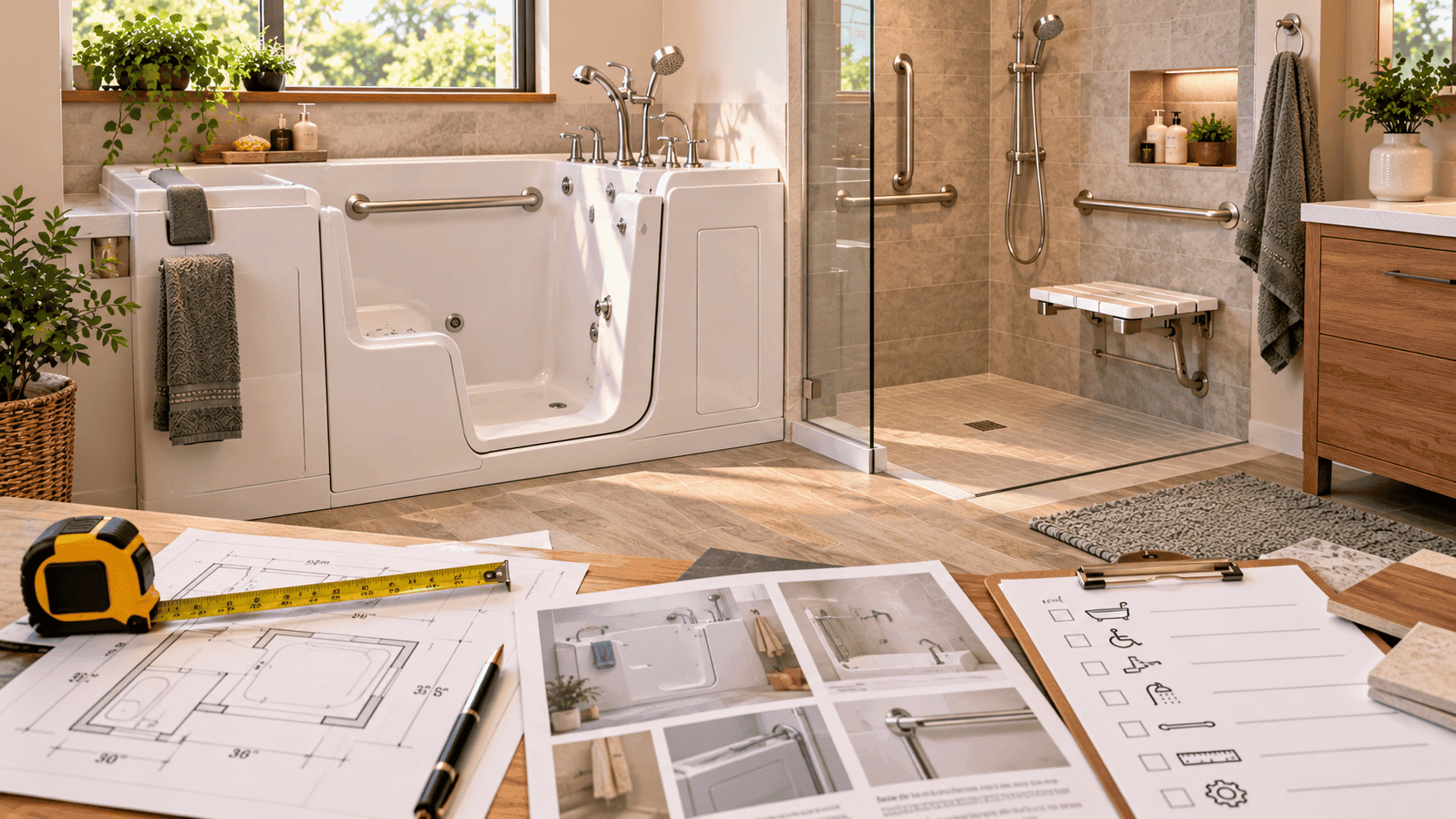
Reviewed using current National Institute on Aging and AARP home-safety guidance plus 2026 walk-in tub cost data.
Walk-in tub shopping becomes confusing quickly because manufacturers tend to organize products around features: air jets, water jets, chromotherapy, heated backrests, quick drains, therapeutic packages, inward-opening doors, outward-opening doors, wide seats, bariatric shells, and dozens of finish options.
Those details matter, but they are not where the buying decision should begin.
The first questions are simpler: Can the person get in safely? Can they sit and stand from the seat? Will the door work in the room? Is there enough hot water? Can a walker or caregiver fit where they need to? Will the tub still work if mobility changes?
This guide turns those questions into a practical buying process. It is designed to help you narrow down the right type of walk-in tub—or recognize when another solution makes more sense.
Step 1: Decide whether a walk-in tub is actually the right format
A walk-in tub is most useful when the user still wants to bathe while seated and the main problem is crossing the high wall of a standard bathtub or lowering to the bottom of a conventional tub.
It is usually worth comparing a shower first when:
- a walker is used regularly;
- wheelchair access is likely;
- a caregiver assists with bathing;
- the person prefers quick showers;
- future mobility is expected to change significantly;
- the bathroom is being rebuilt anyway.
Our walk-in tub vs walk-in shower comparison covers this decision in detail.
Quick buying checklist
| Check before buying | Why it matters |
|---|---|
| Threshold height | A “low entry” can still be too high for some users. |
| Door width and swing | Affects transfer space and whether the bathroom layout works. |
| Seat dimensions | Determines comfort and sit-to-stand difficulty. |
| Grab-bar placement | Should match the user’s real transfer path. |
| Fill time | The user normally waits inside while the tub fills. |
| Drain time | The door usually remains closed until water drops below the opening. |
| Water-heater capacity | Deep tubs can expose limitations in the existing hot-water system. |
| Electrical requirements | Jets, heaters, pumps, and powered systems may need dedicated circuits. |
| Service access | Pumps and controls should be reachable for future repairs. |
| Warranty | Shell, door seal, pumps, controls, labor, and installation may have different coverage. |
| Local service | A long warranty has little value if nobody nearby will service the brand. |
| Complete installed price | The fixture price alone does not show the true project cost. |
Step 2: Measure the person, not just the bathroom
Most buying guides focus on room dimensions. That is only half the job.
The user should be able to:
- step over the threshold without catching a foot;
- turn inside the tub safely;
- lower onto the seat without dropping;
- stand from the seat without pulling on an unsafe surface;
- reach the controls while seated;
- position both feet securely;
- use the grab bars naturally;
- leave the tub without an awkward twist.
Seat height can be especially important. A seat that is too low makes standing harder; one that is too high can reduce stable foot contact. Seat width and depth also affect comfort and transfer technique.
Use a sturdy chair at a similar height to the tub seat. Practice sitting, standing, turning, and reaching. This simple test can reveal more than a product brochure.
Step 3: Measure the bathroom carefully
Do not measure only the alcove where the old tub sits.
Check:
- finished wall-to-wall opening;
- bathroom door width;
- hallway width;
- tight turns between the exterior door and bathroom;
- ceiling height where relevant;
- door swing clearance;
- space for a walker or caregiver;
- access to plumbing and service panels;
- existing drain and supply locations.
A tub can fit the alcove and still be impossible to bring into the room without removing a doorway, trim, wall section, or other fixture.
Common walk-in tub sizes
Actual dimensions vary by manufacturer, but current 2026 market data commonly groups tubs into three broad size families.
| Type | Typical width | Typical length | Best for |
|---|---|---|---|
| Compact | About 26–28 in. | About 35–40 in. | Small bathrooms and tighter layouts |
| Standard | About 30–32 in. | About 52–60 in. | Replacing a conventional alcove tub |
| Bariatric / oversized | About 32–36 in. | About 60–72 in. | More seat width, higher capacities, larger users |
These ranges are useful for planning, not installation. Always verify the exact specification sheet for the model being considered.
Step 4: Choose the right door style
Inward-opening door
The door swings into the tub.
Advantages:
- requires less bathroom floor space outside the tub;
- water pressure can help keep the door sealed while the tub is full;
- often fits compact bathrooms more easily.
Trade-offs:
- the door occupies some interior footwell space;
- it can make transfer positioning tighter;
- may be more difficult for certain wheelchair transfers.
Outward-opening door
The door swings into the bathroom.
Advantages:
- can create a wider, clearer entry opening;
- often works better for lateral transfers;
- leaves more interior footwell space.
Trade-offs:
- needs clear floor area outside the tub;
- can conflict with a toilet, vanity, walker, or caregiver position;
- requires careful room planning.
Door direction should be chosen around the user’s transfer and the actual room, not because one design is universally “better.”
Step 5: Check the threshold height
“Low threshold” is a marketing phrase, not a measurement.
Ask for the exact height in inches. Then simulate that height at home with a safe, stable object or taped reference.
This is especially important for users with:
- foot drop;
- neuropathy;
- reduced hip flexion;
- shuffling gait;
- knee stiffness;
- balance limitations.
A threshold that is easy today may become difficult later, which is one reason long-term buyers should also compare curbless shower options.
Step 6: Evaluate the seat
The seat is one of the most important parts of the tub and one of the least glamorous parts of a sales presentation.
Check:
- height from the tub floor;
- width;
- depth;
- back support;
- legroom;
- relationship to grab bars;
- distance to controls;
- whether the user can place both feet securely.
If possible, sit in the exact model before buying. A seat can look spacious in photos and feel very different in real use.
Step 7: Decide whether you need a simple soaker or hydrotherapy
Basic soaking tub
A basic soaker gives you the accessibility features without pumps or jet systems.
Best when:
- the priority is safe entry and seated bathing;
- you want lower cost;
- you prefer simpler maintenance;
- you want fewer mechanical parts.
Whirlpool
Uses water jets powered by a pump.
Consider if you value strong water movement and are comfortable with extra cleaning, electrical requirements, and future service needs.
Air bath
Uses air to create gentler bubbling. Some people prefer this sensation to stronger water jets.
Combination system
Uses both air and water systems and may add heated seats, heated backrests, or lighting.
The more systems you add, the more important local service access becomes.
Jets, lights, and heated surfaces can improve comfort, but they do not replace a usable threshold, stable seat, correctly placed grab bars, safe controls, or a workable transfer.
Step 8: Check grab bars and support points
The National Institute on Aging recommends grab bars near toilets and in tubs or showers and nonslip treatment on surfaces that may become wet. AARP also emphasizes that towel bars are not substitutes for properly anchored grab bars. citeturn442696search1turn442696search5
For a walk-in tub, look at three moments:
- stepping through the door;
- sitting and standing from the seat;
- stepping back out onto the bathroom floor.
The user should have a stable support at each difficult transition.
Step 9: Check floor traction
Look for a textured or slip-resistant tub floor, but also check the bathroom floor immediately outside the tub. Water often reaches that area during drying and transfers.
NIA recommends nonslip treatment on wet surfaces and advises removing loose rugs and other fall hazards. citeturn442696search3
Step 10: Understand fill time before you buy
The user usually enters the walk-in tub before it fills.
Actual fill time depends on:
- tub volume;
- home water pressure;
- supply line diameter;
- faucet flow rate;
- hot/cold mixing;
- other water use in the home.
Do not accept a showroom fill-time claim without asking what plumbing conditions produced it.
Step 11: Understand drain time
The user normally waits inside while the water drains because the door cannot be opened safely while water is above the opening.
“Fast drain” systems can help, but performance depends on both the tub and the home drain.
Ask:
- what drain size the manufacturer recommends;
- whether the existing drain is adequate;
- what realistic drain time the installer expects in this bathroom.
Step 12: Check your water heater
Many walk-in tubs use roughly 40 to 50 gallons for a bath, though capacity varies. Large and bariatric models may use more.
A tub that cannot be filled comfortably with the home’s existing hot-water supply is not a good purchase, even if every other feature looks right.
Have the installer compare the model’s usable fill requirement with:
- water-heater type;
- tank size or recovery rate;
- household demand;
- incoming water temperature;
- temperature setting.
Step 13: Check electrical requirements
Basic soaking tubs may need little or no additional electrical work. Models with pumps, air systems, heaters, powered drains, or controls may require dedicated protected circuits.
Ask for the electrical specification sheet before signing the contract and make sure electrical work is included in the quote when required.
Step 14: Check the installation route
Installers need to get the tub from the delivery point to the bathroom.
Measure:
- front or side door;
- hallways;
- stairs;
- doorways;
- corners;
- bathroom opening.
Ask who pays if trim, doors, wall sections, or other materials must be removed and rebuilt to get the tub into place.
Step 15: Understand the complete installation scope
A complete quote can include:
- old tub removal;
- disposal;
- new walk-in tub;
- plumbing changes;
- drain modifications;
- electrical work;
- wall repair;
- waterproofing;
- floor repair;
- grab bars;
- trim;
- permits;
- cleanup;
- warranty labor.
Current 2026 data from Angi puts the average complete walk-in tub project at about $8,000, with many projects between $4,000 and $15,000. Site preparation, demolition, and disposal can add meaningful cost, and premium or more complex installations can go higher. citeturn442696search9
See our walk-in tub cost guide for a detailed budget breakdown.
Step 16: Compare warranties carefully
A single “lifetime warranty” headline is not enough.
Ask separately about:
- tub shell;
- door;
- door gasket;
- faucet;
- drain;
- water pump;
- air pump;
- heater;
- electronics;
- labor;
- installation leaks;
- service-call fees.
Also ask whether the warranty:
- is transferable;
- requires registration;
- requires use of approved service technicians;
- covers shipping on replacement parts;
- covers labor after the first year.
Step 17: Confirm local service before choosing a brand
A brand can have excellent specifications and still be a poor choice if nobody nearby services it.
Ask:
- Who repairs the tub locally?
- Is the installer also the service provider?
- How long are parts typically available?
- Can independent plumbers or electricians work on the system?
- What happens if the dealer closes?
This is particularly important with proprietary pumps, controls, or door hardware.
Step 18: Compare installed price, not list price
A heavily discounted product can still become an expensive project.
Compare complete written proposals using the same scope.
| Quote item | Company A | Company B | Company C |
|---|---|---|---|
| Tub model | Check | Check | Check |
| Demolition | Check | Check | Check |
| Plumbing | Check | Check | Check |
| Electrical | Check | Check | Check |
| Wall/floor repair | Check | Check | Check |
| Permits | Check | Check | Check |
| Cleanup | Check | Check | Check |
| Labor warranty | Check | Check | Check |
| Total installed price | Compare | Compare | Compare |
Step 19: Watch for sales-pressure tactics
A walk-in tub is expensive and difficult to reverse. If a salesperson says a major discount disappears when they leave, treat that as a reason to slow down, not speed up.
Other red flags:
- refusing to leave a written quote;
- claiming Medicare will pay without specific benefit documentation;
- focusing on monthly payment instead of total price;
- not measuring the water heater;
- not discussing electrical requirements;
- calling the tub “wheelchair accessible” without explaining the transfer;
- not identifying who provides service;
- not separating product and labor warranty.
Step 20: Compare the tub with smaller safety upgrades
Do not assume a major remodel is the first solution.
If the existing bathing area is still easy to enter, smaller changes can sometimes solve the immediate problem:
- properly anchored grab bars;
- shower chair;
- handheld showerhead;
- better lighting;
- floor traction;
- repositioned storage;
- toilet support rails.
See our Bathroom Safety for Seniors hub for the lower-cost options.
Which walk-in tub type fits which buyer?
| User profile | Start by comparing |
|---|---|
| Independent user who loves baths | Standard soaking tub |
| Joint stiffness but good transfer ability | Soaker vs air/whirlpool tub |
| Small bathroom | Compact inward-door model |
| Larger user | Bariatric model with appropriate seat and capacity |
| Wheelchair user with lateral transfer | Outward-door transfer tub vs roll-in shower |
| Caregiver assistance | Walk-in tub vs larger accessible shower |
| Future mobility uncertain | Walk-in tub vs curbless shower |
Brand comparison: what we will score
Accessible Bath Advisor will not rank brands based only on features or affiliate payouts. Our brand reviews will use a consistent framework.
We will look at:
- published dimensions;
- threshold height;
- seat dimensions;
- door design;
- available tub sizes;
- service coverage;
- warranty clarity;
- fill/drain claims and plumbing requirements;
- electrical requirements;
- accessibility options;
- price transparency;
- installation model;
- customer-service patterns where reliable evidence exists.
That methodology will become the basis of our Brand Reviews section.
Questions to ask every walk-in tub salesperson
- What is the exact threshold height?
- What are the seat height, width, and depth?
- How wide is the door opening?
- Does the door open inward or outward?
- How much floor clearance does the door need?
- How many gallons does a normal bath require?
- Will my current water heater supply enough hot water?
- What fill time should I expect in this house?
- What drain time should I expect?
- What size supply lines are recommended?
- What drain size is recommended?
- Does this model need electricity?
- Does it need a dedicated circuit?
- Where are the grab bars?
- Can the user reach all controls while seated?
- Who services the tub locally?
- What is covered by the shell warranty?
- What is covered by the door and gasket warranty?
- What is covered by the pump/electronics warranty?
- What is covered by the labor warranty?
- Is demolition included?
- Is disposal included?
- Are permits included?
- Are plumbing changes included?
- Are electrical changes included?
- What happens if hidden water damage is found?
- What is the cash price?
- What is the financed price?
- What costs are not included?
- Can I take the written quote home?
Walk-in tub buying path
If you are just starting, use this order:
- Decide between tub and shower. Read Walk-In Tub vs Walk-In Shower.
- Check whether the tub solves your real problem. Read Are Walk-In Tubs Worth It?
- Understand price. Use our 2026 cost guide.
- Review safety. Use the Bathroom Safety hub.
- Check funding. Visit Cost & Financing.
- Compare brands only after requirements are clear. Then use Brand Reviews.
Frequently asked questions
What is the best type of walk-in tub?
There is no single best type. A basic soaking model often suits buyers who prioritize accessibility and lower maintenance. Hydrotherapy models make sense when comfort features are genuinely valued. Transfer-oriented or bariatric models serve more specific needs.
What size walk-in tub should I buy?
Choose based on both bathroom dimensions and the user’s body size and transfer needs. Standard models often fit conventional alcove spaces, but seat width, door clearance, threshold height, and service access matter just as much as exterior length.
Is an inward-opening or outward-opening door better?
Inward doors save bathroom floor space; outward doors can provide a clearer opening for transfers. The better choice depends on the room layout and user’s mobility.
How much should I expect to spend?
Angi’s 2026 data puts the average complete walk-in tub installation around $8,000, with many projects between $4,000 and $15,000. Complex or premium installations can cost more.
Do I need a bigger water heater?
Not always, but the existing system must provide enough usable hot water for the tub. Large tubs can expose limits in small or older water heaters.
Are jets worth the extra cost?
Only if the user values them enough to justify extra cost, cleaning, electrical requirements, and future maintenance. Accessibility fundamentals should come first.
What warranty matters most?
Do not look for one headline number. Check shell, door gasket, pumps, controls, labor, installation leaks, and service-call coverage separately.
Should I buy from a national brand or local installer?
Either can work. The more important questions are who installs the tub, who services it locally, how clear the warranty is, and whether parts will remain available.
Should I buy a walk-in tub online?
Buying the fixture online can work for experienced remodelers, but the user still needs accurate measurements, plumbing and electrical planning, installation labor, and warranty/service support. For accessibility-focused projects, a home assessment can prevent expensive fit mistakes.
Can Medicare pay for the tub?
Original Medicare does not list permanently installed walk-in tubs as standard covered durable medical equipment. Check our Cost & Financing hub for other programs and funding routes.
Sources and research approach
- National Institute on Aging — Home Safety Tips for Older Adults
- National Institute on Aging — Preventing Falls at Home: Room by Room
- AARP HomeFit — The Bathroom
- Angi — Walk-In Bathtub Installation Cost, 2026
Accessible Bath Advisor provides general educational information. Walk-in tub fit and safety depend on the user’s mobility, transfer ability, bathroom layout, plumbing, and installation quality. For complex mobility needs, consider an occupational-therapy assessment; for construction, plumbing, and electrical work, use appropriately qualified professionals.