Decision section updated to compare mobility, transfer, fill/drain waiting, space, maintenance and total project cost.
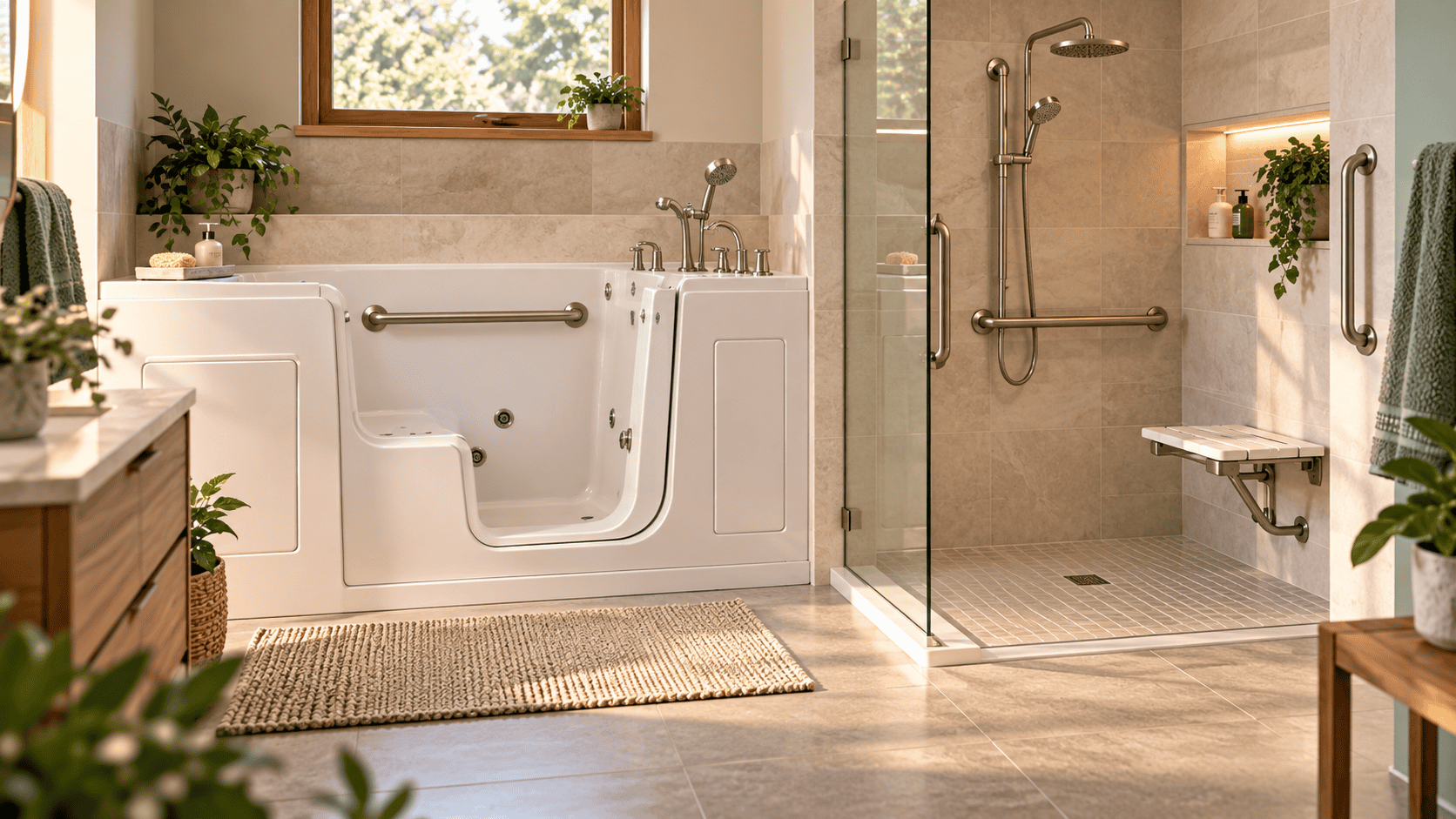
Walk-in tubs solve a specific problem very well: they let someone bathe while seated without climbing over the full wall of a conventional bathtub. That can preserve a familiar bathing routine for a person who still has enough mobility to step through the door, turn, sit and stand again.
They are not automatically the safest or most future-proof bathroom option. The door usually has to stay closed while the tub fills, the user normally waits for the water to drain before getting out, the seat and door geometry can complicate wheelchair transfers, and a deep tub can require more hot water and more cleaning than a simple accessible shower.
The useful question is therefore not “Are walk-in tubs good?” but “Does a walk-in tub solve this person’s main bathroom problem better than a shower, transfer tub or smaller safety upgrade?”
Walk-in tub pros and cons by user profile
| Decision factor | When a walk-in tub is a good fit | When it may be the wrong fit | What to check next |
|---|---|---|---|
| Mobility | The user can step over a low threshold, turn, sit and stand with stable support. | Even a 3–4 inch step is difficult, foot clearance is poor, or standing from a chair-height seat is unsafe. | Measure threshold and seat height in the Buying Guide. |
| Fill and drain waiting | The user enjoys longer baths and is comfortable waiting inside while the tub fills and drains. | The user gets cold easily, fatigues quickly, becomes anxious while waiting, or prefers five-minute showers. | Compare real plumbing performance in our water-heater and fill/drain guide. |
| Access and transfer | The user can enter through the door and transfer onto the seat independently or with light assistance. | Lateral wheelchair transfer, roll-in access, or substantial caregiver assistance is required. | Compare door geometry in the door-types guide and consider a curbless shower. |
| Bathroom space | The tub fits without blocking the toilet, vanity, walker route, caregiver position or bathroom door. | The fixture technically fits the alcove but makes the rest of the room difficult to use. | Use the dimensions and bathroom-fit guide. |
| Maintenance | The buyer is comfortable cleaning the door gasket, textured surfaces and any jet system. | The household wants the simplest possible fixture with few pumps, seals or specialty components. | Choose the simplest model that meets the user’s needs; hydrotherapy is optional, not required for accessibility. |
| Total cost | The complete installed price fits the budget without delaying more urgent safety work. | The project requires major plumbing, electrical, water-heater or structural work and a simpler shower would solve the same problem. | Compare the full installed cost, not just the advertised tub price. |
| Long-term mobility | The user expects seated bathing to remain practical for years. | Roll-in access or more caregiver space is likely to be needed soon. | Read Walk-In Tub vs Walk-In Shower before committing. |
If the user wants to keep bathing, can safely step in, turn, sit and stand, and accepts the fill/drain wait and higher installed cost, a walk-in tub can be worth it. If one of those conditions fails, compare an accessible shower before buying.
The main advantages of a walk-in tub
1. Lower entry than a standard bathtub
The most obvious benefit is the door. A conventional bathtub usually requires the user to lift one leg over a relatively high side while balancing on the other leg. That can become difficult with arthritis, reduced hip or knee mobility, weakness, or balance problems.
A walk-in tub replaces that movement with a much lower step through a watertight door. The exact threshold varies by model, so it is worth checking the actual measurement rather than relying on the phrase “low entry.” Someone who struggles with even a small step should test or simulate the movement before buying.
The National Institute on Aging recommends bathroom grab bars and nonslip treatment in wet areas as part of fall-prevention planning. Those measures still matter with a walk-in tub. A low threshold reduces one obstacle; it does not remove the need for stable handholds and good traction.
2. Built-in seated bathing
Many people choose a walk-in tub because they no longer feel comfortable standing for a full shower or lowering themselves into a standard bathtub. The integrated chair-height seat changes that.
You enter through the door, turn, sit, and bathe while supported by the tub seat. For someone who can perform that sequence safely, the design can make bathing feel much more manageable.
Seat dimensions matter. A seat that is too low, too narrow, or poorly positioned can be difficult to use even if the tub fits the bathroom perfectly. Check seat height, width, back support, legroom, and the location of grab bars in relation to the seat.
3. It allows deep soaking without sitting on the floor of the tub
A standard bathtub often becomes impractical long before a person stops enjoying baths. The difficult part may be getting down to the bottom and standing back up afterward.
A walk-in tub allows deeper water around a person who is already sitting at chair height. That can preserve a familiar bathing routine without requiring a floor-level transfer.
Some models add air jets, water jets, heated backrests, or heated seats. These features can make the bath more comfortable, but they also increase purchase price and maintenance. They should be treated as optional comfort features rather than the reason a tub is “safe.”
4. Controls are usually designed around the seated user
In a good installation, the faucet, handheld showerhead, drain control, and other controls are reachable from the seat. This can reduce twisting and unnecessary standing.
That does not mean every model is well designed for every body size or range of motion. If shoulder mobility is limited, for example, a handheld showerhead mounted too high may still be awkward. Whenever possible, sit in the tub before purchasing or ask for precise reach measurements.
5. It can support independence for the right user
If the main obstacle to bathing is stepping over the bathtub wall or getting down to a low tub floor, a walk-in model may allow someone to continue bathing with less assistance.
That is a meaningful benefit, but it should be evaluated realistically. Independence depends on the full routine: entering the bathroom, undressing, stepping into the tub, turning, sitting, operating the controls, drying, standing, and leaving. A fixture that solves only one of those steps may not solve the larger problem.
The drawbacks people often discover after installation
1. You have to sit inside while the tub fills
This is the most important practical difference from a conventional bathtub.
Because the access door needs to remain open while you enter, you cannot normally fill a walk-in tub first and then step into hot water. You get in, close the door, and wait while the tub fills around you.
That wait can feel long if the home has modest water pressure or the tub has a large capacity. Heated-seat options can make it more comfortable, but they do not make the fill time disappear.
Ask the seller for the tub’s water capacity and recommended supply-line requirements. A showroom with strong water pressure may not reflect how the same tub behaves in your home.
2. You usually have to wait for it to drain before opening the door
The same door that makes entry easier also creates the tub’s biggest inconvenience. You generally cannot open it until the water level has dropped below the opening.
Fast-drain systems can reduce the wait, but actual drain time depends on the fixture, drain size, home plumbing, and installation. The useful question is not “does it have fast drain?” but “how long should this exact model take to drain in my house?”
For someone who tires easily or gets cold quickly, fill and drain time may matter more than whirlpool jets or decorative finishes.
3. A low threshold is not the same as zero-step access
Marketing photos can make the door opening look almost flush with the floor. In practice, most walk-in tubs still have some threshold. A few inches may be trivial for one person and a significant obstacle for another.
If toe clearance, shuffling gait, neuropathy, or foot drop is an issue, measure the entry step carefully. A true curbless shower may be the better design when even a small raised edge is difficult.
4. Wheelchair use can be awkward
Some walk-in tubs have wider outward-opening doors and seats designed to make lateral transfers easier. That can work well for people with suitable upper-body strength, transfer technique, or caregiver assistance.
But the wheelchair itself does not enter most tubs. If the long-term goal is to roll directly into the bathing area, a roll-in shower is usually the more adaptable concept.
5. Caregiver access may be more limited
The tall walls that make a walk-in tub feel enclosed also make it harder for another person to reach the bather from different angles.
If a family member or professional caregiver already assists with bathing—or may need to in the future—compare the physical working space around a walk-in tub with a larger shower. An open shower often gives a helper more room to stand, turn, and assist with transfers.
6. Water and hot-water demand can be significant
Angi notes that walk-in tubs commonly use roughly 40 to 50 gallons, although capacity varies by model. A large tub or bariatric model can require more.
That means water-heater capacity matters. If the heater cannot provide enough hot water for a comfortable fill, the user may end up with a lukewarm bath or may need a water-heater upgrade.
Before purchasing, ask for the tub’s normal fill volume—not just the maximum shell capacity—and compare it with the usable hot-water output of the existing system.
7. More features mean more things to maintain
A basic soaking tub is relatively simple. A hydrotherapy tub may add pumps, air lines, jets, heaters, electronic controls, and access panels.
The door gasket also matters. It must stay clean and in good condition to maintain a watertight seal. Ask how the seal should be cleaned, what the warranty covers, and whether replacement parts will still be available several years from now.
If a model relies on proprietary electronics or pumps, find out who services it locally. A long warranty is much less useful if no technician in your area will work on the product.
How much does a walk-in tub cost in 2026?
Walk-in tubs are not inexpensive upgrades. Current 2026 cost data from Angi puts the average complete installation around $8,000, with many homeowners spending approximately $4,000 to $15,000. More complex installations and premium models can go considerably higher.
Cost depends on both the tub and the bathroom. A relatively straightforward replacement can be much cheaper than a project that needs plumbing relocation, electrical work, wall repair, floor reinforcement, widened access, or a larger tub.
| Cost factor | Why it matters |
|---|---|
| Tub size | Larger and bariatric models cost more and may require more space or structural work. |
| Door type | Outward-opening and transfer-oriented doors can affect product cost and floor-space requirements. |
| Hydrotherapy | Jets, pumps, heaters, and air systems add equipment and electrical needs. |
| Plumbing | Moving supply lines or drains increases labor and demolition. |
| Electrical work | Heated surfaces, pumps, and certain systems may require dedicated circuits or upgrades. |
| Demolition | Removing the existing tub, surround, tile, or damaged materials adds labor and disposal costs. |
| Bathroom layout | Narrow doors, tight hallways, or insufficient clearance can complicate installation. |
| Water heater | A larger-capacity or upgraded system may be needed for some tubs. |
For a more detailed breakdown, including installation scenarios and hidden costs, see How Much Does a Walk-In Tub Cost in 2026?.
When a walk-in tub is usually worth the money
You already prefer baths
This sounds obvious, but it is one of the most important filters. If the person rarely takes baths and prefers quick showers, converting the bathroom to a specialized tub may not improve daily life. A shower with a bench, grab bars, and handheld showerhead could better match existing habits.
If bathing is an important routine and the problem is climbing over the tub side or getting down to floor level, a walk-in tub directly addresses that problem.
You can enter and transfer safely
The user should be able to step through the door, turn, sit, and stand again with the available supports. If those movements are already difficult, a walk-in tub may simply replace one difficult transfer with another.
For uncertain cases, an occupational therapist can assess the specific transfer rather than making a recommendation based on age or diagnosis alone.
The bathroom layout suits the tub
The best value comes from a model that fits the existing bathroom without major reconstruction. Many standard walk-in tubs are designed around the footprint of a typical alcove bathtub, but “same footprint” does not always mean “simple installation.”
Door swing, plumbing access, service panels, electrical needs, wall finish, and the route used to bring the tub into the house all matter.
You expect to stay in the home for years
A walk-in tub is easier to justify when the homeowner expects to use it for a long time. It is a substantial fixture, and resale value is uncertain.
If the plan is to sell the home soon, a more broadly appealing accessible shower may make more sense unless the property specifically serves a market where accessible bathing features are particularly desirable.
The cost is manageable without compromising more important safety work
A walk-in tub should not consume the entire home-safety budget if other problems are more urgent.
For example, poor lighting, loose rugs, inaccessible stairs, or lack of grab bars may deserve attention before an expensive tub replacement. The National Institute on Aging specifically recommends good lighting, secured floor coverings, grab bars, and nonslip treatment as part of a broader approach to safer aging at home.
When a walk-in tub may not be worth it
You may need wheelchair or roll-in access
A tub that works today can become restrictive if the user later needs a rolling shower chair or has difficulty transferring across the tub threshold.
When future mobility is uncertain, compare the cost of the tub with a properly designed curbless or roll-in shower before signing a contract.
You need caregiver assistance
If bathing already requires another person, test the space with both people in mind. The tub needs enough clearance for the door, the user, and the caregiver’s position.
A larger open shower can be easier for two-person use because there are fewer high walls restricting access.
You dislike waiting
People who prefer quick bathing often find walk-in tubs frustrating. You cannot simply fill the bath before entering and step out immediately when finished.
If the household routine is built around five-minute showers, a walk-in tub can feel like a major behavioral change rather than an accessibility upgrade.
Your hot-water system is marginal
If the existing water heater already struggles to supply the household, a deep tub may expose that limitation quickly.
A water-heater upgrade can turn a seemingly affordable tub purchase into a larger plumbing and electrical project.
The bathroom is very small
Walk-in tubs can fit compact spaces, but an outward-opening door, transfer area, or caregiver clearance may be difficult in a tight room. A product can technically fit while leaving the bathroom awkward to use.
Do not approve a layout based only on the tub footprint. Look at the full movement path from the bathroom door to the seat.
Is a walk-in tub safer than a regular bathtub?
It can reduce specific risks, particularly the need to climb over a high tub wall and lower yourself to the bottom of a conventional bath.
But it does not make the entire bathroom automatically safe. The National Institute on Aging recommends grab bars in and around tubs and showers and nonslip treatment on surfaces that may become wet. AARP’s HomeFit guidance also emphasizes that a towel bar is not a substitute for a properly anchored grab bar.
The practical safety checklist for a walk-in tub should include:
- A threshold the user can clear without catching a foot.
- Grab bars positioned for the actual entry and sit-to-stand movement.
- A slip-resistant floor inside and outside the tub.
- Controls reachable from the seat.
- A handheld showerhead reachable while seated.
- Good lighting without glare.
- Enough dry floor space for a walker or caregiver.
- A way to stay warm while filling and draining.
Safety is a system. The door is only one part of it.
Are hydrotherapy jets worth paying extra for?
That depends on whether the person values the bathing experience enough to justify the added cost and maintenance.
Jets can make a tub more comfortable and enjoyable. However, claims that a particular hydrotherapy feature “treats” arthritis, circulation problems, neuropathy, or another medical condition should be treated carefully unless supported by appropriate medical evidence.
From a buying perspective, the trade-off is straightforward: jets add pumps, plumbing, cleaning requirements, noise, electrical demand, and potential repair points.
If you are choosing between a better basic tub and a cheaper tub loaded with features, prioritize the fundamentals first: entry height, seat comfort, transfer space, grab-bar position, fill and drain performance, warranty, and local service.
Does a walk-in tub add value to a home?
There is no reliable universal percentage you can apply to resale value.
A walk-in tub may be attractive to a buyer who wants accessible bathing, especially in a home or community that already appeals to older adults. It may be less appealing to someone who wants a conventional tub, a larger shower, or a more neutral bathroom.
Resale concerns are usually smaller when the house has another bathroom with a traditional tub or shower. In a one-bathroom home, replacing the only conventional bathing fixture deserves more thought.
If you expect to remain in the home for many years, daily usability may reasonably matter more than speculative resale value.
What about cleaning?
The simplest walk-in tubs have a seat, door, faucet, handheld shower, and drain. These are manageable, although the deeper interior can require more reaching than a standard tub.
Models with whirlpool jets, air systems, textured floors, and multiple fixtures take longer to clean. Follow the manufacturer’s flushing instructions for any jet system.
The door seal should also be cleaned as recommended. Soap residue, hair, and debris around the gasket can interfere with a proper seal.
If easy maintenance matters, ask to see the cleaning instructions before purchasing—not after installation.
Questions to ask before buying a walk-in tub
- What is the exact threshold height?
- How high is the seat from the tub floor?
- What are the seat width and depth?
- Does the door open inward or outward?
- How much clear floor space does the door need?
- Can I reach every control while seated?
- How many gallons does a normal bath use?
- Will my existing water heater supply enough hot water?
- What fill time should I expect with my plumbing?
- What drain time should I expect?
- Does installation require a new electrical circuit?
- Will plumbing or the drain have to move?
- Where will the grab bars be anchored?
- What does the product warranty cover?
- What does the labor warranty cover?
- How long is the door gasket covered?
- Who services the tub locally if a pump or control fails?
- What happens if the subfloor is damaged when the old tub is removed?
- Are permits included in the quote?
- What is specifically excluded from the quote?
A heavily discounted tub can still lead to an expensive project once demolition, plumbing, electrical work, permits, disposal, wall repair, and water-heater upgrades are added. Compare complete installed prices.
Walk-in tub alternatives worth comparing
Curbless walk-in shower
A properly designed curbless shower removes the bathtub wall completely and can provide a nearly level entrance. It is often easier to adapt for walkers, shower chairs, wheelchairs, and caregiver assistance.
The trade-off is that a custom curbless installation may require floor and drainage work, and it does not provide deep soaking.
Low-threshold shower
This can be a practical middle ground where a fully curbless floor is difficult or too expensive. A small curb is still an obstacle, but much less than a conventional tub wall.
Standard shower with accessibility upgrades
If entry is already manageable, grab bars, a secure seat, handheld showerhead, improved lighting, and better floor traction may solve the immediate problem for much less money.
Tub cut-out
Some contractors modify an existing bathtub wall by cutting out a section and installing a finished step-through opening. This can lower the entry barrier at a fraction of the cost of a new walk-in tub.
However, the result is generally intended for showering rather than retaining the tub as a full-depth bath. Waterproofing and structural integrity need to be handled correctly.
A simple test before you spend thousands
Before you shop by brand, perform this exercise in the current bathroom.
- Stand where you normally approach the tub.
- Note what you hold onto.
- Measure the highest step you can comfortably clear.
- Simulate turning and sitting on a chair placed near the tub.
- Check whether you can stand from that height without pulling on an unsafe fixture.
- Place a walker, if used, where it would have to stay during bathing.
- Have a caregiver stand where they would need to assist.
This often reveals the real problem faster than comparing product brochures. You may discover that the critical issue is threshold height, seat height, caregiver space, or grab-bar position rather than the tub itself.
Walk-in tub buying scenarios
Scenario 1: Independent user with knee arthritis who loves baths
A walk-in tub can be a strong fit if the person can step over the threshold and move between standing and the built-in seat safely. The ability to soak while sitting at chair height may be more valuable than the flexibility of a shower.
Scenario 2: Walker user who mainly showers
A low-threshold or curbless shower with a secure seat is usually worth comparing first. It may allow the walker to stay closer to the user and can make the transfer less constrained.
Scenario 3: Wheelchair user with caregiver assistance
A roll-in shower is often the more adaptable starting point. Some walk-in tubs support lateral transfers, but they still create a defined transfer into a fixed seat.
Scenario 4: Healthy couple remodeling for future aging
This is less clear. A walk-in tub may be unnecessary if neither person values baths. A spacious low-threshold shower with structural backing for future grab bars can preserve more options as mobility changes.
Scenario 5: Small bathroom, limited budget, minor balance issues
Start with smaller safety improvements before assuming the room needs a major remodel. Proper grab bars, a shower chair, handheld showerhead, lighting, and floor traction may address the immediate needs at much lower cost.
Are walk-in tubs covered by Medicare?
Original Medicare Part B covers qualifying durable medical equipment when the item meets Medicare’s rules and is medically necessary for use in the home. Medicare’s public list includes items such as walkers, wheelchairs, hospital beds, commode chairs, and other qualifying equipment.
A permanently installed walk-in tub is not listed as standard covered DME in Medicare’s public coverage information. That is one reason homeowners should not assume that a doctor’s recommendation automatically makes a bathroom remodel reimbursable.
Coverage questions can become more complicated with Medicare Advantage plans or other assistance programs, so we will cover this separately in our upcoming guide, Does Medicare Pay for Walk-In Tubs?
Final decision: when the answer is yes
A walk-in tub is most likely to be worth the investment when it solves a specific problem that the user already has, matches the way the person prefers to bathe, fits the bathroom without disproportionate reconstruction, and remains usable under realistic future mobility needs.
It is less likely to be worth it when the decision is driven mainly by the label “senior-friendly,” when the person prefers showers, when wheelchair or caregiver access is likely to become important, or when the project consumes a large safety budget that could address more pressing hazards elsewhere in the home.
The best purchase is not the tub with the longest feature list. It is the one that makes the difficult parts of bathing simpler without creating new ones.
Frequently asked questions
What is the biggest disadvantage of a walk-in tub?
For many users, it is the need to enter before filling and remain inside while the tub drains. That can make bathing slower and can be uncomfortable if the tub fills or drains slowly.
Do walk-in tubs really help seniors?
They can help people who have difficulty stepping over a conventional tub wall or lowering themselves to the bottom of a standard bathtub. Age alone is not enough to determine whether one is appropriate; transfer ability, balance, mobility aids, and caregiver needs matter more.
Can you shower in a walk-in tub?
Many models include a handheld showerhead, and some can be paired with wall surrounds or overhead shower fixtures. However, the experience is still different from a spacious walk-in shower.
Do walk-in tubs use a lot of hot water?
They can. Angi notes typical water use around 40 to 50 gallons for many walk-in tubs, though capacity varies. Larger models may require more. Check the selected model against your water heater before purchase.
How long does a walk-in tub take to fill?
There is no reliable universal number because fill time depends on tub capacity, water pressure, supply-line size, and the faucet system. Ask for a realistic estimate based on your home’s plumbing.
Do walk-in tubs leak?
The door is designed with a watertight gasket. Proper installation and routine cleaning of the seal are important. Ask about the door and gasket warranty and the availability of replacement parts.
Are walk-in tubs hard to clean?
Basic soaking tubs are fairly straightforward, but deep walls, seating, door seals, textured surfaces, and hydrotherapy jets add cleaning time. Models with jets usually require periodic flushing according to the manufacturer’s instructions.
Is a walk-in tub better than a walk-in shower?
Neither is universally better. A tub is stronger for seated soaking; an accessible shower is often more flexible for walkers, wheelchairs, and caregivers. See our full walk-in tub vs walk-in shower comparison.
Are walk-in tubs worth it for resale?
Resale value depends on the buyer and local market. A specialized tub may appeal to buyers who need accessibility but less to buyers who prefer a conventional tub or large shower. Daily usability should usually be weighed separately from speculative resale value.
Should I buy a walk-in tub if I may need a wheelchair later?
Compare a roll-in shower before deciding. Some walk-in tubs are designed for lateral transfers, but a curbless shower can provide more flexibility for rolling access and caregiver assistance.
Sources and methodology
This guide uses current home-safety guidance and 2026 remodeling-cost information. Product specifications vary widely, so threshold height, capacity, seat dimensions, fill/drain performance, warranty, and electrical requirements should always be checked for the exact model being considered.
- National Institute on Aging — Home Safety Tips for Older Adults
- National Institute on Aging — Preventing Falls at Home: Room by Room
- AARP HomeFit — The Bathroom
- Angi — Walk-In Bathtub Installation Cost, 2026
- Angi — Pros and Cons of Walk-In Bathtubs, updated 2026
- Medicare — Durable Medical Equipment Coverage
Accessible Bath Advisor provides general educational information. It does not replace an individualized mobility or medical assessment. For complex transfer needs, consider an occupational-therapy assessment; for construction, plumbing, electrical, and structural work, use appropriately licensed professionals where required.