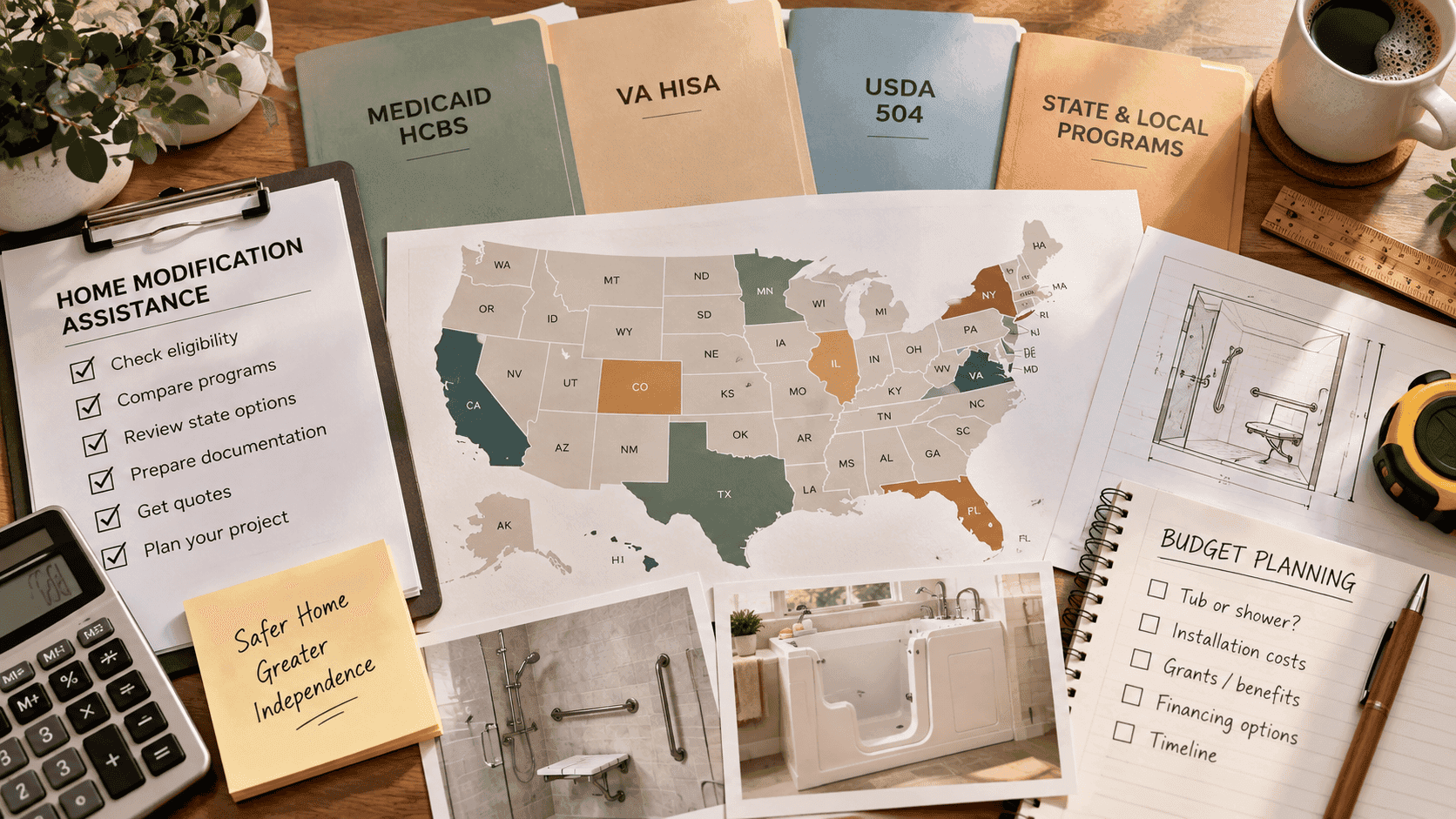
Reviewed using current Medicaid HCBS, USDA Rural Development, U.S. Department of Veterans Affairs, HUD, and federal aging-resource guidance. State and local programs change frequently and should be verified before work begins.
Searching for help with an accessible bathroom can be frustrating because the programs do not use one consistent name. One state may call the benefit an environmental modification, another an environmental accessibility adaptation, another a home modification, and a city housing department may simply call it owner-occupied rehabilitation.
Find bathroom modification help in your state
Choose a state to open its verified guide when available. Unpublished states stay in the research queue rather than linking to a thin page.
Select a state to see whether its guide is published.
10 state guides currently published. National programs on this page apply regardless of state where eligibility rules are met.
10 state guides verified and live
Each guide checks the state's Medicaid pathways, aging programs, housing-repair assistance, USDA, VA benefits, and useful local programs instead of repeating a generic national list.
Fall-prevention and accessibility help through local aging agencies.
Verified guide Florida SHIP + Medicaid LTCLocal rehabilitation funds plus Home Accessibility Adaptation.
Verified guide Georgia Home Access ProgramState accessibility funding that explicitly includes bathroom retrofits.
Verified guide Illinois HCBS + HomeModMedicaid adaptations plus Chicago accessibility resources.
Verified guide Michigan MI ChoiceEnvironmental accessibility adaptations plus strong Detroit repair programs.
Verified guide New York Access to HomeOne of the strongest state accessibility programs, delivered locally.
Verified guide North Carolina CAP/DADetailed Medicaid bathroom modifications and aging/home-repair routes.
Verified guide Ohio PASSPORTMedicaid home modifications for eligible older adults in the community.
Verified guide Pennsylvania OPTIONS + MedicaidAging-in-place modifications plus HCBS home adaptations.
Verified guide Texas STAR+PLUSMedicaid minor home modifications for eligible HCBS members.
The funding routes that appear most often
The name changes by state, but these four routes repeatedly lead to real bathroom-accessibility help.
Medicaid HCBS
Look for Environmental Modifications, Home Adaptations, Minor Home Modifications, or similar waiver services.
Aging & disability agencies
Area Agencies on Aging and independent-living organizations often uncover programs that are difficult to find online.
Housing rehabilitation
State, county, and city programs may fund accessibility through owner-occupied repair, SHIP, HOME, CDBG, or local grants.
Federal programs
USDA Section 504 and VA HISA are national programs, but eligibility and project approval still depend on the household.
The work can be similar even when the program names are different: grab bars, a safer shower, doorway changes, plumbing alterations, wheelchair access, or other modifications that help a person remain safely at home.
This page is the national directory for Accessible Bath Advisor. It explains where bathroom-modification funding can come from, how state programs differ, what documentation is usually required, and how our individual state guides will be organized.
What kind of bathroom work can assistance programs pay for?
Programs generally focus on health, safety, accessibility, or independent living, not cosmetic remodeling.
| Work that may fit accessibility programs | Work less likely to qualify |
|---|---|
| Grab bars and structural backing | Designer towel bars |
| Low-threshold or roll-in shower | Luxury spa shower upgrades |
| Doorway widening | Unrelated room expansion |
| Accessible toilet or transfer support | Premium decorative toilet chosen for style |
| Wheelchair-accessible sink modifications | High-end vanity replacement for appearance |
| Necessary plumbing/electrical changes | Whole-house upgrades not tied to accessibility |
| Slip-resistant surfaces | Premium tile selected mainly for aesthetics |
| Medical/accessibility bathing equipment | Hot tubs or spa features |
The distinction matters because many programs require the work to be necessary for a person’s disability, medical condition, safety, or ability to remain in the community.
The 7 places to check before paying for the whole project yourself
- Your state Medicaid program or waiver case manager — ask specifically about environmental modifications, environmental accessibility adaptations, or home accessibility adaptations.
- Your local Area Agency on Aging — it may know county, city, nonprofit, and aging-in-place programs that are difficult to find online.
- USDA Rural Development — if the home is in an eligible rural area and the household meets income rules.
- VA — if the homeowner or resident is an eligible Veteran or Servicemember.
- Your city or county housing department — ask about owner-occupied rehabilitation, accessibility grants, emergency repair, or CDBG-funded programs.
- Your state housing or community-development agency — many states administer repair and accessibility funds through local partners.
- Nonprofit organizations — local Rebuilding Together affiliates, disability organizations, faith-based programs, and community groups may sometimes help with labor or materials.
Medicaid HCBS: why the rules change by state
Medicaid Home and Community-Based Services (HCBS) allow states to provide services that help eligible people live in their homes or communities instead of institutional settings. Federal Medicaid materials recognize environmental modifications / home accessibility adaptations as an HCBS service category. citeturn540813search0turn540813search2
The important word is states. States choose which HCBS authorities and waivers they operate, which populations they serve, what services they include, how eligibility is determined, and what spending limits apply. Medicaid notes that 47 states and the District of Columbia operate at least one 1915(c) waiver, but the benefits within those waivers are not identical. citeturn540813search9
What home modifications can look like under Medicaid
Actual state program language can include changes such as:
- grab bars;
- bathroom modifications;
- doorway widening;
- ramps;
- specialized plumbing or electrical work;
- other accessibility adaptations needed for independence or health and safety.
For example, approved Medicaid documentation for Connecticut describes home adaptations including grab bars, widened doorways, bathroom modifications, and specialized electrical or plumbing systems when they are necessary to accommodate the participant’s needs. citeturn540813search61
That example does not mean Connecticut rules apply elsewhere. It illustrates why you need the exact state program rather than a generic statement that “Medicaid pays for bathroom remodels.”
How to ask Medicaid the right question
Instead of asking:
“Does Medicaid pay for walk-in tubs?”
ask:
“Does my Medicaid program or HCBS waiver cover environmental modifications, home accessibility adaptations, or bathroom modifications needed to support safe community living?”
Then ask:
- Do I need to be enrolled in a specific waiver?
- Does the modification have to appear in a person-centered service plan?
- Is an occupational-therapy or medical assessment required?
- Is prior authorization required?
- Is there a lifetime or annual spending cap?
- Can I choose my own contractor?
- Can work start before approval?
- Are materials and labor both covered?
- Are landlord-approved modifications allowed for renters?
Area Agencies on Aging: a useful first local call
For older adults, the local aging network can be one of the most useful places to start because it understands programs that may never rank well in a Google search.
Area Agencies on Aging and related aging-resource networks can help residents connect with local services, home repair programs, caregiver support, transportation, benefits counseling, and other community resources. The exact services differ by area.
When calling, ask specifically about:
- home modification programs;
- aging-in-place repairs;
- minor home repair;
- accessibility grants;
- bathroom safety modifications;
- county housing rehabilitation;
- volunteer repair programs;
- Medicaid waiver contacts;
- Veteran resources if applicable.
USDA Section 504 Home Repair assistance
USDA Rural Development’s Single Family Housing Repair Loans & Grants program—often called Section 504 Home Repair—can be particularly valuable for qualifying rural homeowners.
USDA says the program provides loans to very-low-income homeowners to repair, improve, or modernize their homes and grants to eligible elderly very-low-income homeowners to remove health and safety hazards.
Current program limits include:
- up to $40,000 in loans;
- up to $10,000 in grants;
- up to $50,000 combined;
- a 20-year loan term;
- a fixed 1% interest rate for the Section 504 loan;
- grant eligibility generally requiring the homeowner to be age 62 or older and unable to repay a repair loan.
Eligibility also depends on income and whether the home is in an eligible rural area. Funding availability and processing can vary by location.
VA HISA and other Veteran home-modification benefits
The U.S. Department of Veterans Affairs’ Home Improvements and Structural Alterations (HISA) benefit can help eligible Veterans or Servicemembers with medically necessary improvements to a primary residence.
VA specifically identifies improvements that allow access to essential lavatory and sanitary facilities and gives roll-in showers as an example. HISA can also cover certain plumbing and electrical work made necessary by home medical equipment.
Current VA guidance publishes a lifetime HISA benefit of up to $6,800 in certain qualifying circumstances, with a lower lifetime amount applying in some other cases.
Separate VA housing-adaptation benefits may exist for Veterans with specific service-connected disabilities, so HISA should not always be the only VA program investigated.
A contractor’s statement that a project is “VA eligible” is not approval. Contact the appropriate VA office and follow the required process before work begins.
City and county housing rehabilitation programs
Some of the best local assistance is administered by housing departments rather than health agencies.
Common program names include:
- Owner-Occupied Housing Rehabilitation;
- Emergency Home Repair;
- Senior Home Repair;
- Accessibility Modification Program;
- Housing Preservation;
- Minor Home Repair;
- Home Rehabilitation Loan or Grant;
- Barrier Removal Program.
Funding may come from federal housing sources such as Community Development Block Grants (CDBG), state funds, local taxes, or a combination. Local governments decide how eligible housing funds are used within federal and state rules.
These programs can be income-limited, geographically restricted, wait-listed, or temporarily closed when annual funds are exhausted. A program that exists in January may stop accepting applications later in the year.
State housing agencies
State housing finance agencies and community-development departments can administer or oversee programs that help with:
- owner-occupied rehabilitation;
- accessibility changes;
- critical repairs;
- energy and safety improvements;
- low-interest rehabilitation loans;
- local housing-program funding.
In some states the money goes directly to households; in others it is distributed through counties, cities, nonprofit agencies, or approved lenders.
Nonprofit home-repair programs
Nonprofit help is highly local, but it is worth checking, especially for smaller safety projects.
Possible sources include:
- Rebuilding Together affiliates;
- Habitat for Humanity local repair programs;
- Centers for Independent Living;
- local disability organizations;
- faith-based home repair programs;
- community action agencies;
- volunteer handyman programs for older adults;
- disease-specific nonprofits.
Some provide money; others provide volunteer labor, materials, or referrals. Availability changes by community.
What does “grant” actually mean?
Online articles often use the word grant too loosely.
| Funding type | How it works |
|---|---|
| Grant | Usually does not require repayment if program conditions are met. |
| Forgivable loan | May be forgiven over time if the homeowner remains in the property and follows program rules. |
| Deferred loan | Repayment may be postponed until sale, transfer, refinance, or another triggering event. |
| Low-interest loan | Must be repaid but may have more favorable terms than normal consumer credit. |
| Waiver benefit | A service authorized under Medicaid or another benefit program rather than cash paid directly to the homeowner. |
| Reimbursement | Eligible costs may be repaid after required approval and documentation. |
Always understand which of these you are applying for. A “home repair grant program” advertised online may actually be a deferred loan.
State guides: what we will verify
Each Accessible Bath Advisor state page will follow the same research framework rather than simply listing generic national programs.
For every state we will check:
- Medicaid HCBS waivers and state-plan services;
- environmental modification or home accessibility benefits;
- state aging-agency programs;
- state housing and rehabilitation programs;
- USDA rural eligibility route;
- VA resources;
- major city and county programs where relevant;
- Area Agency on Aging contacts;
- Centers for Independent Living;
- state assistive-technology resources;
- important application deadlines or wait lists;
- whether programs are grants, loans, reimbursements, or benefits.
State directory
We are building the state guides in stages so that each page can be checked against current government and local sources rather than publishing 50 thin pages at once.
First research group: California, Texas, Florida, New York, Pennsylvania, Ohio, Illinois, North Carolina, Georgia, and Michigan.
These first guides will become the model for the remaining states. As pages are published, this directory will link directly to them.
All 50 states
Alabama · Alaska · Arizona · Arkansas · California · Colorado · Connecticut · Delaware · Florida · Georgia · Hawaii · Idaho · Illinois · Indiana · Iowa · Kansas · Kentucky · Louisiana · Maine · Maryland · Massachusetts · Michigan · Minnesota · Mississippi · Missouri · Montana · Nebraska · Nevada · New Hampshire · New Jersey · New Mexico · New York · North Carolina · North Dakota · Ohio · Oklahoma · Oregon · Pennsylvania · Rhode Island · South Carolina · South Dakota · Tennessee · Texas · Utah · Vermont · Virginia · Washington · West Virginia · Wisconsin · Wyoming
What documents should you collect before applying?
Requirements vary, but many programs ask for some combination of:
- photo identification;
- proof of age;
- proof of disability or medical need;
- proof of income;
- bank or asset information;
- proof of homeownership;
- property-tax information;
- homeowners insurance;
- Medicaid identification;
- Veteran documentation;
- occupational-therapy or medical recommendations;
- photos of the current bathroom;
- contractor estimates;
- product specifications;
- landlord approval for rental property modifications;
- proof that taxes or mortgage payments are current, where required.
Do not wait until an application deadline to gather these. A dedicated digital folder can save days.
Why you should not start construction before approval
This is one of the most important rules on the page.
Many benefit and grant programs require:
- an assessment before work begins;
- prior authorization;
- approved contractors;
- multiple estimates;
- an approved scope of work;
- inspection before payment;
- documentation that the modification is necessary.
If you install the shower first and ask for reimbursement later, the program may have no authority to pay you.
Unless a program explicitly tells you otherwise in writing, assume that work started before authorization may be ineligible.
How to write the project description
Describe the functional problem rather than the product you want.
Less useful:
“I want a walk-in tub.”
More useful:
“The resident cannot safely step over the existing 15-inch bathtub wall and needs a lower-entry bathing solution with seated bathing and properly anchored support.”
The second explanation makes the accessibility need clear and leaves room for the program or assessor to identify an appropriate solution.
Walk-in tubs and grants: an important distinction
Some programs may fund a bathroom modification but not necessarily the specific walk-in tub brand or spa package a homeowner prefers.
For example, a program may approve:
- a low-threshold shower instead of a tub;
- a transfer bench and grab bars;
- a basic accessible tub without optional jets;
- only the medically necessary part of a larger remodel.
That is why the right first question is “what modification is covered?” rather than “which tub will you buy for me?”
How income limits work
Many housing-repair programs use household income as a percentage of Area Median Income (AMI) or another federal/state standard.
You may see limits such as:
- 30% of AMI;
- 50% of AMI;
- 80% of AMI;
- very-low-income limits;
- program-specific Medicaid income and asset rules.
The dollar amount changes by household size and location. Do not assume you are over the limit based on a national income figure.
Homeownership vs renting
Many repair grants require the applicant to own and occupy the home, but not every accessibility benefit does.
Medicaid environmental modifications, disability programs, and certain nonprofit resources may sometimes allow work in rental property if the landlord approves it. Program rules can require a written agreement and may exclude restoration costs when the tenant moves.
Renters should ask both the benefit program and landlord before making permanent changes.
Can grants be combined?
Sometimes. A project may be funded through several sources as long as the same cost is not paid twice and each program allows coordination.
For example, a household might use:
- a local grant for grab bars and doorway work;
- personal savings for upgraded finishes;
- a low-interest loan for the remaining construction;
- a Medicaid benefit for a specific authorized accessibility adaptation.
Tell each program about other funding sources and ask how they coordinate.
How long can approval take?
There is no national timeline.
Some programs process small repairs in weeks. Others have wait lists, annual funding cycles, assessment requirements, contractor bidding, environmental review, or limited budgets.
If the bathroom is currently unsafe, ask whether there is:
- an emergency repair track;
- a minor home modification program;
- a temporary equipment option;
- a faster nonprofit resource;
- an occupational-therapy recommendation for interim safety.
What if you do not qualify for a grant?
Grant ineligibility does not mean the project has to be abandoned.
Alternatives include:
- reducing the project to essential safety work;
- USDA loans if rural and eligible;
- state or local low-interest rehabilitation loans;
- home-equity financing;
- personal loans;
- contractor financing;
- nonprofit labor assistance;
- medical-expense tax treatment where applicable.
See our Bathroom Remodel Cost & Financing 2026 hub for a full comparison.
Red flags in “free bathroom remodel” ads
- The ad does not name the actual government or nonprofit program.
- It uses seals or flags to look official but links to a private lead form.
- It claims every senior qualifies.
- It claims Medicare universally pays for walk-in tubs.
- It asks for Social Security or banking information before explaining the program.
- It requires a same-day remodeling contract.
- The “grant” turns out to be financing.
- The company cannot provide program rules in writing.
Official assistance programs can have complicated rules, but they should be identifiable. You should be able to determine who administers the money and why you qualify.
Our grants and financing guides
- Bathroom Remodel Cost & Financing 2026 — Medicare, Medicaid, VA, USDA, loans, tax issues, and financing.
- Walk-In Tub Cost 2026 — understand the full installed project before applying for assistance.
- Bathroom Safety for Seniors — identify the modifications that actually solve the problem.
- Walk-In Tubs Guide 2026 — understand tub types, installation, and accessibility.
- Walk-In Tub Buying Guide — compare products only after the accessibility requirements are clear.
Frequently asked questions
Are there government grants for bathroom remodeling for seniors?
There is no universal federal bathroom-remodel grant for every senior. Eligible households may find assistance through USDA Section 504, VA programs, Medicaid HCBS, state and local housing programs, aging agencies, or nonprofits.
Can Medicaid pay for a walk-in shower?
Some state Medicaid HCBS programs cover environmental modifications or home accessibility adaptations, which can include bathroom work when it is necessary under the person’s approved service plan. Coverage differs by state and waiver.
Does Medicare pay for bathroom modifications?
Original Medicare mainly covers qualifying medical care and durable medical equipment rather than permanent home remodeling. Some Medicare Advantage plans may offer supplemental home-safety benefits, but plan rules vary.
Can VA pay for a bathroom remodel?
Eligible Veterans may qualify for HISA or other VA housing-adaptation benefits. HISA specifically supports medically necessary home improvements and can include access to essential bathroom facilities.
What is the USDA senior home repair grant?
USDA Section 504 offers grants of up to $10,000 to qualifying homeowners age 62 or older with very low income to remove health and safety hazards in eligible rural homes. Loans of up to $40,000 may also be available under the program.
Can I get a grant if I rent my home?
Many housing-repair grants are owner-occupied only. Some Medicaid or disability-related modification programs may allow rental-property adaptations with landlord approval. Check the exact program rules.
Do grants pay for walk-in tubs?
Some programs may approve an accessible bathing modification, but they do not necessarily pay for a specific walk-in tub or optional luxury features. Approval is usually based on functional need.
Do I need a doctor’s letter?
Some medical or disability programs require clinical documentation, while housing-repair programs may focus on age, income, ownership, and property condition. Requirements vary.
Can I start work while my grant application is pending?
Usually this is risky. Many programs require approval before construction begins. Starting early can make the expense ineligible.
What state has the best home modification grants?
Programs serve different populations and use different eligibility rules, so there is no single “best” state. Our state guides focus on identifying the programs actually available and who can qualify rather than ranking states.
Sources and research approach
Because state and local funding changes frequently, Accessible Bath Advisor prioritizes official program sources and clearly distinguishes federal programs from state-specific benefits. State pages will show a review date and will be updated when material program rules change.
- Medicaid — Home & Community-Based Services
- Medicaid — HCBS Authorities
- Medicaid — 1915(i) HCBS
- USDA Rural Development — Single Family Housing Repair Loans & Grants
- U.S. Department of Veterans Affairs — HISA
- HUD — Community Development Block Grants
Accessible Bath Advisor provides general educational information and does not guarantee eligibility or funding. Program rules, budgets, wait lists, and application windows can change. Verify current requirements with the administering agency before beginning work or signing a remodeling contract.