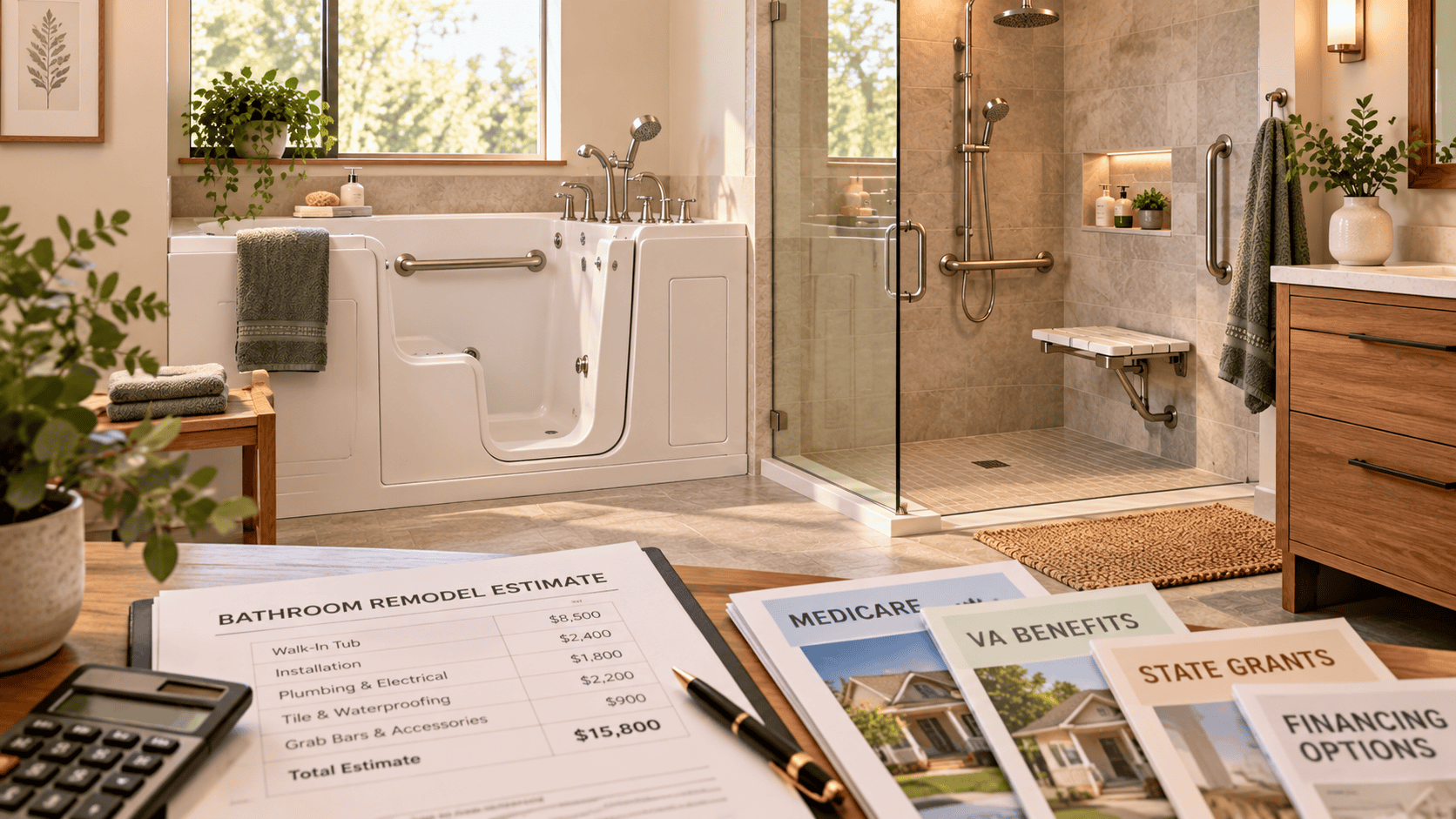
Reviewed using current Medicare, Medicaid, U.S. Department of Veterans Affairs, USDA Rural Development, and IRS guidance. Program rules, funding, and state availability can change.
Bathroom accessibility work is rarely one simple purchase. A homeowner may start by pricing a walk-in tub and discover that the project also needs demolition, plumbing, electrical work, wall repair, grab bars, flooring, a water-heater upgrade, or a wider doorway. Another household may need only a shower seat, two properly anchored grab bars, and better lighting.

The financing question is therefore not just “How do I pay for a walk-in tub?” It is “What level of work is actually needed, what does the complete project cost, and which funding routes fit this household?”
This page is the central financing guide for Accessible Bath Advisor. It explains the main ways people pay for accessible bathroom work in the United States and links to our more detailed cost and assistance guides.
How much should you budget for an accessible bathroom?
The answer depends on whether you are making a few targeted safety changes or rebuilding the bathing area.
| Project level | Typical scope | Planning range |
|---|---|---|
| Basic safety upgrades | Grab bars, shower seat, handheld showerhead, lighting, traction improvements | Hundreds to low thousands |
| Moderate accessibility work | Low-threshold shower conversion, new controls, wall reinforcement, flooring | Several thousand dollars |
| Walk-in tub project | Tub, removal, installation, plumbing/electrical adjustments, finish work | Often around $4,000–$15,000 |
| Major accessible remodel | Curbless shower, widened doorway, drain/floor changes, caregiver space, full finishes | Can exceed $10,000 substantially |
Current 2026 cost data puts a complete walk-in tub project around $8,000 on average, with many installations between $4,000 and $15,000. That is why it is important to compare the entire installed project rather than the advertised price of the fixture.
For a detailed walk-in tub breakdown and our estimator, see How Much Does a Walk-In Tub Cost in 2026?.
Start with the smallest project that solves the actual problem
Funding is easier when the project scope is clear. Before looking for grants or loans, identify what is making the bathroom difficult to use.
If the main issue is balance while stepping into the shower, a correctly placed grab bar and seat may solve the immediate problem. If the person cannot safely cross a bathtub wall, a structural change may be necessary. If a wheelchair or caregiver must enter the bathing area, the room may need a larger redesign.
This matters because many assistance programs pay only for work tied to a health, safety, disability, or accessibility need. Decorative tile, premium finishes, spa features, and unrelated upgrades are much harder to justify under those rules.
Ask contractors to itemize accessibility-related work separately from aesthetic upgrades. That makes it easier to compare bids, apply for assistance, and document potentially eligible medical expenses.
Ways to pay for an accessible bathroom remodel
Most households use one or more of these routes:
- cash or savings;
- contractor or manufacturer financing;
- home-equity financing;
- personal loans;
- Medicaid home- and community-based services in participating state programs;
- VA HISA or other Veteran housing benefits when eligible;
- USDA Section 504 loans and grants in eligible rural areas;
- state, county, city, or nonprofit home-modification programs;
- possible medical-expense tax treatment for qualifying accessibility work.
The right order is usually to check assistance first, then compare borrowing options for any remaining balance. It is frustrating to finance a project and discover afterward that a local or federal program might have helped with part of it.
Does Medicare pay for bathroom remodeling?
Original Medicare Part B covers qualifying durable medical equipment (DME) when it meets Medicare’s rules and is prescribed for home use. Medicare’s public examples include walkers, wheelchairs, commode chairs, hospital beds, oxygen equipment, and other qualifying medical equipment. citeturn914274search0
A permanently installed walk-in tub, curbless shower, wider doorway, or general bathroom remodel is not presented on Medicare’s public DME list as standard covered equipment. That is the key distinction: Medicare is built around medical care and qualifying equipment, not general home renovation.
That does not mean every related bathroom item is automatically excluded. Certain portable or qualifying medical devices may be covered if they meet Medicare’s DME rules, while the structural remodeling around them may not be.
Medicare’s home-health coverage can also include some skilled services and qualifying DME, but it does not turn a general remodeling project into a covered benefit. citeturn914274search5
What about Medicare Advantage?
Medicare Advantage plans can offer benefits beyond Original Medicare, and plan benefits vary. Some plans have offered supplemental benefits tied to in-home support or safety. Availability, eligibility, vendors, limits, and covered items can differ by plan and year.
For that reason, the practical approach is:
- check the current Evidence of Coverage for the specific plan;
- call the plan and ask specifically about home-safety or bathroom-modification benefits;
- ask whether prior authorization is required;
- confirm whether you must use an approved vendor;
- get coverage confirmation before signing a remodeling contract.
If a salesperson says Medicare will pay for a walk-in tub or remodel, ask for the exact benefit, coverage rule, authorization process, and written confirmation from the plan before committing.
Can Medicaid help pay for home modifications?
Potentially, yes—but this is highly state-specific.
Medicaid’s Home and Community-Based Services (HCBS) framework allows states to provide long-term services and supports in homes and community settings rather than institutions. Medicaid explicitly recognizes environmental modifications/home accessibility adaptations as an HCBS benefit category, and 1915(i) programs may include environmental modifications among state-defined services. citeturn914274search1turn914274search3
That does not mean every Medicaid beneficiary can automatically receive a bathroom remodel. States decide which HCBS programs they operate, which populations qualify, what modifications are covered, spending limits, assessment requirements, and whether the work must be tied to a person-centered care plan.
Examples of work that may be considered
Depending on the state program, environmental or accessibility modifications can include changes such as:
- grab bars and supports;
- accessible bathing changes;
- doorway modifications;
- ramps;
- other structural adaptations needed for independence or safety.
The correct next step is not to ask a contractor whether “Medicaid covers it.” Contact the applicable state Medicaid program, waiver case manager, managed-care organization, or HCBS coordinator and ask about environmental modifications or home accessibility adaptations.
VA HISA: bathroom modification help for eligible Veterans
The Department of Veterans Affairs has one of the clearest federal programs directly relevant to bathroom accessibility: Home Improvements and Structural Alterations (HISA).
VA says HISA can provide medically necessary improvements and structural alterations to a Veteran or Servicemember’s primary residence. Eligible purposes include access to essential lavatory and sanitary facilities, and VA specifically gives roll-in showers as an example. HISA may also cover plumbing or electrical changes made necessary by the installation of home medical equipment. citeturn954847search0
Current HISA lifetime benefit amounts
VA’s current published guidance lists a lifetime benefit of up to $6,800 for certain qualifying service-connected situations. A VA health-system page updated in April 2026 also lists $2,000 for certain other qualifying disabilities. citeturn954847search7
Eligibility depends on the Veteran’s circumstances, medical justification, disability status, and remaining lifetime benefit.
What HISA does not pay for
VA guidance says HISA does not pay for items such as spas, hot tubs, or Jacuzzi-type tubs, exterior decking, and new construction. citeturn954847search0
That is important for walk-in tub shoppers. A medically necessary bathroom alteration may be eligible, but a luxury spa feature should not be assumed to qualify.
How to approach HISA
- Contact the local VA Prosthetic and Sensory Aids Service.
- Ask what documentation and medical justification are required.
- Confirm your remaining HISA benefit.
- Do not start work until you understand the authorization process.
- Use written contractor estimates that clearly describe the accessibility work.
USDA Section 504 Home Repair loans and grants
For eligible homeowners in rural areas, USDA Rural Development’s Single Family Housing Repair Loans & Grants program—commonly called the Section 504 Home Repair program—can be one of the most valuable funding routes.
USDA says the program provides loans to low- and very-low-income homeowners to repair, improve, or modernize homes, and grants to elderly very-low-income homeowners to remove health and safety hazards. citeturn954847search4
Current USDA limits
USDA currently lists:
- maximum loan: $40,000;
- maximum grant: $10,000;
- combined loan and grant assistance: up to $50,000;
- loan term: 20 years;
- fixed loan interest rate: 1%;
- grant eligibility generally requires the homeowner to be 62 or older and meet the very-low-income limit.
USDA says grants must be used to remove health and safety hazards, and the property must be in an eligible rural area. Applications are handled through local Rural Development offices, with funding availability affecting processing time. citeturn954847search4
Could bathroom accessibility work qualify?
Potentially, when the work addresses a health or safety hazard and the household and property meet program rules. USDA has published a case in which Section 504 assistance helped an older couple complete essential bathroom work including a walk-in shower. citeturn954847search8
That example does not guarantee approval for another household, but it shows why the program is worth checking before taking on high-interest financing.
State and local bathroom-modification programs
This is one of the most fragmented parts of the funding landscape.
Depending on where you live, help may come from:
- state aging departments;
- Area Agencies on Aging;
- county housing-rehabilitation programs;
- city home-repair grants;
- Community Development Block Grant-funded local programs;
- state assistive-technology programs;
- Medicaid waivers;
- nonprofit aging-in-place organizations;
- local disability organizations;
- weatherization or rehabilitation programs that coordinate safety repairs.
Program names and rules vary so much that a single national list quickly becomes inaccurate. That is why we are building a dedicated Grants by State section rather than presenting “senior bathroom grants” as if they were one federal benefit.
Can bathroom accessibility work be tax deductible?
Potentially, in some circumstances.
IRS Publication 502 explains that amounts paid for special equipment installed in a home or for home improvements may be included as medical expenses when their main purpose is medical care for the taxpayer, spouse, or dependent. For permanent improvements that increase the property’s value, the potentially qualifying medical expense is generally reduced by the increase in property value. citeturn914274search2
The IRS also states that certain improvements made to accommodate a home to a disabled condition do not usually increase the home’s value and may be included in full as medical expenses. Its examples specifically include:
- widening doorways;
- modifying hallways;
- installing railings or support bars;
- other bathroom modifications;
- adding grab bars;
- modifying electrical outlets and fixtures;
- other reasonable accessibility work.
The IRS emphasizes that only reasonable costs related to accommodating the disability qualify; extra spending for personal, architectural, or aesthetic reasons does not automatically count as medical care. citeturn914274search2
Important tax distinction
A tax deduction is not the same as receiving a grant or reimbursement. Whether a household can actually benefit depends on current tax law, itemization, adjusted gross income thresholds, the nature of the improvement, property-value effects, and the taxpayer’s circumstances.
Keep:
- medical recommendations when applicable;
- contractor invoices;
- itemized scopes of work;
- before-and-after appraisals if property-value rules are relevant;
- receipts for equipment and installation.
For a substantial project, ask a qualified tax professional how the current rules apply to your situation.
Contractor financing
Many bathroom-remodeling companies offer financing. It is convenient because the financing is arranged at the same time as the project, but convenience can make comparison difficult.
Before accepting contractor financing, ask for:
- APR;
- loan term;
- monthly payment;
- total of payments;
- origination or dealer fees;
- prepayment penalties;
- whether an introductory 0% offer becomes retroactive interest if not paid by a deadline;
- whether the cash price differs from the financed price.
A low monthly payment can hide a long term or high total cost. Compare the amount you will pay over the life of the loan, not only the monthly figure.
Manufacturer financing
Some walk-in tub brands work with financing partners or offer promotional terms through dealers.
The same rule applies: separate the product decision from the credit decision. A tub should not become attractive simply because a salesperson can make the monthly payment look manageable.
Get the installed cash price first. Then compare financing offers against that number.
Home equity loans and HELOCs
Home-equity financing can offer lower interest rates than unsecured personal loans because the debt is secured by the home. The trade-off is that the house is collateral.
Home equity loan
Usually provides a lump sum with a fixed repayment schedule. This can fit a defined remodel with a known contract price.
HELOC
A home equity line of credit lets the homeowner draw funds as needed, which may help when a project has uncertain stages or change orders. Rates are often variable.
For either option, compare closing costs, appraisal requirements, draw periods, variable-rate risk, and total repayment.
Personal loans
An unsecured personal loan avoids placing a lien on the home, but rates can be higher than secured borrowing. Credit score, income, term, and lender all affect pricing.
Personal loans can make sense for moderate projects when the homeowner wants a fixed payment and does not want to use home equity. Shop by APR and total cost rather than advertised monthly payment.
Credit cards
Credit cards are usually a poor way to finance a large remodel unless the balance can be repaid quickly or a promotional offer is used very carefully.
High standard APRs can make a $10,000 project dramatically more expensive. If a 0% promotional period is involved, check exactly when the rate changes and whether unpaid promotional balances trigger deferred interest.
Reverse mortgages
Some older homeowners consider home equity conversion products to fund aging-in-place work. These products are complex, can affect home equity and estate planning, and should not be chosen merely because a contractor mentions them.
If exploring this route, compare it independently from the remodeling proposal and understand fees, interest accumulation, occupancy rules, taxes, insurance obligations, and long-term consequences.
How to compare financing offers
| Compare | Why it matters |
|---|---|
| Cash project price | Establishes the real cost before financing |
| APR | Combines interest and certain fees into a comparable rate |
| Term | Longer loans reduce monthly payments but can increase total interest |
| Total of payments | Shows what the project will actually cost over time |
| Fees | Origination, dealer, closing, and appraisal fees can materially change cost |
| Secured vs unsecured | Determines whether the home is collateral |
| Fixed vs variable rate | Affects future payment certainty |
| Prepayment rules | Important if you expect to repay early |
Why you should get multiple remodeling quotes before financing
Financing the wrong project efficiently is still the wrong project.
Get at least two or three detailed proposals when practical. Each quote should state what is included and excluded:
- fixture;
- labor;
- demolition;
- plumbing;
- electrical work;
- permits;
- wall and floor repair;
- waterproofing;
- grab bars;
- cleanup and disposal;
- warranty;
- possible change-order conditions.
A quote that says only “walk-in tub installed: $11,995” is much harder to evaluate than a written scope that separates the work.
Financing example: $10,000 bathroom accessibility project
Imagine a project with a $10,000 installed cash price.
One homeowner might pay $4,000 from savings and finance $6,000. Another may qualify for a local program that covers part of the safety work. An eligible Veteran might use HISA toward medically necessary alterations. A rural homeowner might qualify for USDA assistance. A Medicaid HCBS participant might have access to environmental modifications through a state program.
This is why it is worth checking assistance before borrowing the entire amount.
The funding stack might look like:
| Source | Illustrative amount |
|---|---|
| Assistance / grant | $3,000 |
| Household savings | $2,000 |
| Amount financed | $5,000 |
This example is illustrative, not a promise that assistance will be available.
Which programs should you check first?
A practical order is:
- Veteran? Check VA HISA and other applicable VA housing-adaptation benefits.
- Medicaid or long-term services participant? Ask about HCBS environmental modifications/home accessibility adaptations.
- Rural homeowner with low or very-low income? Check USDA Section 504.
- Older adult or disabled resident? Contact the Area Agency on Aging and local housing department.
- Specific state? Use our Grants by State hub as it expands.
- Medicare Advantage member? Check current supplemental benefits directly with the plan.
- Paying out of pocket? Compare tax implications and financing only after the project scope is finalized.
Documents to gather before applying for assistance
Programs differ, but common documentation can include:
- proof of identity;
- proof of homeownership or residence;
- income documentation;
- medical or functional justification;
- contractor estimates;
- photos of the current bathroom;
- property-tax or insurance records;
- Veteran documentation where applicable;
- Medicaid or program enrollment information;
- product specifications;
- proof that the proposed work addresses a health or safety need.
Keep a digital folder from the beginning. Funding applications become much easier when estimates, photos, letters, and receipts are already organized.
Red flags in “free walk-in tub” advertising
Ads may refer to a limited grant, financing promotion, insurance benefit, local assistance program, or lead-generation offer. Always identify the actual payer, eligibility rule, maximum benefit, and whether the advertisement is connected to an official government program.
Be cautious when an advertisement:
- uses government-style logos without clearly identifying the program;
- claims “Medicare pays” without naming a benefit;
- asks for sensitive information before explaining eligibility;
- pressures you to sign a contract immediately;
- offers a large “discount” only if you agree that day;
- refuses to provide the cash price;
- will not give program information in writing.
How to lower the project cost without cutting safety
Spend first on the elements that change usability:
- safe entry;
- proper structural support for grab bars;
- slip-resistant surfaces;
- seating;
- reachable controls;
- handheld shower access;
- lighting;
- adequate clear floor space.
Costs can often be controlled by using solid wall panels instead of elaborate custom tile, keeping plumbing near its existing location, choosing a basic soaking walk-in tub rather than a jet-heavy model, and separating essential accessibility work from decorative remodeling.
Cost & financing guides
- How Much Does a Walk-In Tub Cost in 2026? — product, labor, plumbing, electrical work, and hidden costs.
- Walk-In Tubs Guide 2026 — types, dimensions, safety, installation, and buying decisions.
- Are Walk-In Tubs Worth It? — decide whether the investment fits the user’s needs.
- Walk-In Tub vs Walk-In Shower — compare cost and long-term accessibility.
- Grants by State — state and local assistance as we build out the database.
Frequently asked questions
Does Medicare pay for a walk-in tub?
Original Medicare’s public durable medical equipment rules do not list permanently installed walk-in tubs as standard covered DME. Medicare may cover qualifying medical equipment, while permanent bathroom remodeling generally falls outside normal DME coverage. Medicare Advantage benefits can vary by plan.
Can Medicaid pay for a bathroom remodel?
Some state Medicaid HCBS programs can cover environmental modifications or home accessibility adaptations when they are part of an eligible person’s care plan. Coverage, spending limits, and eligibility vary by state and program.
How much does VA HISA pay?
VA currently publishes a lifetime HISA amount of up to $6,800 for certain qualifying situations, with $2,000 available in certain other qualifying cases. Medical justification and eligibility rules apply.
What is the USDA Section 504 grant?
USDA’s Section 504 Home Repair program offers loans and, for eligible homeowners age 62 or older with very low income, grants to remove health and safety hazards in eligible rural homes. USDA currently lists a maximum $40,000 loan, $10,000 grant, or up to $50,000 combined assistance.
Can I deduct an accessible bathroom remodel on my taxes?
IRS Publication 502 says some medically necessary home improvements can qualify as medical expenses. Rules differ depending on whether the improvement increases property value and whether the work is primarily for medical care or disability accommodation. A tax professional can help apply the rules to a specific project.
Are there grants specifically for seniors to remodel bathrooms?
There is no single nationwide “senior bathroom grant.” Assistance may come from USDA, VA, Medicaid HCBS, state programs, local housing departments, Area Agencies on Aging, or nonprofit programs, depending on eligibility and location.
Is contractor financing a good idea?
It can be convenient, but compare APR, term, fees, total payments, and the cash price first. Promotional financing can be expensive if the balance is not repaid under the required terms.
Should I use a HELOC for a bathroom remodel?
A HELOC can offer flexible access to home equity and potentially lower rates than unsecured credit, but rates may be variable and the home secures the debt. Compare it with fixed home-equity loans and personal loans before deciding.
Can I combine grants and financing?
Often, yes, depending on program rules. Some households use assistance for eligible safety work and pay or finance the remaining project cost. Confirm whether a specific program has restrictions on other funding sources.
Should I apply for assistance before hiring a contractor?
Usually, yes. Some programs require approval, assessments, or specific contractor documentation before work begins. Starting the project too early can make otherwise eligible costs ineligible for reimbursement.
Sources and research approach
This page prioritizes federal sources because program rules are easy to misstate and can change. State and local programs will be documented separately in our Grants by State section.
- Medicare — Durable Medical Equipment Coverage
- Medicaid — Home & Community-Based Services
- Medicaid — 1915(i) Home & Community-Based Services
- U.S. Department of Veterans Affairs — HISA
- USDA Rural Development — Single Family Housing Repair Loans & Grants
- IRS Publication 502 — Medical and Dental Expenses
Accessible Bath Advisor provides general educational information and does not guarantee program eligibility, reimbursement, tax treatment, or financing approval. Verify current program rules before beginning work. For tax questions, consult a qualified tax professional; for benefit eligibility, contact the relevant program directly.