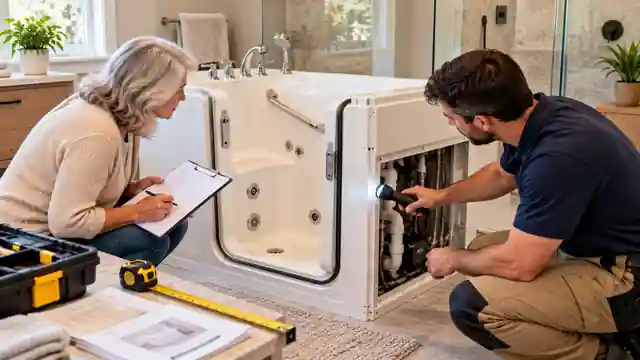
Used-tub guidance reviewed against current manufacturer warranty, support and installation materials. Warranty transfer rules differ by brand; Ella's Bubbles, for example, currently states that its Lifetime Limited Warranty is nontransferable and tied to the original purchaser and installation address. Always verify the exact model's current parts and warranty status before buying.
Used walk-in tubs appear on local marketplaces, remodeling-company inventories, estate-sale listings and occasionally as showroom or open-box units. The prices can look attractive because a new walk-in tub is a major purchase.
The difficult part is that a walk-in tub is not a freestanding appliance you simply carry home and plug in. It is a large plumbing fixture with a watertight door, proprietary hardware and, on many models, pumps, blowers, heaters, controls and dedicated electrical requirements.
That makes a used walk-in tub closer to buying a used mechanical system than buying a used standard bathtub.
Used walk-in tubs: when they make sense
A used tub can be a rational purchase when most of the following are true:
- the exact model and serial number are known;
- the tub can be inspected before purchase;
- the shell, frame and door opening show no structural damage;
- the seal and latch operate normally;
- all therapy systems can be wet-tested safely;
- replacement parts are still supported;
- the installation manual and specification sheet are available;
- the tub’s dimensions, drain side and door orientation suit your bathroom;
- you already have compatible plumbing/electrical or have priced the changes;
- the discount is large enough to justify the loss of new-product warranty and installation certainty.
A used tub is less attractive when the seller cannot identify the model, the unit has already been removed carelessly, the door frame is damaged, pumps cannot be tested, proprietary panels or hardware are missing, or the new installation requires major bathroom reconstruction.
The purchase price is only one part of the cost
The most common mistake is comparing the price of a used tub with the retail price of a new tub and treating the difference as savings.
A more useful comparison is:
| Cost | Used tub | New tub |
|---|---|---|
| Fixture purchase | Usually lower | Higher |
| Removal from seller’s home | May be your responsibility | Not applicable |
| Transport | Often separate | Often arranged through seller/dealer |
| Missing parts/panels | Possible extra cost | Normally complete |
| Warranty | May be limited or nonexistent | New-product terms generally apply |
| Installation | Must be independently arranged in many cases | May be bundled with turnkey brands |
| Unexpected repair | Higher uncertainty | Lower initial uncertainty |
If a $1,500 used tub needs $2,500 of extra plumbing, electrical, transport and missing parts, it may be a worse value than a more expensive new tub with a compatible installation package.
For the full-project numbers, compare with our walk-in tub cost guide.
1. Get the model and serial number before you travel
Do not start with photos alone.
Ask the seller for:
- brand;
- exact model number;
- serial number;
- approximate purchase date;
- original installation date;
- left- or right-hand drain;
- door orientation;
- therapy package;
- photos of all access panels;
- photos of the data/serial label;
- owner’s manual and installation manual if available.
The serial number can help the manufacturer identify the original configuration and compatible replacement parts. It is especially useful when the seller does not know whether the tub has an air system, whirlpool, inline heater or other optional equipment.
If you cannot identify the exact model, you cannot reliably verify dimensions, drain position, electrical requirements, replacement seal, pump parts or installation instructions. A very low price does not solve that problem.
2. Confirm the tub will physically fit your home
Do not assume “60-inch walk-in tub” means it will fit wherever a 60-inch bathtub currently sits.
Verify:
- overall cabinet length;
- width;
- height;
- doorway clearance for delivery;
- drain-center location;
- door side and swing;
- service-panel side;
- required filler/extension panels;
- filled weight;
- minimum service clearances.
Use our walk-in tub dimensions and bathroom-fit guide before committing to a unit.
3. Inspect the shell and structural frame
Surface scratches are different from structural damage.
Look closely for:
- cracks around the door opening;
- cracks near drains or jets;
- stress marks around frame mounting points;
- warped panels;
- corrosion on a steel frame;
- evidence that the tub was dropped or twisted during removal;
- patches or repairs that are not documented.
Acrylic or fiberglass cosmetic wear may be repairable. A distorted door opening is much more serious because the door and gasket depend on the tub geometry remaining correct.
4. The door is the most important used-tub inspection
A walk-in tub is only useful if the door closes predictably and remains watertight.
Check the door dry
- Open it through its full range.
- Check hinge movement.
- Make sure the latch does not require excessive force.
- Look for looseness in the handle or locking mechanism.
- Inspect the door frame for cracks, distortion or repaired damage.
- Inspect the gasket for tears, hardening, flattened sections or sections pulled from their channel.
Do not treat a visibly damaged gasket as a minor detail until you have confirmed that the exact replacement seal is still available.
Then wet-test the door if possible
The best inspection is with the tub installed, level and filled. A tub sitting loose in a garage cannot reproduce the frame support and door compression it had when installed.
If the tub is still installed, ask to see it filled above the door threshold and inspect the perimeter carefully.
Our walk-in tub troubleshooting guide explains why level and frame stability can affect door leakage.
5. Test every therapy system—not just the water jets
A seller may describe a tub as “working” because the faucet and drain operate. That does not prove the powered systems work.
Depending on the model, test:
- whirlpool pump;
- air blower;
- inline heater;
- heated seat/back;
- microbubble system;
- chromotherapy;
- electronic controls;
- powered drain;
- automatic air purge.
Listen for grinding, excessive vibration, repeated clicking or a pump that hums without moving water.
If the tub has already been removed, do not plug it in and press the jet button with an empty pump. Many water-based systems require the correct water level before operation.
6. Inspect underneath and behind the access panels
The service compartment often tells you more than the glossy shell.
Look for:
- water staining;
- mineral deposits around unions;
- corroded clamps or fittings;
- pump rust;
- loose hoses;
- burn marks or melted electrical connectors;
- non-factory splices;
- missing covers;
- evidence of repeated sealant repairs.
A clean-looking bathroom does not guarantee the equipment compartment is dry.
7. Find out why the tub is being sold
The answer does not determine whether the tub is good, but it can reveal where to look.
Reasonable explanations include:
- bathroom conversion to a roll-in shower;
- home sale or renovation;
- change in the user’s mobility needs;
- estate cleanout;
- unused showroom or open-box inventory.
More caution is appropriate if the seller says the tub was removed because “the jets stopped working,” “it leaked a little,” “the door needs adjustment” or “the electrician couldn’t get it to stop tripping.” Those may still be repairable problems, but they belong in your price calculation.
8. Assume the original warranty may not transfer
This is one of the biggest differences between buying new and buying used.
Warranty rules vary by manufacturer, so you must check the exact brand and model. Do not rely on a seller saying “it has a lifetime warranty.”
For example, Ella’s Bubbles currently states that its Lifetime Limited Warranty:
- belongs to the first purchaser;
- is tied to the original installation address;
- is nontransferable;
- becomes void if ownership changes or the tub is relocated.
Ella also states that second owners can still access technical support and replacement parts, but not the original warranty coverage. See the current Ella’s Bubbles warranty terms.
That does not mean every brand uses the same policy. Ask the manufacturer directly using the serial number before buying.
For a broader explanation, see our walk-in tub warranty and lifespan guide.
9. Verify replacement-part availability before buying
A used tub can be mechanically sound today and still be a poor purchase if proprietary parts are no longer available.
Ask the manufacturer whether it can still supply:
- door gasket;
- door/latch hardware;
- pump;
- blower;
- control buttons or control box;
- thermostatic valve cartridge;
- faucet parts;
- drain components;
- access panels;
- model-specific hoses or fittings.
Generic plumbing parts may work in ordinary connections, but a proprietary door seal or electronic controller may have no safe generic substitute.
10. Price the installation before paying for the tub
This is where many apparent bargains disappear.
Give the installer the model’s specification sheet and ask for a quote that addresses:
- transport into the bathroom;
- subfloor condition;
- drain relocation;
- water-supply connections;
- electrical circuits and GFCI protection;
- service access;
- wall/finish work;
- testing and commissioning.
A used tub with the drain on the wrong side or a different electrical package can cost more to install than a better-matched new unit.
Use our walk-in tub installation guide and electrical requirements checklist when comparing quotes.
11. Check whether your water heater is adequate
A used tub may be larger than the fixture it replaces.
Confirm the actual fill volume and compare it with the usable hot-water capacity in your home. A large soaking tub is not a bargain if you later discover the household water heater cannot deliver a comfortable fill.
Our water heater, fill and drain guide explains how to evaluate this.
12. Transport is a real risk
Walk-in tubs can be bulky, heavy and vulnerable to damage if moved incorrectly.
Before pickup:
- remove detachable access panels;
- protect the door and latch;
- secure loose hoses and cords;
- keep proprietary hardware labeled;
- do not lift by faucets, door hardware, pumps or plumbing;
- support the structural frame;
- keep the tub upright unless the manufacturer gives different handling instructions.
If the tub is still installed, consider paying a qualified contractor to remove it. Damage caused during hurried DIY removal can destroy the value you were trying to save.
13. Ask for every loose part before leaving
A used walk-in tub is often sold with pieces scattered through a garage after removal.
Before transport, inventory:
- all access panels;
- end panels/filler panels;
- door/latch hardware;
- faucet components;
- handshower and hose;
- drain components;
- power cords/control boxes;
- mounting brackets;
- manuals;
- installation template or drawings;
- original model/serial labels.
Missing cosmetic trim may be manageable. Missing model-specific door or control hardware may not be.
Used, open-box, showroom or refurbished: they are not the same
| Type | Typical risk | What to ask |
|---|---|---|
| Used in a home | Unknown wear/service history | Age, reason for removal, serial number, wet test |
| Showroom/display | May have door/finish wear; may never have been wet-tested | Manufacturer warranty eligibility and missing parts |
| Open-box | Shipping/handling damage possible | Why returned, inspection report, warranty status |
| Refurbished | Quality depends on refurbisher | Exactly what was replaced, test procedure, written warranty |
Do not pay a premium for the word “refurbished” unless the seller documents the work and gives a meaningful warranty.
A practical used walk-in tub inspection checklist
- ☐ Brand, model and serial number confirmed.
- ☐ Current spec sheet and installation manual found.
- ☐ Overall dimensions fit the bathroom and delivery path.
- ☐ Drain side/location works with your project.
- ☐ Door orientation works for the user.
- ☐ Shell and frame have no structural damage.
- ☐ Door opens, closes and latches normally.
- ☐ Correct replacement door seal is still available.
- ☐ All access panels are present.
- ☐ No active leak evidence under the tub.
- ☐ Pumps/blowers/heaters tested with proper water level.
- ☐ Controls tested.
- ☐ Drain tested.
- ☐ Electrical requirements documented.
- ☐ Manufacturer confirms parts availability.
- ☐ Warranty/transfer status confirmed in writing.
- ☐ Installation quote obtained before purchase.
- ☐ Transport/removal cost included in the budget.
When I would skip a used walk-in tub
Walk away or price the unit as a parts-only fixture when:
- the model cannot be identified;
- the door frame or shell is cracked;
- the tub has been stored outdoors;
- the seller cannot provide all access panels;
- the pump compartment shows significant corrosion or water damage;
- electrical wiring has been modified informally;
- a proprietary door seal or control is discontinued;
- the unit cannot be tested and the asking price assumes it works;
- installation changes would eliminate the savings;
- the door/seat configuration is wrong for the intended user.
When buying new may be the better value
A new tub can justify its higher fixture price when it gives you:
- a current warranty;
- known service history;
- exact model selection for the bathroom;
- correct door/drain orientation;
- current parts support;
- turnkey installation;
- one company responsible for product and installation;
- less uncertainty around leaks and powered systems.
If you are still deciding whether the category itself makes sense for your household, start with Are Walk-In Tubs Worth It?.
Frequently asked questions
Is it safe to buy a used walk-in tub?
It can be, provided the exact tub is inspected, the door and frame are sound, powered systems work, parts are available and the unit can be installed to the manufacturer’s requirements and local code. Buying an unidentified or untested tub carries much more risk.
Do used walk-in tubs still have a warranty?
Sometimes, but do not assume so. Warranty transfer rules are brand-specific. Some manufacturers tie lifetime coverage to the original purchaser and original installation address. Verify the exact serial number with the manufacturer before purchase.
Can a used walk-in tub be moved to another house?
Physically, many can be moved, but relocation must follow the manufacturer’s handling instructions and the new installation must match the model’s structural, plumbing and electrical requirements. Moving can also affect warranty coverage.
Can I install a used walk-in tub myself?
That depends on your skills, local code and the manufacturer’s requirements. Plumbing and electrical work may require licensed trades. The installation is also critical to door sealing, drainage and service access, so a low-cost fixture does not justify a poor installation.
How much should I pay for a used walk-in tub?
There is no reliable universal percentage of new price. Base your offer on condition, model age, parts availability, warranty status, included hardware, ability to wet-test it, removal/transport cost and the quote to install it in your bathroom.
What is the biggest hidden cost?
Usually installation mismatch: moving a drain, adding dedicated GFCI circuits, repairing a subfloor, replacing missing proprietary parts or rebuilding surrounding finishes can exceed the savings on the fixture.
Bottom line
A used walk-in tub is not automatically a bad idea, but it should be purchased like a used mechanical fixture—not like a bargain piece of bathroom furniture.
The best used tub is one you can identify, inspect, wet-test, service and install without major surprises. If any of those pieces are missing, compare the true all-in cost with a new tub before committing.
If you are replacing an existing fixture, continue with our walk-in tub replacement guide. If this will be a first-time installation, use the installation checklist before buying.