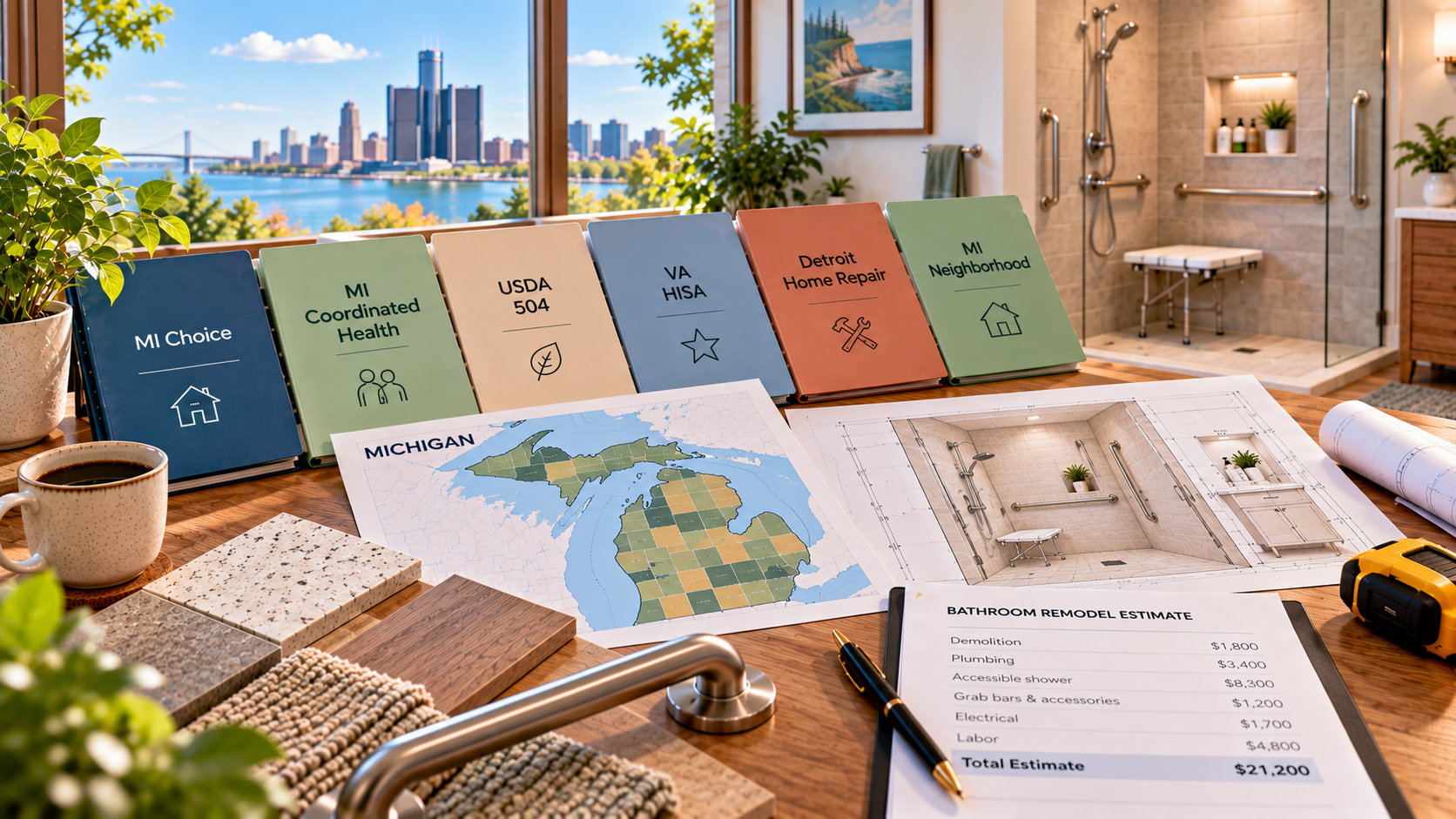
Verified against current Michigan MDHHS, MSHDA, City of Detroit, USDA Rural Development, and VA sources. Local funding, application windows, and intake status can change.
Michigan has several strong home-accessibility routes, but the programs are spread across Medicaid, aging services, housing rehabilitation, city programs, rural development, and Veteran benefits.
For bathroom projects, the best strategy is to identify the functional barrier first: difficulty stepping over a tub, unsafe transfers, lack of grab support, doorway width, wheelchair clearance, or the inability to use the toilet or sink safely. Public programs usually fund the least-cost modification that solves the documented need—not a cosmetic remodel.
This guide explains the main Michigan options and which one to check first.
Michigan programs at a glance
| Program / route | Who it may help | Bathroom-related help | How to start |
|---|---|---|---|
| MI Choice Waiver | Adults 65+ and adults with disabilities who meet nursing-facility level-of-care criteria | Environmental accessibility adaptations, grab bars, doorway widening, bathroom modifications | Local MI Choice waiver agency |
| MI Coordinated Health HCBS | Eligible MICH enrollees who need nursing-home-level care but live in the community | Environmental modifications, including complex bathroom work when medically necessary | Care coordinator / health plan |
| Michigan Aging Services | Older adults seeking to remain at home | Home repair, home injury control, local referrals | Local Area Agency on Aging |
| MI Neighborhood | Low- and moderate-income households served by funded local organizations | Occupied rehabilitation, home repairs, accessibility improvements | Local grantee / housing organization |
| Detroit Critical Home Repair | Eligible Detroit homeowners with urgent health, safety, or accessibility needs | Accessibility-related bathroom repairs, plumbing, electrical, heating and other critical work | City of Detroit application during open periods |
| Detroit Home Accessibility / Senior Accessibility Fund | Low-income seniors and residents with disabilities | Safety and access improvements | Detroit Housing Network / City of Detroit |
| USDA Section 504 | Qualifying rural homeowners; grants generally age 62+ with very-low income | Health/safety repairs and accessibility work | USDA Rural Development Michigan |
| VA HISA | Eligible Veterans / Servicemembers with medical need | Roll-in showers, bathroom access, related plumbing/electrical work | Local VA Prosthetic & Sensory Aids Service |
1. MI Choice Waiver
MI Choice is Michigan’s Medicaid waiver for adults who meet nursing-facility level-of-care criteria but prefer to receive long-term services and supports at home or in the community.
Michigan currently lists Environmental Accessibility Adaptations among MI Choice waiver services.
What can MI Choice environmental adaptations include?
Michigan waiver language identifies examples such as:
- installation of ramps;
- grab bars;
- widening doorways;
- modification of bathroom facilities;
- specialized electrical systems;
- specialized plumbing systems required for approved medical equipment or accessibility needs.
The modification must be required by the participant’s service plan and be necessary to protect health, welfare, safety, or greater independence at home.
Who should ask about MI Choice?
MI Choice is especially relevant for:
- adults age 65+ who would otherwise need nursing-home care;
- adults with disabilities who meet the same functional criteria;
- people whose current bathroom creates a barrier to safe home living.
Michigan provides a regional list of MI Choice waiver agencies so applicants can contact the organization serving their county.
MI Choice environmental adaptations are waiver services. The modification should be authorized through the participant’s service plan before construction begins.
2. MI Coordinated Health environmental modifications
Michigan’s newer MI Coordinated Health (MICH) HCBS framework also includes Environmental Modifications for eligible enrollees who require nursing-home-level care but remain in the community.
Current Michigan guidance describes environmental modifications as physical adaptations to the primary residence that are necessary for health, welfare, safety, or greater independence.
Bathroom-related examples
The program language includes:
- ramps;
- grab bars;
- widening doorways;
- bathroom-facility modifications;
- specialized plumbing;
- specialized electrical systems.
Michigan’s current guidance also says complex kitchen and bathroom modifications may be completed when medically necessary.
Medicaid is a payer of last resort
Michigan requires participants and care coordinators to make reasonable efforts to use other available funding sources first. The state specifically references housing commission grants, MSHDA resources, and Community Development Block Grant programs.
This means your care coordinator may ask you to document applications or denials from other programs before Medicaid funds the project.
3. Michigan 1915(i) environmental modifications
Michigan’s 1915(i) HCBS state-plan services also include environmental modifications for eligible beneficiaries.
Current 2026 state-plan language allows adaptations such as ramps, grab bars, doorway widening, bathroom modifications, and specialized plumbing or electrical work when required by the beneficiary’s needs.
Rental properties can be modified when the landlord agrees in writing and the required agreement addresses restoration responsibilities.
General maintenance, ordinary home improvement, roof repair, central air conditioning, garages, landscaping, and unrelated new construction are excluded.
4. Michigan Aging Services and Area Agencies on Aging
Michigan’s aging-services network is another useful starting point for older adults who do not know which benefit applies.
The Michigan Department of Health and Human Services currently lists community services including:
- Home Repair;
- Home Injury Control;
- crisis energy assistance;
- transportation;
- case coordination;
- other community supports.
Service availability varies by region, so your local Area Agency on Aging can help identify:
- home repair programs;
- grab-bar or fall-prevention assistance;
- MI Choice eligibility;
- local nonprofit repair programs;
- county or city rehabilitation programs;
- other aging-in-place resources.
5. Michigan State Emergency Relief home repairs
Michigan’s State Emergency Relief program can help with certain essential home repairs when the condition creates a direct threat to health or safety.
This is not a general accessibility grant. Current Michigan guidance focuses on urgent repairs such as:
- non-functioning furnaces;
- hot-water heaters;
- septic systems;
- other essential repairs needed to restore a safe, livable condition.
The current lifetime maximum for non-energy-related home repairs is relatively small, so this program is more useful for urgent essential systems than for a full accessible-bathroom remodel.
6. MI Neighborhood occupied rehabilitation
The Michigan State Housing Development Authority’s MI Neighborhood program funds local organizations to address housing needs using state and federal resources.
The occupied-rehabilitation component is designed to keep existing homes safe and in good condition.
Michigan says this rehabilitation funding can include:
- small and large home repairs;
- energy-efficiency updates;
- accessibility improvements.
Individual homeowners do not apply to MSHDA as if MI Neighborhood were a statewide bathroom grant. The key is to identify a funded local nonprofit or community program serving your area.
7. Detroit Critical Home Repair Program
Detroit has one of the strongest local examples in Michigan.
The City’s Critical Home Repair Program provides free repairs to eligible homeowners with serious health, safety, or accessibility needs.
Current Detroit guidance specifically includes:
- severe plumbing problems;
- actively leaking roofs;
- heating-system failure;
- electrical hazards;
- accessibility-related repairs to bathrooms;
- accessibility-related repairs to entrances and exits.
Who may qualify?
Current initial eligibility includes:
- owning and occupying a Detroit home;
- being current on property taxes or enrolled in a payment plan;
- meeting household income limits;
- having at least one qualifying household member, such as:
- a child under 18;
- an adult age 62+;
- a resident with a documented disability.
Current application status
Detroit opened both spring and fall 2026 pre-application periods. The most recent fall window ran from September 9 through September 22, 2026 and is now closed.
The City says applications are expected to open twice each year, so residents should join the Home Repair Interest List or monitor the program page for the next round.
8. Detroit Home Accessibility Program / Senior Accessibility Fund
Detroit also operates the Senior Accessibility Home Repair Fund, created with $6.6 million in ARPA funding.
The initiative is designed to provide safety and access improvements for:
- low-income Detroit seniors;
- residents with disabilities;
- households struggling with access inside or into the home.
The City has directed interested seniors to apply through the Detroit Housing Network and lists the program contact number as:
313-224-6380
Previous Detroit program materials specifically referenced accessibility improvements such as ramps and widened doorways. For bathroom-specific work, confirm the current scope with the program administrator.
9. USDA Section 504 in rural Michigan
USDA Rural Development currently lists the Single Family Housing Repair Loans & Grants program for Michigan.
Current standard terms include:
- up to $40,000 in loans;
- up to $10,000 in grants;
- up to $50,000 combined;
- a 20-year loan term;
- a fixed 1% interest rate.
Who can qualify?
Applicants generally must:
- own and occupy the home;
- live in an eligible rural area;
- meet income limits;
- be unable to obtain affordable credit elsewhere;
- and, for grants, generally be age 62+ with very-low income.
Loans can be used to repair, improve, or modernize the home or remove health and safety hazards. Grants are limited to removing health and safety hazards.
10. VA HISA for Michigan Veterans
Eligible Michigan Veterans and Servicemembers can use the federal Home Improvements and Structural Alterations (HISA) benefit for medically necessary changes to a primary residence.
Potential bathroom uses include:
- roll-in showers;
- essential bathroom and sanitary access;
- accessible sinks or counters;
- necessary plumbing work;
- necessary electrical work.
HISA is not a general remodel benefit. VA approval should be obtained before construction begins.
Which Michigan route should you check first?
| Your situation | Start here |
|---|---|
| Adult 65+ or disabled and may need nursing-home-level care | MI Choice |
| MI Coordinated Health enrollee | Care coordinator / Environmental Modifications |
| Older adult who is unsure which program applies | Local Area Agency on Aging |
| Low/moderate-income homeowner needing local rehabilitation | MI Neighborhood local grantee |
| Detroit senior or household with disability and urgent repairs | Critical Home Repair / Senior Accessibility Fund |
| Rural homeowner age 62+ with very-low income | USDA Section 504 |
| Veteran with medically necessary bathroom need | VA HISA |
What bathroom work may qualify?
Depending on the program and assessed need, potentially eligible work can include:
- grab bars;
- bathroom-facility modifications;
- doorway widening;
- complex bathroom modifications when medically necessary;
- specialized plumbing;
- specialized electrical work;
- accessibility-related bathroom repairs;
- other changes required to avoid institutional placement or improve independence.
Describe the barrier, not the product
Less useful:
“I want a walk-in tub.”
Better:
“The resident cannot safely step over the existing bathtub wall and needs a lower-entry bathing arrangement, stable grab support, and enough space for transfers.”
This gives the case manager or housing program room to identify the least-cost solution that meets the need.
Documents to gather before applying
- photo ID;
- proof of Michigan residency;
- proof of age;
- proof of disability or medical need where required;
- Medicaid and waiver information;
- proof of income;
- proof of homeownership or lease;
- landlord permission if required;
- photos of the current bathroom;
- bathroom and doorway measurements;
- medical, OT, or PT recommendations when requested;
- contractor estimates if required;
- Veteran documentation if applying for HISA.
Do not begin construction before approval
Michigan Medicaid, MI Choice, USDA, VA, Detroit, and other public programs can require assessment, an approved service plan, contractor bids, or written authorization before construction.
If you are relying on program funding, assume that work started before authorization may not be reimbursed.
Homeowners vs renters in Michigan
USDA and many repair programs are owner-occupied routes.
Michigan Medicaid environmental modifications may sometimes be possible in rental housing when the landlord gives written approval and program rules are satisfied.
Fair-housing law also requires housing providers to allow reasonable disability-related modifications in many situations, although the tenant may sometimes be responsible for the cost.
Michigan application checklist
- Identify the unsafe bathroom movement.
- If the resident may meet nursing-home-level care criteria, contact the local MI Choice agency.
- If enrolled in MI Coordinated Health, contact the care coordinator.
- If age 60+, call the local Area Agency on Aging.
- Check for MI Neighborhood-funded rehabilitation in your community.
- If in Detroit, monitor Critical Home Repair and Senior Accessibility programs.
- If rural, check USDA property and income eligibility.
- If a Veteran, contact VA HISA.
- Separate essential accessibility work from cosmetic remodeling.
- Wait for written authorization before construction.
Red flags in Michigan “free bathroom” ads
- The ad says every Michigan senior qualifies.
- It does not identify MI Choice, Medicaid, USDA, VA, MSHDA, Detroit, or another real program.
- The “grant” is actually financing.
- The salesperson promises a specific tub before an assessment.
- You are pressured to sign before benefit approval.
- The website uses government-style graphics but only collects private sales leads.
Related Michigan bathroom-planning guides
- Bathroom Accessibility Grants by State
- Bathroom Remodel Cost & Financing 2026
- Bathroom Safety for Seniors
- Walk-In Tub Cost 2026
- Walk-In Tub vs Walk-In Shower
Frequently asked questions
Does Michigan have bathroom remodel grants for seniors?
Michigan does not have one universal bathroom grant. Older adults may find help through MI Choice, aging services, local housing rehabilitation, USDA Section 504, VA HISA, and city programs such as Detroit Critical Home Repair.
Can MI Choice pay for bathroom modifications?
Yes, for eligible participants when the modification is authorized as an Environmental Accessibility Adaptation. Michigan specifically lists bathroom modifications, grab bars, doorway widening, and specialized plumbing or electrical systems.
Can Michigan Medicaid pay for complex bathroom modifications?
Yes, in qualifying programs. Current MI Coordinated Health guidance says complex kitchen and bathroom modifications may be completed when medically necessary.
What is MI Neighborhood?
MI Neighborhood is a Michigan housing program that funds local organizations for neighborhood and housing needs. Occupied rehabilitation can include home repairs, energy-efficiency updates, and accessibility improvements.
Does Detroit pay for bathroom accessibility repairs?
Yes. Detroit’s Critical Home Repair Program explicitly includes accessibility-related repairs to bathrooms for eligible homeowners. The application opens in limited periods.
Does Detroit have a separate accessibility program for seniors and people with disabilities?
Yes. The Senior Accessibility Home Repair Fund was created with $6.6 million in ARPA funding to provide safety and access improvements for low-income seniors and residents with disabilities.
Can rural Michigan seniors use USDA Section 504?
Yes. Michigan participates in the federal Section 504 repair program for eligible rural homeowners, including grants for qualifying homeowners age 62+ with very-low income.
Can renters receive Michigan Medicaid home modifications?
Potentially. Current Michigan Medicaid language allows adaptations in rental properties when the owner agrees in writing and program conditions are met.
Can Veterans use HISA for bathroom accessibility in Michigan?
Yes, when the work is medically necessary and approved by VA. Eligible work can include roll-in showers and other changes required for essential bathroom access.
Should I start the remodel while my application is pending?
No. Most public programs require prior approval, an authorized care plan, or an approved scope before work begins.
Official sources and verification
- Michigan MDHHS — MI Choice Waiver Program
- Michigan MDHHS — MI Coordinated Health HCBS
- Michigan MDHHS — Aging Services
- Michigan MDHHS — State Emergency Relief Home Repairs
- MSHDA — MI Neighborhood
- City of Detroit — Critical Home Repair Program
- City of Detroit — Senior Accessibility Home Repair Fund
- USDA Rural Development — Michigan Programs
- U.S. Department of Veterans Affairs — HISA
Accessible Bath Advisor provides general educational information and does not guarantee eligibility, funding, approval, or reimbursement. Michigan Medicaid, aging, housing, USDA, VA, city, county, and nonprofit program rules and funding can change. Confirm current terms with the administering agency before beginning work or signing a remodeling contract.