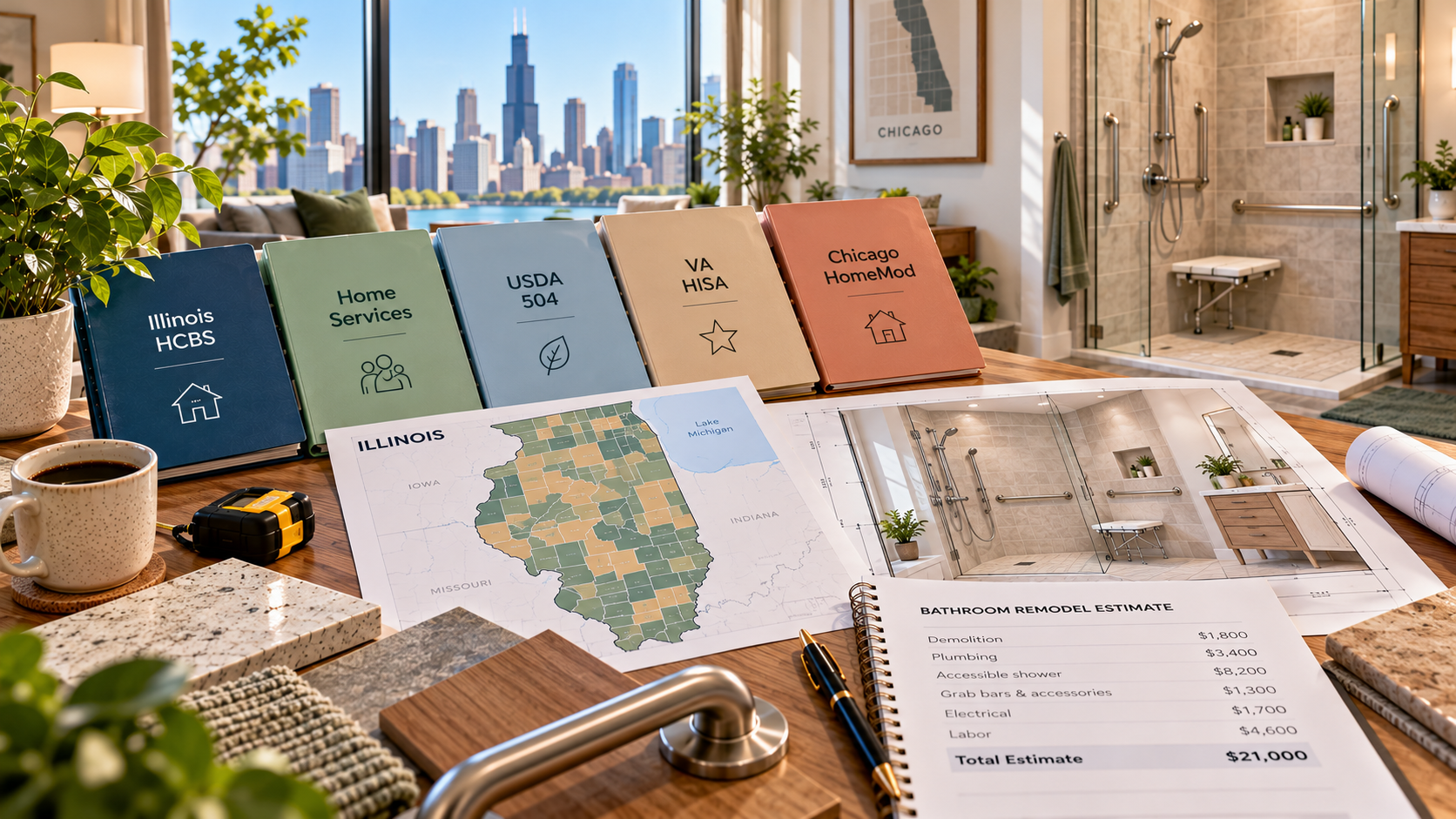
Verified against current Illinois HFS, Illinois Department on Aging, Chicago MOPD, USDA Rural Development, and VA sources. Local funding, intake, and service availability can change.
Illinois has several useful routes for accessibility improvements, but the terminology varies depending on the program. One agency may call the work an Environmental Accessibility Adaptation, another a home modification, and a city program may simply call it HomeMod.
For bathroom projects, the key is to show why the current layout creates a functional barrier: stepping over the bathtub, unsafe transfers, lack of grab support, wheelchair clearance, or difficulty using the toilet or sink safely.
This guide organizes the main Illinois programs and explains which ones are worth checking first.
Illinois programs at a glance
| Program / route | Who it may help | Bathroom-related help | How to start |
|---|---|---|---|
| Illinois Medicaid HCBS | Eligible waiver participants | Environmental Accessibility Adaptations, including bathroom modifications, grab bars, doorway widening, plumbing/electrical work | Case manager / waiver service coordinator |
| Illinois Department on Aging / AAAs | Older adults, especially those at risk of institutional placement | Home modification, chore services, assistive equipment, safety changes | Local Area Agency on Aging |
| Home Services Program | Eligible adults under 60 with severe disabilities | Environmental modification and assistive supports | Illinois DHS Division of Rehabilitation Services |
| Chicago HomeMod | Chicago residents with disabilities | Roll-in showers, widened doorways, accessible sinks, ramps and lifts | Mayor’s Office for People with Disabilities |
| USDA Section 504 | Qualifying rural homeowners; grants generally age 62+ with very-low income | Health/safety repairs and accessibility improvements | USDA Rural Development Illinois |
| VA HISA | Eligible Veterans / Servicemembers with medical need | Roll-in showers, essential bathroom access, related plumbing/electrical work | Local VA Prosthetic & Sensory Aids Service |
1. Illinois Medicaid HCBS Environmental Accessibility Adaptations
Illinois Medicaid Home and Community-Based Services programs can include Environmental Accessibility Adaptations for eligible participants.
Illinois HFS describes this service as physically modifying the home to accommodate a person’s loss of function in Activities of Daily Living.
Current waiver language includes examples such as:
- ramps;
- grab bars;
- widened doorways;
- modification of bathroom facilities;
- specialized electrical systems;
- specialized plumbing systems required for medical or accessibility needs.
These modifications must be connected to the participant’s plan of care and be necessary for health, welfare, safety, or greater independence at home.
What does that mean for a bathroom project?
If the person cannot safely bathe, transfer, or use bathroom fixtures, a case manager can evaluate whether the bathroom barrier should be addressed through an authorized environmental modification.
The approved solution could involve:
- grab bars;
- doorway widening;
- a lower-entry shower configuration;
- toilet-area changes;
- plumbing modifications;
- electrical work needed for approved accessibility equipment.
What Medicaid generally does not cover
Illinois waiver guidance excludes general home improvements that are not directly related to the participant’s medical or remedial need.
Examples of work that is usually outside the accessibility benefit include:
- ordinary roof repair;
- general remodeling for appearance;
- carpeting unrelated to accessibility;
- whole-home upgrades with no direct functional need;
- additions that simply increase square footage.
Environmental modifications are waiver services tied to an approved plan of care. Do not assume work completed first can be reimbursed later.
2. Illinois Home Services Program
The Illinois Department of Human Services Division of Rehabilitation Services operates the Home Services Program for eligible adults under age 60 with severe disabilities.
The program is designed to help people remain at home instead of entering a nursing facility.
Illinois describes Environmental Modification as home changes that compensate for reduced mobility, strength, sensation, or function; increase safety; and reduce dependence on direct assistance.
For eligible participants, services can be provided without out-of-pocket cost under the program rules.
Why this matters for bathrooms
A bathroom is often the room where loss of mobility has the biggest impact. A home-services assessment may identify changes such as:
- grab bars;
- transfer support;
- doorway or clearance changes;
- safer bathing access;
- assistive equipment.
The Home Services Program is especially relevant for adults with significant disabilities who are too young for age-based senior programs.
3. Illinois Department on Aging and Area Agencies on Aging
Illinois’ aging network also funds and coordinates home-based services for older adults.
The Illinois Department on Aging states that Area Agencies on Aging can support services such as:
- case management;
- homemaker and chore services;
- assistive equipment;
- home modification;
- information and assistance;
- other in-home supports.
The exact service package differs by region, so your local AAA is often the best place to start if you are age 60+ and unsure which program fits.
What to ask your Area Agency on Aging
Use specific terms:
- home modification;
- bathroom safety;
- grab bars;
- fall prevention;
- assistive equipment;
- minor home repair;
- Medicaid waiver screening;
- local city/county accessibility programs.
Illinois aging guidance specifically tells caregivers to ask their local Area Agency on Aging or Caregiver Resource Center about home-modification devices such as ramps, grab bars, and handrails.
4. Community Care Program
The Illinois Community Care Program helps eligible adults age 60+ remain at home rather than entering nursing-home care.
The core program focuses on services such as care coordination, in-home services, adult day services, emergency response, and medication support.
Bathroom modifications are not presented as a universal direct CCP benefit on the main program page, but the broader Illinois aging network can connect eligible older adults to home-modification and environmental-modification resources.
For that reason, Community Care screening plus a local AAA referral is still worth pursuing when the person’s bathroom safety is part of a larger aging-in-place need.
5. Chicago HomeMod Program
Chicago residents have an additional local route through the Mayor’s Office for People with Disabilities (MOPD).
The City’s current MOPD page lists HomeMod Program under Housing and Home Modification services.
Chicago has historically used HomeMod to help people with disabilities make accessibility changes such as:
- ramps;
- porch and stair lifts;
- roll-in showers;
- widened doorways;
- accessible sinks;
- accessible cabinets.
For current eligibility, funding availability, and application procedures, contact MOPD directly because program details can change between funding cycles.
Chicago MOPD contact
The City’s current MOPD page lists:
312-746-5773
Ask specifically about the current HomeMod intake and whether bathroom-accessibility projects are being accepted.
6. Other Chicago accessibility resources
Chicago’s disability-services ecosystem also includes housing-resource guides and independent-living partners.
If HomeMod intake is limited, ask MOPD whether there are current referrals to:
- Access Living;
- community development organizations;
- housing rehabilitation programs;
- independent-living programs;
- other CDBG-funded accessibility resources.
Chicago also offers permit-fee waivers for qualifying long-term senior homeowners age 65+ for certain residential repairs, alterations, and additions. That does not pay for the remodel itself, but it can reduce project costs.
7. USDA Section 504 in rural Illinois
USDA Rural Development’s Single Family Housing Repair Loans & Grants program is currently open in Illinois.
The standard current terms are:
- maximum loan: $40,000;
- maximum grant: $10,000;
- maximum combined assistance: $50,000;
- loan term: 20 years;
- fixed interest rate: 1%.
Who can qualify?
Applicants generally must:
- own and occupy the home;
- live in an eligible rural area;
- meet income limits;
- be unable to obtain affordable credit elsewhere;
- and, for grants, generally be age 62 or older with very-low income.
Loans can be used to repair, improve, or modernize the home or remove health and safety hazards. Grants are limited to removing health and safety hazards.
USDA’s 2026 public guidance also identifies accessibility improvements such as wheelchair ramps and walk-in tubs as examples of Section 504 use when program conditions are met.
8. VA HISA for Illinois Veterans
Eligible Illinois Veterans and Servicemembers can use the federal Home Improvements and Structural Alterations (HISA) benefit for medically necessary changes to a primary residence.
Potential bathroom uses include:
- roll-in showers;
- access to essential lavatory and sanitary facilities;
- accessible sinks or counters;
- necessary plumbing changes;
- necessary electrical changes.
HISA is not a general luxury-remodel benefit, and the VA should approve the project before construction begins.
9. Illinois programs for transition from institutions
Some Illinois Medicaid transition initiatives can also include home or environmental accessibility modifications when a person is moving from institutional care into community living.
In those cases, the modification is typically part of a larger transition plan rather than a standalone home-improvement grant.
If the resident is preparing to leave a nursing facility or another institutional setting, ask the transition coordinator specifically about:
- home accessibility modifications;
- grab bars and bathroom safety;
- doorway changes;
- transfer equipment;
- other modifications needed before discharge.
10. Which Illinois route should you check first?
| Your situation | Start here |
|---|---|
| Medicaid HCBS participant | Case manager / Environmental Accessibility Adaptations |
| Adult under 60 with severe disability | Home Services Program |
| Older adult age 60+ | Local Area Agency on Aging |
| Chicago resident with disability | MOPD HomeMod |
| Rural homeowner age 62+ with very-low income | USDA Section 504 |
| Veteran with medically necessary bathroom need | VA HISA |
| Transitioning out of institutional care | Medicaid transition coordinator / HCBS team |
What bathroom work may qualify?
Depending on the program and assessed need, eligible work may include:
- grab bars;
- roll-in shower changes;
- bathroom-facility modifications;
- door widening;
- accessible sinks;
- toilet-area adaptations;
- specialized plumbing;
- specialized electrical work;
- threshold or transfer changes.
Describe the problem, not the product
Less useful:
“I want a walk-in tub.”
Better:
“The resident cannot safely step over the existing bathtub wall and needs a lower-entry bathing arrangement, stable support, and enough space for safe transfers.”
This makes it easier for an assessor to identify the lowest-cost modification that actually addresses the need.
Documents to gather before applying
- photo ID;
- proof of Illinois residency;
- proof of age;
- proof of disability or medical need where required;
- Medicaid and waiver information;
- proof of income;
- proof of homeownership or lease;
- landlord approval if required;
- photos of the current bathroom;
- bathroom and doorway measurements;
- medical or occupational-therapy recommendations;
- contractor estimates if requested;
- Veteran documentation if applying for HISA.
Do not begin work before approval
Illinois Medicaid, Home Services, Chicago HomeMod, USDA, VA, and other public programs can require assessment, eligibility verification, an approved scope of work, or a contracted provider before construction.
If you depend on program funding, assume unapproved work may not be reimbursed.
Illinois homeowners vs renters
USDA is primarily an owner-occupied program. Medicaid and disability-focused environmental modifications may sometimes be possible in rental housing with the required property-owner permission.
Always ask whether the program requires:
- owner occupancy;
- landlord approval;
- a minimum period of continued residence;
- restoration agreements;
- specific contractor or permit requirements.
Illinois application checklist
- Identify the unsafe bathroom movement.
- If the resident has Medicaid HCBS, contact the case manager first.
- If under 60 with a severe disability, ask about the Home Services Program.
- If age 60+, contact the Area Agency on Aging.
- If in Chicago, ask MOPD about current HomeMod intake.
- If rural, check USDA property and income eligibility.
- If a Veteran, contact VA HISA.
- Get an accessibility assessment if the program requires one.
- Separate essential accessibility work from cosmetic upgrades.
- Wait for approval before construction.
Red flags in Illinois “free bathroom” ads
- The ad says every Illinois senior qualifies.
- It does not identify an actual Medicaid, aging, USDA, VA, or city program.
- The “grant” is actually financing.
- The salesperson promises a specific tub before any assessment.
- You are asked to sign a remodel contract before eligibility is confirmed.
- The site uses government-style graphics but only collects private sales leads.
Related Illinois bathroom-planning guides
- Bathroom Accessibility Grants by State
- Bathroom Remodel Cost & Financing 2026
- Bathroom Safety for Seniors
- Walk-In Tub Cost 2026
- Walk-In Tub vs Walk-In Shower
Frequently asked questions
Does Illinois have bathroom remodel grants for seniors?
Illinois does not have one universal bathroom grant. Older adults may find help through Area Agencies on Aging, home-modification services, USDA Section 504, VA HISA, Medicaid HCBS when eligible, and local programs.
Can Illinois Medicaid pay for bathroom modifications?
Yes, for eligible HCBS participants when the work is authorized as an Environmental Accessibility Adaptation. Illinois waiver language explicitly includes grab bars, doorway widening, bathroom modifications, and specialized plumbing or electrical systems.
What is Illinois Home Services Program?
The Home Services Program helps eligible adults under age 60 with severe disabilities remain at home. Environmental Modification is one of the services available under the program.
Can an Illinois Area Agency on Aging help with home modifications?
Potentially. Illinois Department on Aging guidance lists home modification among services supported through the aging network, and AAAs can also refer older adults to local resources.
Does Chicago have a home modification program?
Yes. The Mayor’s Office for People with Disabilities currently lists HomeMod under its housing and home-modification services. Historically the program has supported changes such as roll-in showers, widened doorways, ramps, lifts, and accessible sinks.
Can rural Illinois seniors use USDA Section 504?
Yes. The Illinois Section 504 program is currently open. Eligible rural homeowners may qualify for up to $40,000 in loans, $10,000 in grants, or $50,000 combined.
Can Veterans use HISA for bathroom accessibility in Illinois?
Yes, when the work is medically necessary and the Veteran meets HISA requirements. Eligible projects can include roll-in showers and other changes required for essential bathroom access.
Can renters receive accessibility modifications?
Some Medicaid and disability programs may allow modifications in rental housing with owner permission. USDA and many repair programs are limited to homeowners.
Should I start the remodel while my application is pending?
No. Most public programs require prior approval or an approved service plan before work begins.
What should I ask for instead of a walk-in tub?
Describe the unsafe movement or functional barrier. The program may approve a walk-in tub, roll-in shower, grab bars, doorway changes, or another solution depending on need and cost.
Official sources and verification
- Illinois HFS — Persons with Disabilities HCBS
- Illinois Department on Aging — Home & Community-Based Services
- Illinois Department on Aging — In-Home Care and Environmental Modification
- Illinois Department on Aging — Community Care Program
- City of Chicago MOPD — Housing and Home Modification
- USDA Rural Development — Section 504 in Illinois
- USDA Rural Development — Illinois
- U.S. Department of Veterans Affairs — HISA
Accessible Bath Advisor provides general educational information and does not guarantee eligibility, funding, approval, or reimbursement. Illinois Medicaid, aging, USDA, VA, city, county, and nonprofit program rules and funding can change. Confirm current terms with the administering agency before beginning work or signing a remodeling contract.