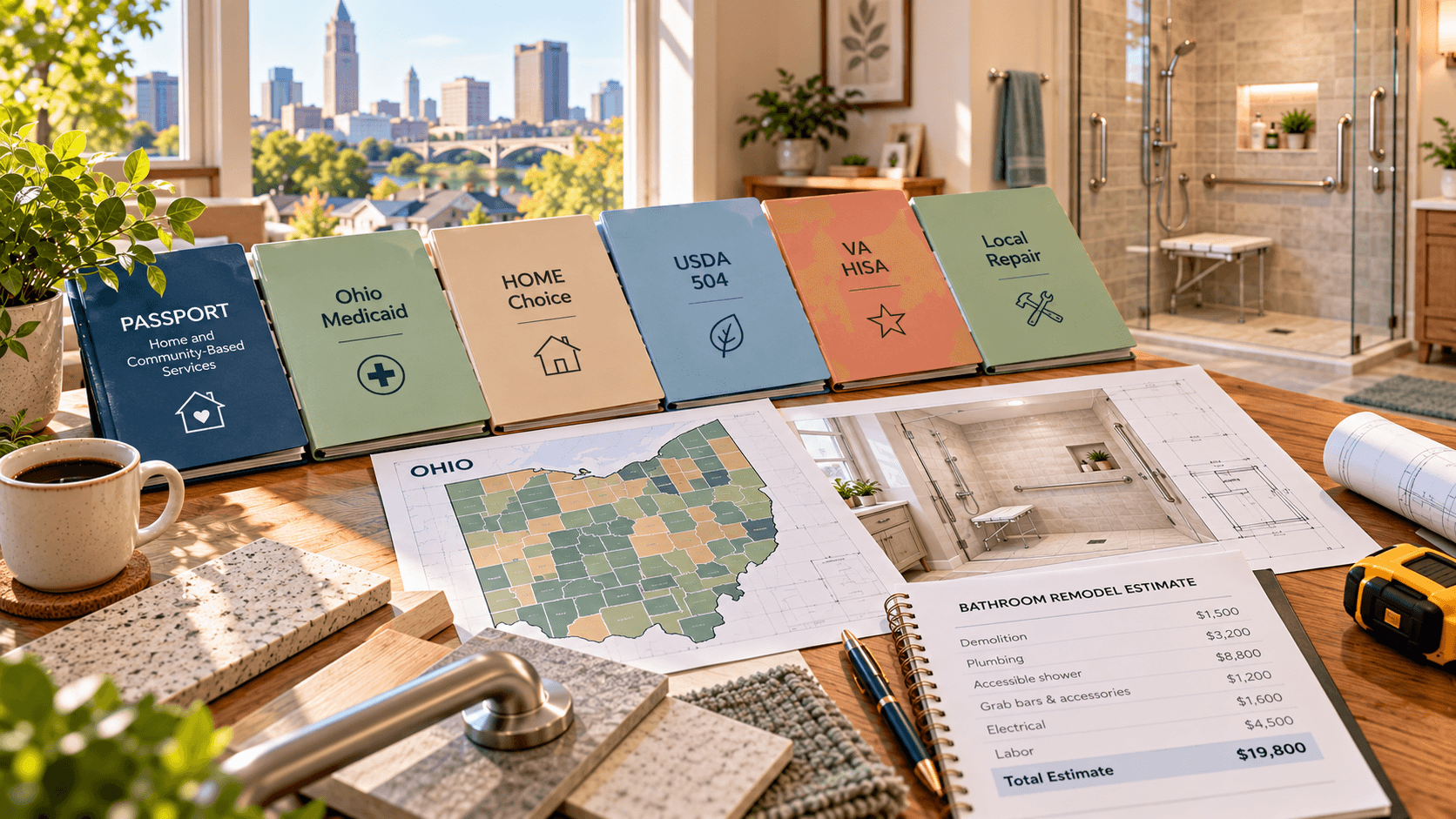
If you receive Social Security retirement benefits, SSDI or SSI, do not assume that the Social Security Administration (SSA) will pay for a walk-in tub, accessible shower or bathroom remodel.
SSA administers benefit programs such as retirement, disability and Supplemental Security Income. Those are primarily cash-benefit programs, not a general home-modification grant for Ohio seniors.
SSA does have separate Impairment-Related Work Expense (IRWE) rules for certain disability-related costs connected to employment. Those rules are not a bathroom-remodel grant. SSA’s own policy explains that when a person works outside the home, interior residential modifications such as rearranging bathroom facilities are not deductible as IRWE.
For real bathroom-modification help in Ohio, use the state, local, rural or Veteran programs below and apply through the agency that actually administers them.
Rechecked against current Social Security Administration, Ohio Medicaid, Ohio Department of Aging, Ohio Administrative Code, Columbus, Cleveland, Cincinnati, USDA Rural Development and VA sources. Program eligibility, local funding and application intake can change.
Ohio bathroom-accessibility help is spread across Medicaid, aging services, disability waivers, transition programs, rural housing and city repair programs. The useful search terms are usually home modification, environmental accessibility adaptation, critical home repair or home safety modification rather than “free bathroom remodel.”
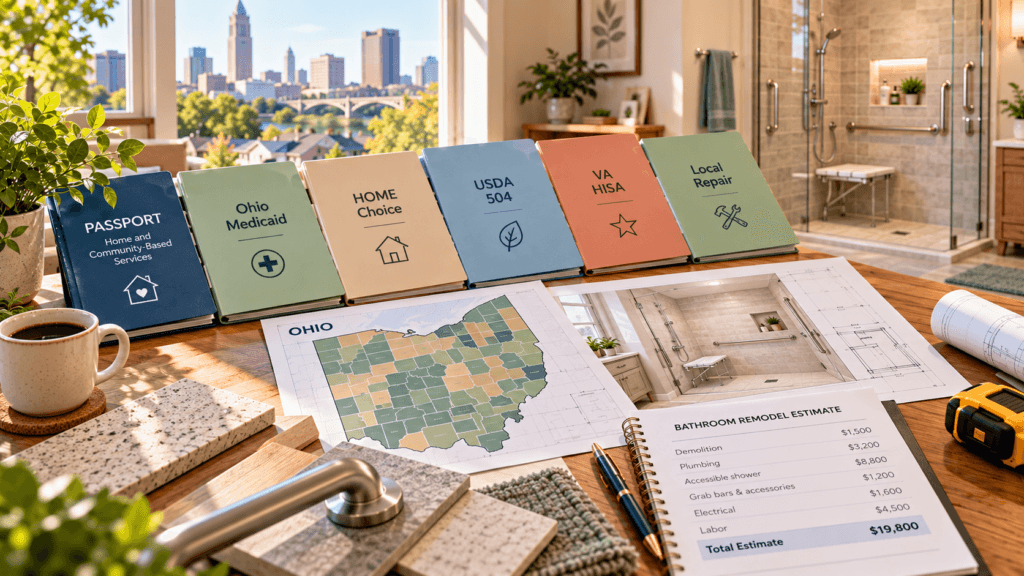
The key is to match the resident to the correct program and describe the functional barrier: inability to step over a tub wall, unsafe transfers, wheelchair clearance, lack of grab-bar support, inaccessible toilet or sink, or a plumbing/layout problem that prevents safe bathing.
Ohio programs at a glance
| Program / route | Who it may help | Bathroom-related help | How to start |
|---|---|---|---|
| PASSPORT / Medicaid HCBS home modification | Eligible older adults who need nursing-facility-level care but can remain in the community | Grab bars, bathroom modifications, doorway widening, specialized plumbing/electrical work | Local Area Agency on Aging / PASSPORT care manager |
| Ohio Home Care Waiver | Eligible Medicaid participants age 59 or younger with qualifying physical/medical needs | Home modification under Ohio Medicaid rules | Ohio Medicaid / waiver enrollment route |
| DODD IO / Level One waivers | Eligible people with developmental disabilities | Environmental accessibility adaptations, including bathroom changes | County board / service team |
| HOME Choice | Eligible Medicaid members moving out of qualifying long-term-care facilities | Home modifications as part of transition planning | HOME Choice application / transition staff |
| Older Americans Act home modification | Older adults where local AAA services and funds are available | Grab bars, accessibility and safety modifications | Area Agency on Aging |
| USDA Section 504 | Qualifying rural homeowners; grants generally age 62+ with very-low income | Health/safety repairs and accessibility work | USDA Rural Development |
| VA HISA | Eligible Veterans / Servicemembers with medical need | Roll-in showers, essential bathroom access, plumbing/electrical changes | VA Prosthetic & Sensory Aids Service |
1. PASSPORT and Ohio Medicaid home modification
Ohio’s Medicaid rules expressly recognize home modification as a service for qualifying nursing-facility-level-of-care HCBS programs, including PASSPORT.
The current statewide rule defines home modifications as environmental adaptations necessary for the individual’s health, welfare, safety or greater independence. It specifically lists:
- ramps and grab bars;
- widening doorways;
- modification of bathroom facilities;
- specialized electrical systems;
- specialized plumbing systems needed for approved medical or accessibility purposes.
The current rule sets a maximum of $15,000 per calendar year per individual for covered home modifications and requires the lowest-cost alternative that adequately meets the assessed need.
Ohio generally excludes additions that increase square footage, but the rule allows an exception when extra space is necessary to complete the adaptation—for example, to configure a bathroom for wheelchair use.
Home modification must be included in the person’s approved service plan. Do not sign a remodeling contract or start work before the administering agency or care manager confirms the approved scope.
Ohio Administrative Code Rule 5160-44-13
2. Ohio Home Care Waiver
The Ohio Home Care Waiver is operated by Ohio Medicaid for people with physical disabilities and unstable medical conditions who can receive services in the community instead of an institution.
Ohio Medicaid currently lists Home Modification among the waiver’s covered services. Current eligibility generally includes Medicaid eligibility, age 59 or younger, and nursing-facility level of care.
For a bathroom project, the important point is that the modification must be tied to assessed need and the person-centered plan rather than being a general renovation.
Ohio Medicaid — Ohio Home Care Waiver
3. DODD Environmental Accessibility Adaptations
Ohio’s Department of Developmental Disabilities uses the term Environmental Accessibility Adaptations under the Individual Options and Level One waivers.
The current rule, effective July 1, 2026, specifically includes:
- ramps;
- grab bars;
- widening doorways;
- modification of bathroom facilities;
- specialized electrical systems needed for medical equipment.
The individual’s team must determine that the change is necessary for community living, health and safety, or greater independence, and it must be included in the individual service plan.
General home improvements and unrelated homeowner responsibilities are excluded.
Ohio Administrative Code Rule 5123-9-23
4. HOME Choice for people leaving long-term care
Ohio HOME Choice helps eligible Ohioans move from a nursing facility, hospital or intermediate-care facility into a home- and community-based setting.
Current eligibility includes:
- being enrolled in Medicaid;
- being age 18 or older;
- currently living in a qualifying Ohio long-term-care facility for at least 60 consecutive days;
- having income or support sufficient for community living;
- participating in an assessment;
- having care needs that can safely be met in the community.
The current HOME Choice application lists Home Modifications among the services/supports relevant to transition planning.
This route is especially important when a person cannot safely return home until a bathroom, entrance or other essential area has been adapted.
5. Older Americans Act home-modification services
Ohio also permits home modification services through Area Agencies on Aging under Older Americans Act rules.
The current Ohio rule defines home modification to include:
- installing grab bars or devices that improve activities of daily living;
- changes to the home that improve health and safety;
- wheelchair ramps and other accessibility modifications;
- repair or replacement of a previously funded modification when another resource is unavailable.
Availability is local and depends on the Area Agency on Aging’s service plan, funding and whether another payer is responsible. This is not a guaranteed statewide “bathroom grant.”
Start by contacting the Area Agency on Aging that serves the resident’s county and ask specifically about home modification, grab-bar installation, fall-prevention work and minor home repair.
Ohio Department of Aging — Home Maintenance, Repair and Modification
6. USDA Section 504 in rural Ohio
USDA Rural Development’s Single Family Housing Repair Loans & Grants program is currently open, with applications accepted on an ongoing basis.
Current standard terms are:
- maximum loan: $40,000;
- maximum grant: $10,000;
- maximum combined assistance: $50,000;
- loan term: 20 years;
- fixed loan interest rate: 1%.
Applicants generally must own and occupy the home, live in an eligible rural area, meet income limits, and be unable to obtain affordable credit elsewhere. Grants are generally for homeowners age 62 or older with very-low income and must be used to remove health and safety hazards.
USDA Rural Development — Section 504
7. VA HISA for Ohio Veterans
Eligible Veterans and Servicemembers can use the federal Home Improvements and Structural Alterations (HISA) benefit for medically necessary changes to a primary residence.
VA currently lists eligible examples including:
- use of essential lavatory and sanitary facilities;
- roll-in or barrier-free showers;
- accessible bathroom sinks or counters;
- necessary plumbing changes;
- necessary electrical changes;
- widening doorways for access to essential bathroom facilities.
VA’s current HISA guidance specifically excludes spa, hot tub and Jacuzzi-style tubs. Approval should be obtained before work begins.
8. Columbus: Critical Home Repair and Chores
Critical Home Repair Program
The City of Columbus Critical Home Repair Program explicitly allows accessibility work such as custom ramps and handrails, widening doorways, modifying bathrooms for accessibility, installing grab bars and toilet-assist railings.
However, the City’s current program page states that the program is not accepting applications at this time. Do not treat it as an open grant today. The page and City intake line are worth monitoring because funding and intake can reopen.
City of Columbus — Critical Home Repair Program
Chores Program
Columbus’ Chores Program is active for smaller health-and-safety repairs. Current City rules require the applicant to be:
- age 60+ or physically disabled age 55+;
- a homeowner and City of Columbus resident;
- at or below 80% of HUD area median income;
- requesting work costing $2,000 or less, including labor and materials.
The City says repairs must be for the resident’s health or safety. This is more suitable for minor work such as grab bars or small accessibility repairs than a full bathroom reconstruction.
City of Columbus — Chores Program
9. Cleveland: SHAP and Age-Friendly Home Investment
Senior Homeowner Assistance Program (SHAP)
Cleveland’s Senior Homeowner Assistance Program provides repair grants for eligible low-income senior and disabled owner-occupants. The City currently lists Handicap Accessibility as an eligible single-project repair category.
Current City guidance says applicants must own and occupy a one- or two-family Cleveland home and meet the program’s income rules. The City describes SHAP as a rolling program, subject to available funding.
City of Cleveland — Home Repair / SHAP
Age-Friendly Home Investment Program
The 2026 Age-Friendly Home Investment Program is aimed at Cleveland homeowners age 60+ and adults age 18–59 receiving disability who meet the program’s income and property rules. It can fund one major home repair, with limited funds available by ward.
This program is most relevant when the bathroom issue is tied to major plumbing, electrical, steps, ramp or another critical repair rather than a cosmetic remodel.
Cleveland Department of Aging — Home Maintenance & Repairs
10. Cincinnati: Housing Repair Services
Cincinnati’s Housing Repair Services (HRS) program uses City grant funding administered through People Working Cooperatively.
The City’s current page specifically lists:
- grab-bar installation;
- electric lifts;
- wheelchair ramps;
- step repairs;
- other critical home repairs.
Current eligibility includes owner occupancy, a qualifying property, repair scope within program limits, no foreclosure, and income generally at or below 50% AMI.
For HRS, the City directs applicants to People Working Cooperatively as the intake/clearinghouse.
City of Cincinnati — Housing Resources
Which Ohio route should you check first?
| Your situation | Start here |
|---|---|
| Older adult who may qualify for Medicaid HCBS | PASSPORT / Area Agency on Aging |
| Ohio Home Care Waiver participant or applicant | Ohio Medicaid / waiver case manager |
| Person with I/DD on an eligible waiver | County board / DODD team |
| Moving out of a nursing facility or other qualifying institution | HOME Choice |
| Older adult seeking smaller safety modifications | Area Agency on Aging / Older Americans Act services |
| Rural homeowner age 62+ with very-low income | USDA Section 504 |
| Veteran with medically necessary bathroom need | VA HISA |
| Columbus resident needing minor work | Chores Program |
| Columbus resident needing major accessibility repair | Monitor Critical Home Repair intake |
| Cleveland senior or disabled homeowner | SHAP / Age-Friendly Home Investment |
| Cincinnati low-income homeowner | Housing Repair Services / People Working Cooperatively |
What bathroom work may qualify?
Depending on the program and assessed need, possible work can include:
- grab bars and handrails;
- bathroom-facility modifications;
- doorway widening;
- wheelchair clearance;
- accessible shower changes;
- toilet-assist rails;
- plumbing needed for an approved accessibility project;
- electrical work tied to approved medical or accessibility equipment.
Programs normally fund the least-cost appropriate solution, not a preferred brand or luxury fixture.
Describe the barrier, not the product
Less useful:
“I want a free walk-in tub.”
Better:
“The resident cannot safely step over the existing tub wall and needs a lower-entry bathing solution, stable support and enough room for transfers.”
This lets the assessor determine whether the right solution is a shower conversion, grab bars, doorway work, a transfer aid, plumbing changes or another modification.
Documents to gather before applying
- photo ID;
- proof of Ohio residency;
- proof of age;
- Medicaid/waiver information where applicable;
- proof of disability or medical need where required;
- household income documentation;
- proof of ownership or lease;
- landlord permission where a program allows rental-property modifications;
- photos and measurements of the bathroom;
- OT, PT, physician or care-plan documentation when requested;
- contractor estimates only when the program instructs you to obtain them;
- Veteran documentation for HISA.
Do not begin construction before approval
Ohio Medicaid waivers, DODD services, HOME Choice, USDA, VA and local repair programs can require assessment, authorization, bids, approved contractors or a written scope of work before construction.
If you are relying on program funding, assume that work started before written authorization may not be reimbursed.
Red flags in Ohio “free bathroom” ads
- The ad claims every Ohio senior qualifies.
- It refers vaguely to an “SSA senior bathroom assistance program” without naming an actual SSA program.
- It suggests Social Security retirement, SSDI or SSI automatically pays for bathroom remodeling.
- It does not name the Ohio agency, city, Medicaid waiver, USDA or VA program providing the funds.
- The “grant” turns out to be financing or a lead-generation form.
- A salesperson promises a specific tub before eligibility or medical need is assessed.
- You are told to start construction before the administering agency approves the project.
Does Social Security pay for bathroom remodeling in Ohio?
Not through a universal SSA remodeling grant. Social Security retirement, SSDI and SSI are benefit programs, not Ohio bathroom-renovation programs.
SSA has work-incentive rules that can affect how certain impairment-related expenses are treated when calculating earnings or benefits, but those rules are not a general grant for an accessible bathroom. SSA specifically says interior residential modifications are not deductible as IRWE for a person employed outside the home.
For actual Ohio funding, use the program routes on this page: Ohio Medicaid HCBS home modification, Area Agency on Aging services, HOME Choice, USDA Section 504, VA HISA and applicable city repair programs.
Related guides
- Bathroom Accessibility Grants by State
- Bathroom Remodel Cost & Financing
- Walk-In Tub Cost 2026
- Walk-In Tub vs Walk-In Shower
- Walk-In Tub Buying Guide
Official sources
- Social Security Administration — Benefit Types
- Social Security Administration — Residential Modifications / IRWE
- Ohio Administrative Code — Medicaid Home Modification
- Ohio Medicaid — Ohio Home Care Waiver
- Ohio Administrative Code — Environmental Accessibility Adaptations
- Ohio Medicaid — HOME Choice
- Ohio Department of Aging — Home Maintenance, Repair and Modification
- City of Columbus — Critical Home Repair Program
- City of Columbus — Chores Program
- City of Cleveland — Home Repair / SHAP
- City of Cincinnati — Housing Repair Services
- USDA Rural Development — Section 504 Home Repair
- VA — HISA
Accessible Bath Advisor is an independent educational publication. Program availability, funding and local intake can change. Always confirm eligibility and current application status with the administering agency before spending money or beginning work.