If you receive Social Security retirement benefits, SSDI or SSI, do not assume that the Social Security Administration (SSA) will pay for a walk-in tub, accessible shower or bathroom remodel.
SSA administers retirement, disability and Supplemental Security Income benefits primarily as monthly payments. It does not operate a general home-modification or “senior bathroom assistance” grant program.
SSA does have separate Impairment-Related Work Expense (IRWE) rules for certain disability-related costs connected to employment. Those rules are not a bathroom-remodel grant. SSA’s own policy says that, for a person who works outside the home, interior residential modifications such as changes to bathroom facilities are not deductible as IRWE.
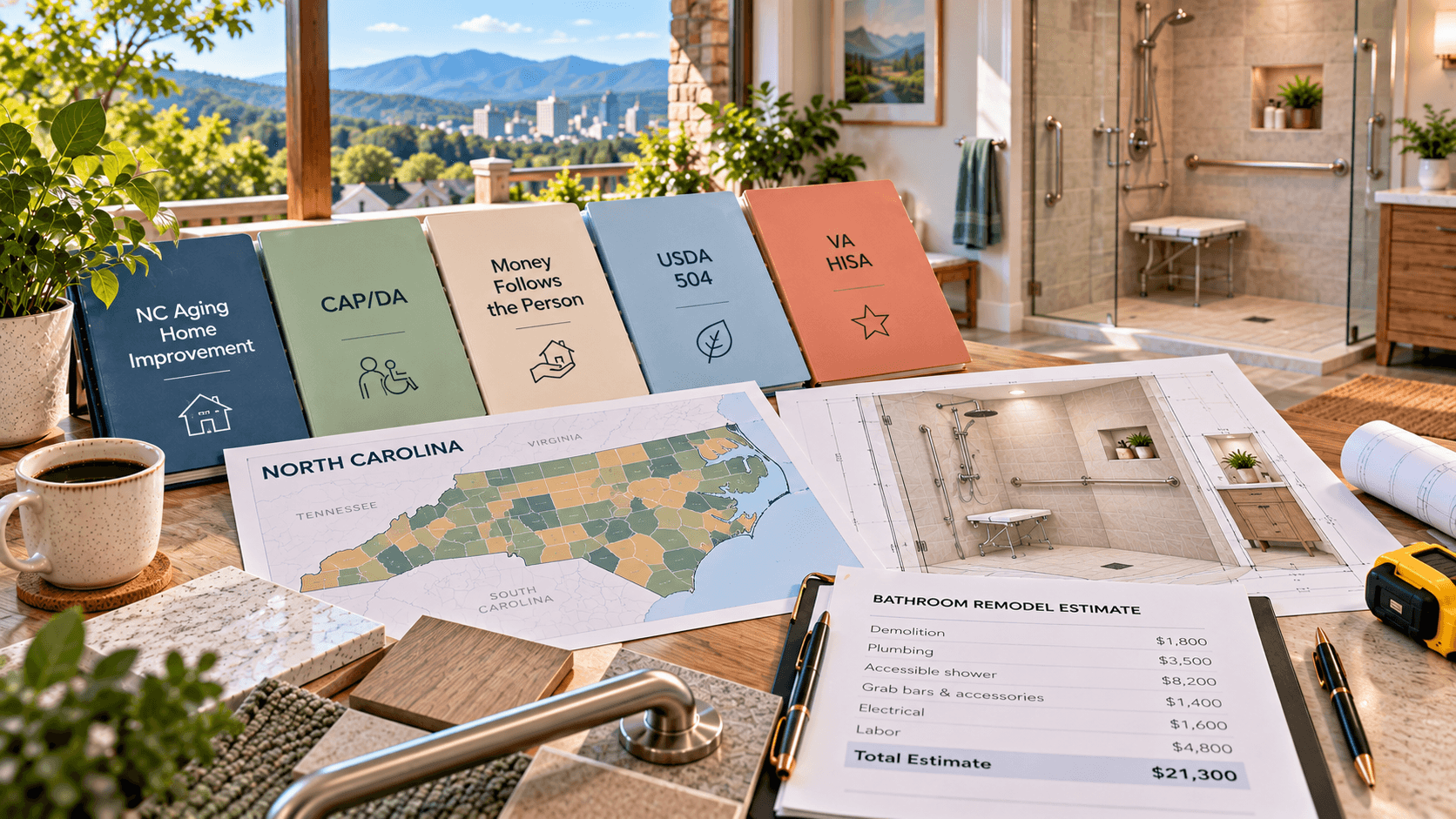
For real bathroom-modification assistance in North Carolina, check the state and local programs below instead: NC Medicaid CAP/DA, NC Division of Aging Housing and Home Improvement Assistance, the North Carolina Housing Finance Agency Urgent Repair Program, eligible Medicaid transition programs, USDA Rural Development and VA benefits where applicable.
See the benefit types administered by Social Security and SSA’s official residential-modification rules.
Rechecked against current Social Security Administration, NC Medicaid, NC Division of Aging and North Carolina Housing Finance Agency sources. Social Security does not operate a universal bathroom-remodel grant; North Carolina assistance comes through separate Medicaid, aging, housing, rural and Veteran programs.
North Carolina has several strong programs for bathroom accessibility, but they sit in different systems: Medicaid waivers, aging services, housing repair, rural development, Veteran benefits, and community-transition programs.
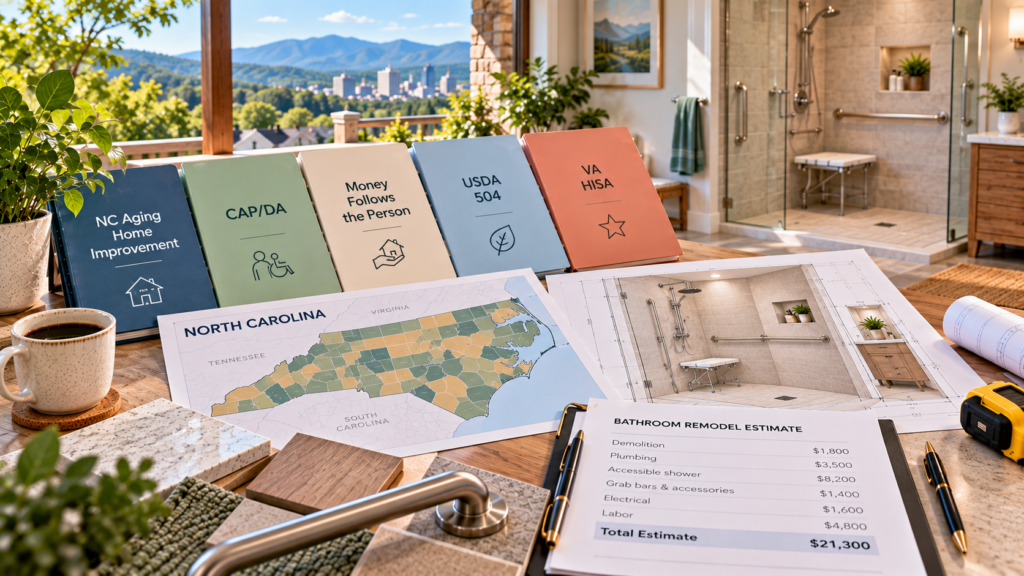
The most important step is to describe the functional barrier. For example: the resident cannot step over the tub, needs stable support for transfers, needs enough space for a walker or wheelchair, or cannot safely use the toilet or sink. Programs are more likely to fund a modification when it is clearly tied to health, safety, independence, or avoiding institutional care.
North Carolina programs at a glance
| Program / route | Who it may help | Bathroom-related help | How to start |
|---|---|---|---|
| CAP/DA Medicaid | Eligible disabled adults who need HCBS instead of institutional care | Grab bars, bathroom modifications, toilet/shower/tub/sink changes, doorway widening, plumbing | CAP/DA case-management entity |
| Housing & Home Improvement Assistance | Adults age 60+ in participating counties | Mobility/accessibility improvements and minor repairs | Local aging/home-repair provider |
| Urgent Repair Program | Low-income homeowners with special needs | Accessibility modifications and emergency repairs | Local government or nonprofit partner |
| Money Follows the Person | Eligible Medicaid members moving from facilities into community housing | Accessibility modifications as part of transition support | NC Medicaid transition team |
| NC Innovations / CAP/C | Eligible waiver participants with developmental or pediatric needs | Home modifications / home accessibility and adaptation | Waiver care manager |
| USDA Section 504 | Qualifying rural homeowners; grants generally age 62+ with very-low income | Health/safety repairs and accessibility work | USDA Rural Development North Carolina |
| VA HISA | Eligible Veterans / Servicemembers with medical need | Roll-in showers, essential bathroom access, plumbing/electrical changes | Local VA Prosthetic & Sensory Aids Service |
1. CAP/DA Medicaid home modifications
North Carolina’s Community Alternatives Program for Disabled Adults (CAP/DA) is one of the strongest bathroom-accessibility routes in the state.
The current CAP/DA waiver includes equipment, modification and technology services designed to help eligible adults remain in the community instead of entering or remaining in institutional care.
What bathroom work can CAP/DA cover?
North Carolina Medicaid policy specifically recognizes accessibility work such as:
- grab bars and safety rails;
- widening doorways or passages for wheelchair/walker access;
- bathroom-facility modifications;
- toilet, shower and tub modifications;
- handheld showers;
- sink and faucet-control changes;
- plumbing modifications;
- changes needed for turnaround space.
The modification must be medically and functionally justified, approved in the service plan, and handled through the required assessment and contractor process.
CAP/DA requires an approved service plan and contractor process. Work completed before authorization can be ineligible for Medicaid payment.
2. Housing and Home Improvement Assistance for adults age 60+
The North Carolina Division of Aging operates Housing and Home Improvement Assistance through local service providers supported by the Home and Community Care Block Grant.
The program can provide minor repairs in owner- and renter-occupied homes; rental homes require written landlord permission.
What categories can be funded?
- security enhancements;
- minor home repairs;
- mobility and accessibility improvements;
- basic household furnishings or appliance repair/replacement.
Local agencies choose which categories they provide, so bathroom help is not identical in every county.
Who qualifies?
- age 60 or older;
- no one able and willing to perform the service for them;
- residence in a county where the service is funded.
North Carolina currently limits this assistance to no more than $7,000 per person per program year, making it better suited to modest accessibility work than a luxury reconstruction.
3. North Carolina Urgent Repair Program
The Urgent Repair Program (URP) is administered by the North Carolina Housing Finance Agency through local governments, regional organizations and nonprofit partners.
It is designed for very-low-income homeowners with special needs whose homes have urgent safety problems. The program can also fund accessibility modifications that allow someone to remain at home after injury or serious illness.
Who is it aimed at?
- households with a full-time member who is elderly, disabled, a Veteran, or otherwise meets the program’s special-needs criteria;
- household income at or below 50% of Area Median Income.
Current program materials allow local partners to provide deferred, forgiven loans of up to $15,000 per household for eligible repairs and modifications. Homeowners apply through participating local organizations rather than receiving cash directly from NCHFA.
4. Money Follows the Person
Money Follows the Person (MFP) helps eligible Medicaid beneficiaries move from hospitals, nursing homes or disability-care facilities into homes in the community.
North Carolina currently lists transition help that can include home changes such as ramps and other accessibility modifications, along with one-time transition items and services.
Basic eligibility
- have lived in a qualifying facility for at least 60 days;
- be eligible for community-based Medicaid;
- be approved for HCBS;
- move to a qualifying home or community residence.
This route matters when a bathroom or entry must be adapted before someone can safely move home.
5. CAP/C home accessibility and adaptation
North Carolina’s Community Alternatives Program for Children (CAP/C) includes Home Accessibility and Adaptation for eligible children. It can cover equipment, physical adaptations or minor modifications intended to improve mobility, safety and independence in the primary residence.
6. NC Innovations Waiver
The NC Innovations Waiver includes Home Modifications for eligible people with intellectual or developmental disabilities.
NC Medicaid describes these as physical changes that make the home safer and easier to move around, such as widening doorways and installing ramps. Bathroom changes can also be considered when they are necessary to make the home usable for the participant.
7. USDA Section 504 in rural North Carolina
USDA Rural Development’s Single Family Housing Repair Loans & Grants program is currently open in North Carolina, with applications accepted on an ongoing basis.
- maximum loan: $40,000;
- maximum grant: $10,000;
- maximum combined assistance: $50,000;
- loan term: 20 years;
- fixed interest rate: 1%.
Who can qualify?
- own and occupy the home;
- live in an eligible rural area;
- meet income limits;
- be unable to obtain affordable credit elsewhere;
- and, for grants, generally be age 62+ with very-low income.
Loans can repair, improve or modernize a home; grants are focused on removing health and safety hazards.
8. VA HISA for North Carolina Veterans
Eligible North Carolina Veterans and Servicemembers can use the federal Home Improvements and Structural Alterations (HISA) benefit for medically necessary home changes.
- roll-in showers;
- essential lavatory and sanitary access;
- accessible sinks or counters;
- necessary plumbing changes;
- necessary electrical changes.
HISA is not a general luxury-bathroom benefit, and approval should be obtained before work begins.
9. Local programs matter in North Carolina
Both Housing and Home Improvement Assistance and the Urgent Repair Program are delivered locally. Useful contacts can include Area Agencies on Aging, county aging departments, regional councils of government, municipal housing departments, community action agencies, nonprofit housing-repair organizations and Centers for Independent Living.
Which North Carolina route should you check first?
| Your situation | Start here |
|---|---|
| Disabled adult on Medicaid who needs HCBS | CAP/DA |
| Adult age 60+ needing modest accessibility work | Housing and Home Improvement Assistance |
| Low-income homeowner with urgent safety/accessibility problem | Urgent Repair Program |
| Moving out of a nursing home or institution | Money Follows the Person |
| Child with CAP/C waiver | CAP/C Home Accessibility and Adaptation |
| Person with I/DD on Innovations Waiver | NC Innovations Home Modifications |
| Rural homeowner age 62+ with very-low income | USDA Section 504 |
| Veteran with medically necessary bathroom need | VA HISA |
What bathroom work may qualify?
- grab bars;
- handrails and safety rails;
- doorway widening;
- bathroom-facility modification;
- toilet modifications;
- shower and tub modifications;
- handheld showers;
- sink and faucet controls;
- plumbing changes;
- wheelchair turnaround space;
- urgent floor or structural repairs tied to safety.
Describe the barrier, not the product
Less useful:
“I need a walk-in tub.”
Better:
“The resident cannot safely step over the existing bathtub wall and needs a lower-entry bathing solution with stable support and enough room for transfers.”
This allows the case manager or housing provider to choose the least-cost solution that actually addresses the need.
Documents to gather before applying
- photo ID;
- proof of North Carolina residency;
- proof of age;
- proof of disability or medical need where applicable;
- Medicaid and waiver information;
- proof of income;
- proof of homeownership or lease;
- landlord permission where required;
- photos of the current bathroom;
- bathroom and doorway measurements;
- medical, nursing, OT or PT recommendations when required;
- contractor estimates if requested;
- Veteran documentation if applying for HISA.
Do not begin construction before approval
CAP/DA, CAP/C, Innovations, MFP, USDA, VA and local housing programs can require assessment, bids, prior authorization or an approved scope of work.
If you are relying on program funding, assume that work started before authorization may not be reimbursed.
Homeowners vs renters in North Carolina
USDA and the Urgent Repair Program are primarily homeowner routes.
North Carolina’s aging home-improvement services can be available in renter-occupied homes with written landlord permission. CAP/DA can also allow certain modifications in rental property when they are portable or permitted by the owner.
North Carolina application checklist
- Identify the unsafe bathroom movement.
- If the resident receives Medicaid HCBS, contact the case manager first.
- If age 60+, ask the local aging provider about Housing and Home Improvement Assistance.
- If the homeowner has very low income and urgent repair needs, ask about the Urgent Repair Program.
- If transitioning from a facility, ask about Money Follows the Person.
- If rural, check USDA eligibility.
- If a Veteran, contact VA HISA.
- Get professional assessments or contractor bids only when the program requests them.
- Separate accessibility work from cosmetic remodeling.
- Wait for written approval before construction.
Red flags in North Carolina “free bathroom” ads
- The ad claims every North Carolina senior qualifies.
- It refers vaguely to “Social Security bathroom grants” without naming an actual SSA program.
- It does not name CAP/DA, NC Aging, NCHFA, USDA, VA or another real program.
- The “grant” is actually a financing product.
- The salesperson promises a specific tub before any assessment.
- You are pressured to sign before eligibility is confirmed.
- The website uses official-looking seals but is only collecting private leads.
Frequently asked questions
Does Social Security pay for bathroom remodeling in North Carolina?
Not through a universal SSA remodeling grant. Social Security retirement, SSDI and SSI are benefit programs, not North Carolina bathroom-renovation programs. SSA has work-incentive rules for certain disability-related expenses, but those rules should not be confused with funding for a general accessible bathroom remodel.
For actual home-modification assistance in North Carolina, check programs such as CAP/DA Medicaid, Housing and Home Improvement Assistance, the Urgent Repair Program, USDA Section 504 and VA HISA if you meet their specific eligibility rules.
Is there one North Carolina grant for every senior who needs a safer bathroom?
No. Eligibility depends on the program. Age, disability, Medicaid status, income, homeownership, rural location, Veteran status and local funding can all matter.
Can a North Carolina program pay for a walk-in tub?
Possibly, but do not assume a specific product is covered. Programs generally evaluate the functional barrier and may approve the least-cost modification that solves the safety or accessibility need. A lower-entry shower, grab bars, transfer equipment or another adaptation may be preferred.
Where should a North Carolina senior start?
If the person receives Medicaid HCBS, start with the case manager. Otherwise, adults age 60+ should contact the local aging/home-improvement provider, and very-low-income homeowners with urgent safety issues should check the Urgent Repair Program partner serving their county.
Related North Carolina bathroom-planning guides
- Bathroom Accessibility Grants by State
- Bathroom Remodel Cost & Financing
- Walk-In Tub Buying Guide
- Walk-In Tub vs Walk-In Shower
Official sources
- Social Security Administration — Benefit Types
- Social Security Administration — Residential Modifications and IRWE Rules
- NC Medicaid — CAP/DA
- NC Division of Aging — Housing and Home Improvement Assistance
- North Carolina Housing Finance Agency — Urgent Repair Program
- NC Medicaid — Money Follows the Person
- NC Medicaid — Innovations Waiver Services
- USDA Rural Development — Section 504 in North Carolina
- VA — Home Improvements and Structural Alterations (HISA)
Program availability, local funding, service areas and application windows can change. Confirm current eligibility and intake with the responsible agency before starting work or relying on a quoted benefit.