Verified against Texas Health and Human Services, USDA Rural Development, VA, City of Austin, and City of Houston sources current in October 2026. Local funding and application windows can change.
Texas has a large number of home-repair and long-term-care programs, but there is no single website where an older adult can type “bathroom grant” and immediately see every option.
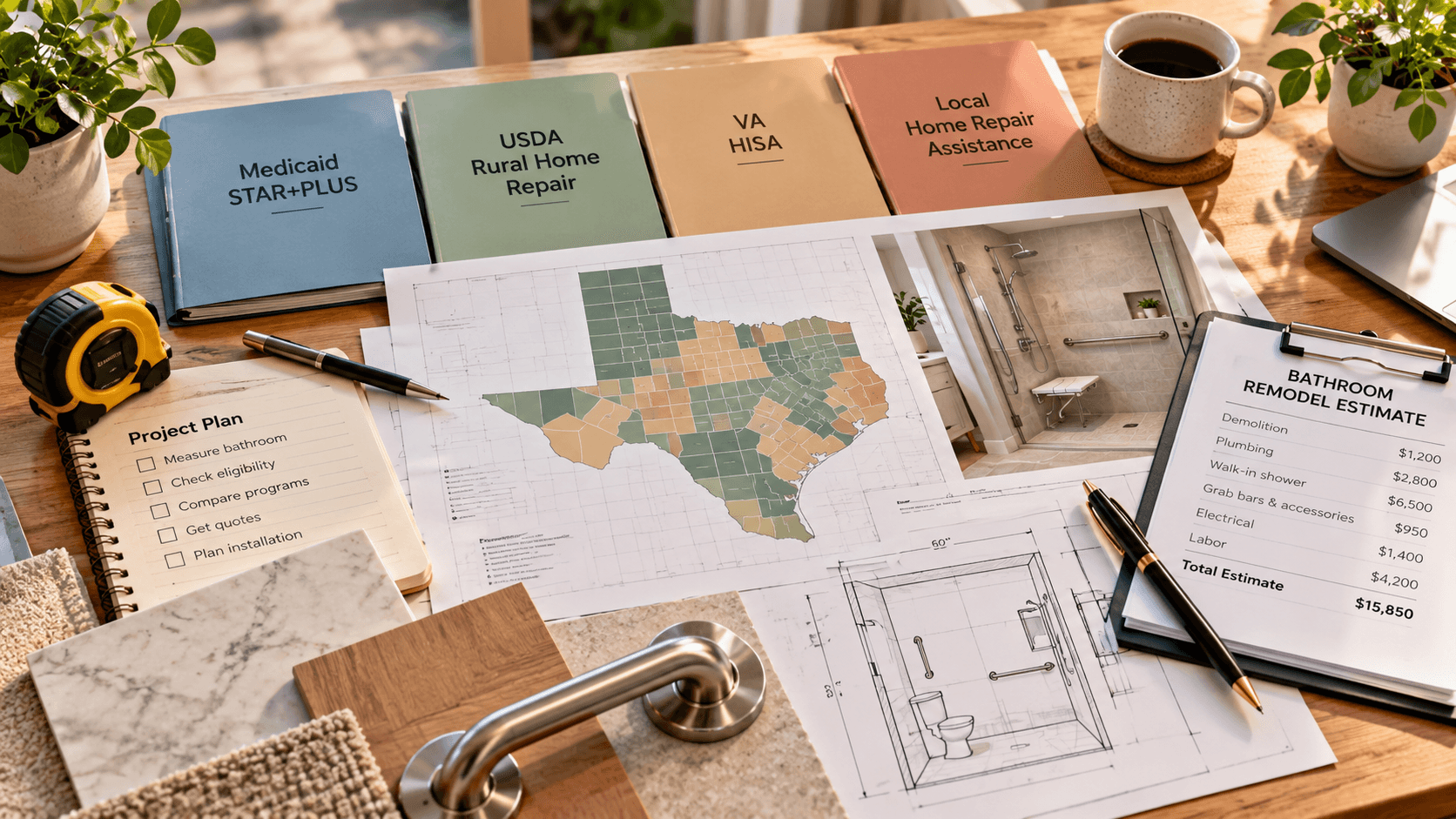
The most useful programs are spread across Medicaid, aging services, disability services, rural housing programs, Veteran benefits, and city housing departments. Some can help with very specific accessibility work such as grab bars, doorway widening, bathtub modifications, accessible showers, faucet controls, or plumbing changes. Others are broader home-repair programs that may help only if the bathroom work is part of an approved health, safety, accessibility, or disaster-recovery project.
This guide separates those routes and shows which Texas programs are worth checking first.
Texas programs at a glance
| Program / route | Who it may help | Bathroom-related help | How to start |
|---|---|---|---|
| STAR+PLUS HCBS Minor Home Modifications | Eligible Medicaid members who meet STAR+PLUS HCBS criteria | Accessible showers, bathtub/toilet/sink modifications, grab bars, doorway widening, plumbing changes | STAR+PLUS service coordinator / managed care plan |
| Texas ADRCs / AAAs | Older adults, people with disabilities, caregivers | Local referrals, long-term-care programs, aging resources | Call 855-937-2372 or 800-252-9240 |
| Independent Living Services | Eligible Texans with disabilities | Home modifications such as grab bars, ramps, stair lifts and other independence-related changes | Local Center for Independent Living / HHS referral |
| USDA Section 504 | Qualifying rural homeowners; grants generally for age 62+ with very-low income | Health and safety repairs, including accessibility improvements | USDA Rural Development Texas |
| VA HISA | Eligible Veterans / Servicemembers with medical need | Roll-in showers, bathroom access, necessary plumbing/electrical changes | Local VA Prosthetic & Sensory Aids Service |
| Austin home-repair programs | Income-eligible Austin homeowners | Safety modifications, accessibility work, plumbing/electrical repairs | Austin Housing |
| Houston home-repair / disaster recovery | Eligible Houston homeowners, depending on active program | Health/safety repairs; disaster-related rehabilitation or reconstruction | Houston Housing & Community Development |
1. STAR+PLUS: the most important statewide Medicaid route
Texas Health and Human Services describes STAR+PLUS as a Medicaid managed care program for adults with disabilities and adults age 65 or older. In addition to health coverage, STAR+PLUS can provide long-term services and supports designed to help members remain in the community.
For eligible members enrolled in the STAR+PLUS Home and Community Based Services program, one of the covered service categories is Minor Home Modifications.
What counts as a minor home modification?
Texas HHS defines these modifications as physical adaptations required by the member’s service plan and needed to protect health, welfare, safety, or greater independence at home.
The state handbook specifically includes:
- ramps;
- grab bars;
- doorway widening;
- bathroom-facility modifications;
- specialized electrical work;
- specialized plumbing systems required for approved accessibility or medical needs.
Bathroom modifications are explicitly listed
The STAR+PLUS handbook is unusually detailed. Under accessible bathroom facilities, it includes:
- wheelchair-accessible showers;
- sink modifications;
- bathtub modifications;
- toilet modifications;
- water-faucet controls;
- floor urinal and bidet adaptations;
- plumbing modifications needed for accessibility adaptations;
- turnaround-space modifications.
This makes STAR+PLUS one of the clearest Texas funding routes for a bathroom modification when the person already qualifies for the waiver and the adaptation is supported by the service plan.
What STAR+PLUS will not treat as accessibility work
Texas excludes general home improvements that are not directly tied to the member’s medical or remedial need.
Examples of items that cannot normally be approved as minor home modifications include:
- routine roof replacement;
- ordinary house painting;
- general landscaping;
- normal maintenance repairs;
- home additions that increase total square footage;
- luxury or unrelated improvements.
The key question is not whether the bathroom would look better. It is whether the modification is necessary for safe function, independence, or prevention of institutional placement.
How to ask STAR+PLUS about a bathroom project
Do not ask only:
“Will STAR+PLUS buy me a walk-in tub?”
Instead say:
“I need to know whether my service plan can authorize a minor home modification for safer bathing and transfers. The current bathroom is difficult to use because of the bathtub threshold and lack of stable support.”
Then ask:
- Does the modification need an occupational-therapy evaluation?
- Does it need prior authorization?
- Which contractors are approved?
- Is there a program cost limit?
- Can the member contribute if the project exceeds the limit?
- What warranty must the contractor provide?
- Can work begin before written approval?
STAR+PLUS minor home modifications are part of an approved service plan. Starting work before the managed care organization authorizes it can make the project ineligible.
2. Aging and Disability Resource Centers (ADRCs)
For Texans who do not know which program applies, an Aging and Disability Resource Center is one of the best first calls.
Texas ADRCs help older adults and people with disabilities find long-term-care services and community resources. The state currently lists ADRCs serving counties across Texas and provides a statewide toll-free number:
855-937-2372
ADRC staff can help identify:
- Medicaid long-term-care options;
- STAR+PLUS resources;
- Area Agency on Aging services;
- Centers for Independent Living;
- local nonprofit repair programs;
- caregiver resources;
- community-based services.
3. Area Agencies on Aging in Texas
Texas Area Agencies on Aging serve people age 60 and older and their caregivers.
Texas HHS currently directs older Texans to call:
800-252-9240
AAAs do not all operate the same home-modification programs, but they are useful because they know what is active locally.
When calling, ask specifically about:
- home safety;
- fall prevention;
- minor home repair;
- grab-bar programs;
- accessibility modifications;
- city/county housing rehabilitation;
- local nonprofit repair partners;
- Texas Ramp Project or similar volunteer programs;
- Centers for Independent Living.
4. Texas Independent Living Services
Texas Health and Human Services also supports Independent Living Services for eligible people with disabilities.
Purchased services can include home modifications designed to increase independence. Texas specifically lists examples such as:
- wheelchair ramps;
- environmental control units;
- stair lifts;
- grab bars;
- other disability-related modifications.
These services are typically connected to Centers for Independent Living and may use a sliding-scale fee based on income.
This is important for people who do not fit an age-based senior program but have a disability that creates a clear accessibility barrier at home.
5. USDA Section 504 in rural Texas
USDA Rural Development operates the Single Family Housing Repair Loans & Grants program in Texas.
The program is open to qualifying homeowners in eligible rural areas and is designed to repair, improve, or modernize homes and remove health and safety hazards.
Current Texas program terms include:
- maximum loan: $40,000;
- maximum grant: $10,000;
- maximum combined assistance: $50,000;
- loan term: 20 years;
- fixed loan rate: 1%;
- grant eligibility generally requiring the homeowner to be 62 or older and very-low-income.
Applicants must own and occupy the home and be unable to obtain affordable credit elsewhere. Income limits vary by county.
Can Section 504 help with accessibility?
Yes. USDA’s 2026 program guidance specifically describes grants as being available to remove health and safety hazards and gives accessibility improvements such as wheelchair ramps and walk-in tubs as examples of how Section 504 funds may be used.
That does not mean every walk-in tub is automatically approved. The project still has to meet USDA eligibility and program requirements.
Texas USDA contact
USDA Rural Development’s Texas office currently lists the Housing Program Staff phone number as:
254-742-9770
6. VA HISA for Texas Veterans
Texas Veterans can also use the federal Home Improvements and Structural Alterations (HISA) benefit if they meet VA eligibility and the modification is medically necessary.
VA says HISA can support:
- access to essential bathroom and sanitary facilities;
- roll-in showers;
- accessible bathroom sinks or counters;
- necessary plumbing or electrical changes related to approved medical equipment.
The current HISA lifetime benefit is up to $6,800 in certain qualifying service-connected circumstances, with lower limits in some other cases.
VA does not treat spas, hot tubs, or Jacuzzi-type upgrades as eligible HISA projects.
7. Austin: one of the strongest local Texas examples
Austin currently has several home-repair programs for income-eligible homeowners.
Austin Housing says its repair programs are designed to help residents remain safely in their homes and include both repair and modification programs.
Safety Repairs and Modifications
Austin’s current program page says eligible households may receive up to $20,000 in grant funds for repairs and safety modifications. Household income generally must be at or below 80% of Median Family Income.
Examples can include:
- wheelchair ramps;
- handrails;
- plumbing repairs;
- electrical repairs;
- mechanical repairs;
- other safety modifications.
GO REPAIR! Grant Program
Austin also operates the GO REPAIR! program, which provides grants of up to $20,000 for serious structural and safety issues for eligible low-income homeowners.
The city states that the program also makes homes more accessible for homeowners with disabilities.
Minor Home Repair Grant
Austin’s Minor Home Repair Grant can provide up to $7,500 for repairs that pose an immediate threat to health and safety.
This program is more focused on urgent repair conditions than accessibility alone, but it can still be relevant when a bathroom hazard is part of a larger health-and-safety problem.
Architectural Barrier Removal
In August 2026 the Austin Housing Finance Corporation announced approximately $1.19 million in funding for the Architectural Barrier Removal Program. The city sought nonprofit organizations and contractors to provide home modifications for eligible low-income elderly and disabled homeowners, with the contract period extending through September 30, 2027.
This is a particularly important signal that Austin continues to fund accessibility-specific home modification work rather than only general repairs.
8. Houston home-repair programs
Houston has historically operated broad home-repair programs for low- and moderate-income homeowners. The city’s general Single-Family Home Repair Program prioritizes health and safety repairs and gives consideration to households with people age 62+, children, and people with disabilities.
However, Houston’s program status changes frequently as funding is exhausted or new disaster-recovery programs open.
As of October 2026:
- the regular Home Repair Program page states that prior funding has been exhausted and the program is closed to new intake;
- Houston’s DR24 Single-Family Home Repair Program is operating for eligible homes damaged by the May 2024 Derecho or Hurricane Beryl;
- priority processing through December 31, 2026 is being given to income-eligible households that include someone age 62+, a person with a disability, or a disabled Veteran;
- eligible home-repair assistance under DR24 can reach up to $100,000, with reconstruction assistance higher where applicable.
This is not a general bathroom-accessibility grant. It is a disaster-recovery program. But if the bathroom is part of an eligible damaged property, the broader rehabilitation may restore safe and accessible living conditions.
9. Other Texas Medicaid home-modification routes
STAR+PLUS is not the only Texas Medicaid program that uses minor home modifications.
Texas HHS also lists minor home modifications within programs such as:
- Medically Dependent Children Program (MDCP);
- Texas Home Living (TxHmL);
- other disability-focused waiver programs.
For example, the STAR Kids handbook for MDCP specifically includes doorway widening, bathroom-facility modification, and work related to approved ramps, doorways, and bathroom facilities. It also states that luxury materials such as granite, marble, and high-end fixtures are excluded.
These routes are population-specific, so the right question is which waiver or Medicaid program the person is enrolled in.
Which Texas route should you check first?
| Your situation | Start here |
|---|---|
| Age 65+ or disabled and on Medicaid | STAR+PLUS / service coordinator |
| Older adult and not sure what applies | Area Agency on Aging |
| Disability-related need but not age-based | ADRC / Independent Living Services |
| Rural homeowner age 62+ with very-low income | USDA Section 504 |
| Veteran with medically necessary bathroom need | VA HISA |
| Austin homeowner with low/moderate income | Austin Housing home-repair programs |
| Houston home damaged by 2024 Derecho/Beryl | Houston DR24 Single-Family Home Repair Program |
| Still unsure | Texas ADRC: 855-937-2372 |
What bathroom work should you describe?
As with California, describe the accessibility problem rather than beginning with a product.
Less useful:
“I need a walk-in tub.”
More useful:
“The resident cannot safely cross the existing tub wall and needs a lower-entry bathing arrangement, seated bathing, stable grab support, and enough space for transfers.”
That allows the program to determine whether the appropriate modification is:
- grab bars;
- a bathtub modification;
- a transfer bench;
- a wheelchair-accessible shower;
- an accessible sink;
- a toilet modification;
- doorway widening;
- a different bathing configuration.
Documents to gather before applying
Texas programs vary, but it helps to prepare:
- photo ID;
- proof of age;
- proof of disability or medical need where relevant;
- Medicaid identification;
- STAR+PLUS plan information;
- proof of income;
- proof of homeownership or lease;
- landlord approval where required;
- photos of the bathroom;
- measurements of doors, tub/shower, and clear floor space;
- occupational-therapy or medical recommendations;
- contractor estimates if requested;
- Veteran documentation if using VA benefits.
Texas application checklist
- Identify the movement or transfer that is unsafe.
- If the resident has Medicaid, ask which waiver or managed-care program applies.
- If STAR+PLUS HCBS applies, request review for a minor home modification.
- Call the local ADRC or AAA for local-program referrals.
- If the resident has a disability, ask about Independent Living Services.
- If rural, check USDA property and income eligibility.
- If a Veteran, contact VA HISA before signing a remodeling contract.
- Check city and county housing departments for active repair funds.
- Separate required accessibility work from cosmetic upgrades.
- Do not begin work until required authorization is in writing.
Red flags in Texas “free bathroom remodel” ads
- The ad says “Texas seniors get free bathrooms” but never names the program.
- The website claims every Medicaid member qualifies.
- The company promises a walk-in tub before an eligibility assessment.
- The offer is really a financing plan.
- A salesperson says Medicare will automatically reimburse the project.
- The company wants a same-day contract before benefit approval.
- The ad uses government logos but links only to a private lead form.
Real programs can be complicated, but they should have an identifiable administering agency and written rules.
Related Texas bathroom-planning guides
- Bathroom Accessibility Grants by State — national funding overview and state directory.
- Bathroom Remodel Cost & Financing 2026 — Medicare, Medicaid, VA, USDA, and financing routes.
- Bathroom Safety for Seniors — identify which modifications actually solve the problem.
- Walk-In Tub Cost 2026 — understand the installed project cost before applying for help.
- Walk-In Tub Buying Guide — compare products only after accessibility needs are clear.
Frequently asked questions
Does Texas have bathroom remodel grants for seniors?
Texas does not have one universal senior bathroom grant. Help may come through STAR+PLUS, local aging and disability programs, USDA Section 504, VA HISA, city housing programs, or nonprofit resources depending on eligibility.
Can STAR+PLUS pay for bathroom modifications?
Yes, for eligible STAR+PLUS HCBS members when the work is authorized as a minor home modification. Texas specifically lists wheelchair-accessible showers, bathtub modifications, sink and toilet modifications, grab bars, doorway widening, and related plumbing changes.
Can STAR+PLUS pay for a walk-in tub?
Texas covers medically necessary minor home modifications rather than guaranteeing a particular product. A bathtub modification may be covered when it meets the service-plan requirements, but the managed care organization determines the approved solution.
Does Texas Medicaid have a home-modification benefit?
Several Texas Medicaid waiver programs include minor home modifications. STAR+PLUS HCBS is the most relevant for many older adults and adults with disabilities, while other waivers serve different populations.
Who should an older Texan call first?
If you are unsure which program applies, call the statewide Aging and Disability Resource Center line at 855-937-2372 or the Area Agency on Aging line at 800-252-9240.
Does Austin provide home-repair grants?
Yes. Austin Housing currently offers multiple repair and safety programs. Some provide up to $20,000 in grant funds for eligible households, while the Minor Home Repair Grant provides up to $7,500 for urgent health-and-safety repairs.
Does Houston currently have a general home-repair program open?
Houston’s general Home Repair Program page currently says prior funding is exhausted and the program is closed to new intake. The DR24 program is active for eligible homes damaged by the May 2024 Derecho or Hurricane Beryl, subject to current application status.
Can USDA help rural Texas seniors with accessibility?
Yes. Section 504 can provide loans and, for eligible homeowners age 62+, grants to remove health and safety hazards. USDA’s 2026 guidance specifically includes accessibility examples such as wheelchair ramps and walk-in tubs.
Can VA HISA pay for a roll-in shower in Texas?
Yes, when medically necessary and the Veteran meets HISA requirements. VA specifically lists access to bathroom facilities and roll-in showers as eligible purposes.
Can renters receive Texas home-modification assistance?
Some Medicaid and disability programs may allow modifications in rental property with the required permissions, while USDA and many city home-repair programs are limited to homeowners. Check the exact program rules before work begins.
Official sources and verification
- Texas HHS — STAR+PLUS
- Texas HHS — STAR+PLUS Minor Home Modifications Handbook
- Texas HHS — Aging Services
- Texas HHS — Find an ADRC
- Texas HHS — Independent Living Services
- USDA Rural Development — Section 504 in Texas
- U.S. Department of Veterans Affairs — HISA
- Austin Housing — Home Repair Programs
- Austin Housing — GO REPAIR! Grant Program
- Austin Housing — Minor Home Repair Grants
- City of Houston — Home Repair
- City of Houston — DR24 Single-Family Home Repair Program
Accessible Bath Advisor provides general educational information and does not guarantee eligibility, funding, approval, or reimbursement. Texas Medicaid, city, county, USDA, VA, and nonprofit programs can change eligibility rules, funding levels, and application status. Confirm current terms with the administering agency before beginning work or signing a remodeling contract.