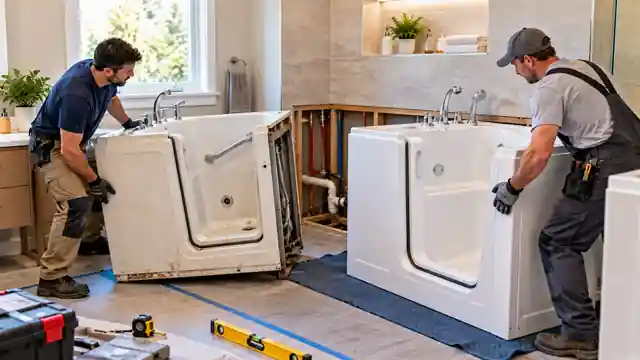
Replacement and removal guidance checked against current KOHLER Walk-In Bath installation information, Ella's Bubbles moving/service-access guidance and American Standard walk-in bath installation documentation. Existing plumbing or electrical can sometimes be reused, but only when it matches the new model and current code requirements.
Walk-in tubs are designed to be permanent bathroom fixtures, but they are not impossible to replace. The difficulty depends less on the word “walk-in” and more on how the original tub was installed.
A tub with removable service panels, accessible shutoffs and sensible rough-in can often be disconnected and removed without rebuilding the whole bathroom. A tub that was boxed in behind tile, wired without accessible disconnects or installed with inaccessible plumbing can turn a straightforward replacement into a much larger project.
This guide explains when replacement makes sense, what can sometimes be reused, what should be rechecked, how removal normally works, and how to compare replacement quotes.
Repair or replace? Start with the failure, not the age
| Situation | Repair usually makes sense | Replacement becomes more reasonable |
|---|---|---|
| Door leak | Dirty/worn gasket, minor latch adjustment, tub can be re-leveled | Damaged door frame, distorted shell, unavailable proprietary door parts |
| Pump or blower failure | Part is available and service access is good | Multiple systems have failed or parts are obsolete |
| Drain problem | Stopper, linkage, powered drain or house drain can be repaired | Major structural access is required and other systems also need work |
| Controls/electronics | Replacement control is supported | Control platform is discontinued and cannot be substituted safely |
| Shell/frame damage | Minor cosmetic issue only | Crack, structural movement, severe corrosion or door opening distortion |
| User needs changed | Current door/seat still supports safe bathing | Transfer style, seat height, door width or step-in no longer works for user |
| Repeated service calls | One isolated failure | Several major components are failing in sequence |
If you have not yet isolated the problem, use our walk-in tub repair and troubleshooting guide before assuming the whole tub needs to come out.
There is no universal replacement age
A walk-in tub does not expire on a fixed schedule.
A simple soaking model may remain serviceable for a long time because it has fewer moving parts. A therapy-heavy tub can still be a good long-term fixture, but it has more individual systems that may eventually need service: pumps, blowers, controls, heaters, valves and powered drains.
The better question is:
Is the tub still structurally sound, supported by available parts, economical to service and suitable for the person using it?
Our walk-in tub warranty and lifespan guide explains why “lifetime warranty” and practical service life are not the same thing.
Can you replace a walk-in tub with another walk-in tub?
Yes. In many bathrooms, that is the most direct replacement path.
But do not assume that a new tub advertised for the same alcove size will connect exactly where the old one did. Confirm:
- overall length, width and height;
- drain side and drain-center location;
- door side and door swing;
- faucet/supply layout;
- number of electrical circuits;
- voltage and amperage;
- service-panel location;
- filled weight and support requirements;
- extension/end-panel arrangement.
A nominal 60-inch replacement can still require plumbing or electrical changes.
Do not remove the old tub and then shop for a replacement based on the empty space. Get the specification sheet and installation manual for the new model first so the contractor can compare the two rough-ins before work begins.
What parts of the existing installation can be reused?
Some existing infrastructure may be reusable, but every item should be treated as “verify first,” not “automatically reuse.”
| Existing item | Can it sometimes be reused? | What must match |
|---|---|---|
| Hot/cold water lines | Often | Condition, size, valve location, connection type, required flow |
| House drain | Often | Drain location, size, venting, slope, new tub connection |
| Dedicated electrical circuit | Sometimes | Voltage, amperage, GFCI, conductor size, circuit count, receptacle location |
| Existing wall surround | Sometimes | New tub height, flange/trim system, waterproofing condition |
| Subfloor | Often | No rot, damage, excessive deflection or unsupported areas |
| Grab bars | Sometimes | Reach, transfer path, structural backing and new tub position |
| Water heater | Often | Usable hot-water capacity for the new tub’s fill volume |
KOHLER currently states that its authorized replacement installations can often use existing plumbing and electrical lines while removing and disposing of the old bathtub. That is a useful example of what can be possible in a compatible bathroom—not a promise that every home’s existing rough-in will suit every replacement model.
See KOHLER’s current Walk-In Bath installation overview.
When existing plumbing should not simply be reused
Replacement is a good time to fix weaknesses hidden by the old tub.
Ask the plumber to inspect:
- corroded or leaking shutoff valves;
- undersized or damaged supply lines;
- poor drain slope;
- improvised adapters;
- old flexible connectors in questionable condition;
- venting problems;
- evidence of previous leaks under the tub.
If the new tub fills slowly because of the house supply or drains slowly because of the building plumbing, replacing only the fixture will not solve the underlying problem.
Use our fill, drain and water-heater guide when planning the replacement.
When existing electrical should be rechecked
A replacement tub can have a completely different electrical load from the old one.
A previous soaker may have had no powered therapy equipment. A new combination tub may have a whirlpool pump, air blower, inline heater, heated seat and other systems. Conversely, a simpler replacement may need fewer circuits.
Have the electrician compare the new manufacturer’s schedule against:
- existing breaker size;
- wire size;
- GFCI protection;
- number of dedicated circuits;
- receptacle location;
- panel capacity;
- grounding/bonding requirements.
Do not adapt a mismatch with extension cords, splitters or a non-GFCI receptacle. Our walk-in tub electrical requirements guide covers this in detail.
How is an old walk-in tub removed?
The exact process depends on the model and installation, but a professional removal normally follows this logic:
- Shut off water and power.
- Confirm the tub is fully drained.
- Remove service/access panels and trim that would be damaged during movement.
- Disconnect electrical equipment safely.
- Disconnect hot/cold supplies and drain connections.
- Release anchors, wall trim or surrounding finish materials as required.
- Protect floors, doors and hallways.
- Move the tub using its structural frame/lifting points—not plumbing, faucets or door hardware.
- Inspect the newly exposed floor, wall, drain and supply area before setting the replacement.
Current Ella’s Bubbles guidance for moving its tubs specifically says removable panels should come off before the tub is carried and that the tub should be lifted by its structural frame. That is brand-specific guidance, but it illustrates why removal instructions for the old model matter.
See Ella’s current access-panel and moving guidance.
Do not damage the old tub if you may reuse or resell it
If the old tub is still functional, decide its destination before demolition.
Possible outcomes include:
- reuse in another property;
- sale as a used fixture;
- donation where a local organization accepts it;
- parts salvage;
- contractor disposal/recycling according to local options.
A used walk-in tub is much less useful if the door, frame, access panels or proprietary hardware are damaged during removal.
Before moving a potentially reusable tub, keep:
- model and serial number;
- installation manual;
- warranty paperwork;
- all removable panels;
- extension panels;
- special brackets/hardware;
- photos of plumbing and electrical connections before disconnection.
Will the old warranty transfer to a new owner or address?
Do not assume it will.
Many walk-in tub warranties are tied to the original purchaser, original home, authorized installation or other conditions. Moving the tub can therefore change or eliminate coverage.
If resale or relocation matters, ask the manufacturer in writing:
- Can this specific model be moved?
- Does moving it affect the warranty?
- Is coverage transferable?
- Does reinstallation need an authorized installer?
- Which parts should be replaced during relocation?
Replacing a walk-in tub with a walk-in shower
Replacement does not have to mean another tub.
A walk-in or roll-in shower may be a better long-term choice when the user:
- primarily showers rather than bathes;
- cannot comfortably wait inside a tub while it fills or drains;
- needs wheelchair roll-in access;
- needs caregiver space;
- finds the walk-in tub door or seat geometry difficult to use.
On the other hand, a walk-in tub may remain preferable for a seated bather who values soaking and hydrotherapy.
Compare the two options in our walk-in tub vs walk-in shower guide.
Replacing a walk-in tub with a standard bathtub
This is possible, but it should be treated as another remodel rather than a simple reversal.
Check whether:
- the drain and overflow location suit the new tub;
- the wall waterproofing needs reconstruction;
- the floor has been altered;
- unused electrical circuits need safe termination or repurposing;
- the standard tub’s entry height is appropriate for the user.
If accessibility was the reason for the original walk-in tub, do not remove it without reassessing how the replacement will affect transfers and fall risk.
How much does walk-in tub replacement cost?
There is no meaningful universal replacement price because the labor can range from a direct swap to a bathroom reconstruction.
The most useful way to compare quotes is to separate the project into line items:
| Cost item | What can change the price |
|---|---|
| Old tub removal | Access path, weight, trim/tile removal, disposal |
| New tub | Size, brand, door type, therapy package |
| Plumbing | Drain relocation, valves, supply changes, slab work |
| Electrical | New circuits, GFCI, panel capacity, outlet relocation |
| Floor/subfloor | Rot, leveling, reinforcement |
| Wall/finish work | Surround reuse, tile repair, drywall, waterproofing |
| Accessibility changes | Doorway width, grab bars, transfer space |
| Permits/inspection | Local requirements |
For broader pricing context, see our walk-in tub cost guide.
Replacement quote: 12 questions to ask
- Is old-tub removal included?
- Is disposal included?
- Which existing plumbing is being reused?
- Will the drain move?
- Does the new model need different electrical circuits?
- Who performs the plumbing and electrical work?
- Is subfloor repair included if damage is discovered?
- Will the existing wall surround be reused?
- How will service panels remain accessible?
- What happens if the new tub cannot fit through the bathroom doorway?
- Who performs the final leak, GFCI and function tests?
- What warranty applies to the product and to installation labor?
If a quote assumes “existing plumbing and electrical can be reused,” ask the contractor to state what happens to the price if that assumption proves wrong after demolition.
Inspect the hidden area before the new tub goes in
Once the old tub is removed, there is a short window when parts of the bathroom are easier to inspect than they may be for years.
Before covering the area again, check for:
- subfloor rot;
- old leak stains;
- mold/moisture damage;
- loose framing;
- corroded valves;
- poor drain connections;
- unprotected or improvised electrical work;
- missing structural backing where grab bars are planned.
Photograph the rough-in after any repairs and before the new tub blocks the view.
Replacement day: commissioning checklist
Do not consider the job finished until the replacement is tested under real operating conditions.
- ☐ Tub is stable and level.
- ☐ Door opens and latches normally.
- ☐ Door seal remains dry during a full fill test.
- ☐ Hot/cold supplies and faucet connections are dry.
- ☐ Drain connection remains dry during emptying.
- ☐ All therapy systems operate.
- ☐ GFCI protection tests and resets correctly.
- ☐ Powered drain works if fitted.
- ☐ Service panels remain removable.
- ☐ User can reach the controls, handshower and grab bars.
- ☐ Serial number and warranty documents are recorded.
- ☐ Old tub/disposal debris has been removed as agreed.
The more detailed process is in our walk-in tub installation guide.
Red flags in a replacement proposal
- “Any 60-inch tub will fit.” Nominal length does not guarantee matching drains, doors or circuits.
- “We can reuse everything.” Without comparing the new manual to the existing rough-in, that is an assumption.
- “No need to test it full.” Leaks can appear only at full water level, with pumps running or during drain-down.
- “We’ll tile over the access panel.” Future pump or plumbing service may then require demolition.
- “The old circuit is close enough.” Electrical requirements must match the new model.
- “Lifetime warranty covers the whole replacement forever.” Product, parts, labor and workmanship warranties can be separate.
Frequently asked questions
Can a walk-in tub be removed without destroying the bathroom?
Often yes, especially when the original installation preserved service access and used removable trim. The amount of finish work depends on how the tub was enclosed, whether plumbing/electrical must move and whether hidden damage is discovered.
Can I put a new walk-in tub where the old one was?
Usually, but compare the new model’s exact dimensions, drain position, door orientation, circuit requirements and service access with the old installation before ordering.
Can existing plumbing be reused?
Sometimes. Supply lines and the house drain may be reusable when their size, position, condition and configuration suit the new model. The plumber should verify rather than assume.
Can existing electrical circuits be reused?
Only if they meet the new tub’s voltage, amperage, GFCI, conductor-size and dedicated-circuit requirements. Therapy packages can change the number of circuits required.
Should I replace a walk-in tub just because the pump fails?
Usually not. If the shell, door and frame are sound and the pump is still supported, an isolated pump failure is normally a repair issue. Replacement becomes more compelling when several systems are failing, parts are obsolete or the tub no longer meets the user’s needs.
Who removes the old walk-in tub?
This varies by contractor. Turnkey replacement programs may include removal and disposal; KOHLER currently states that old-tub removal and disposal are part of its authorized installation process. Independent contractors may quote removal separately, so confirm it in writing.
Can a used walk-in tub be moved to another house?
Some can, but the tub must be removed and transported according to its manufacturer guidance, and the new bathroom needs a compatible rough-in. Check warranty implications before moving it.
Official resources used for this guide
- KOHLER Walk-In Bath — Installation and old-tub removal
- KOHLER Walk-In Bath — Installation and removal FAQs
- Ella’s Bubbles — Removing access panels before moving a walk-in tub
- Ella’s Bubbles — Walk-in tub service access panels
- American Standard — Walk-in bath installation and owner’s manual
For the next decision, continue with our warranty and lifespan guide, repair guide, or walk-in tub buying guide.