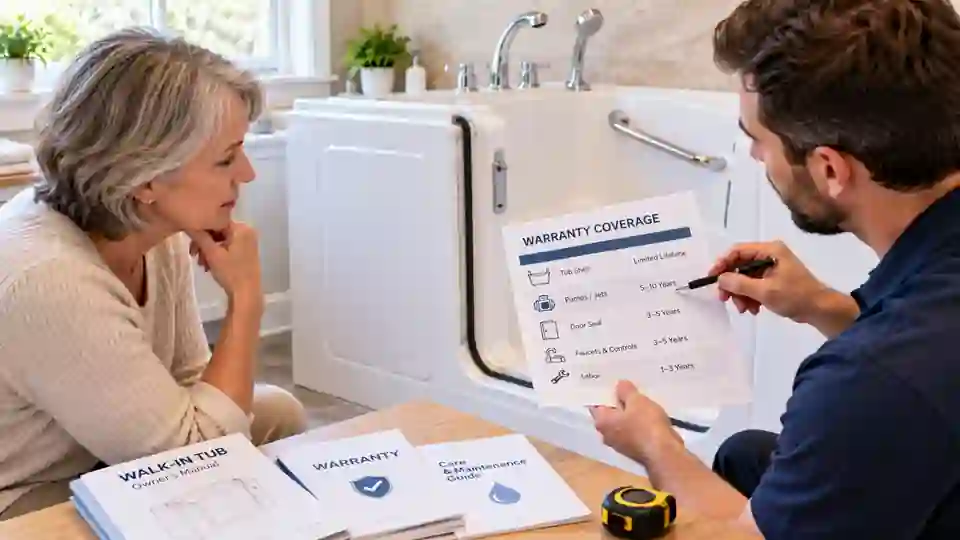
Warranty examples checked against current KOHLER Walk-In Bath, Safe Step, Ella's Bubbles and American Standard published warranty/product materials. Terms can change and can differ by model, sales channel, installation method and original purchaser status; the written warranty supplied with your exact tub controls.
A walk-in tub is a long-term home purchase. Buyers often spend more time comparing jets and door styles than reading the warranty, even though the warranty determines what happens when a pump fails, a seal leaks or a control panel stops responding years later.
The confusing part is that manufacturers use similar marketing words for very different coverage structures. “Lifetime,” “limited lifetime,” “parts warranty,” “labor warranty,” “door-seal warranty” and “installation warranty” are not interchangeable.
This guide explains how to read a walk-in tub warranty, what current major-brand terms look like, what is commonly excluded, and how warranty coverage should factor into the decision to repair or replace an older tub.
Walk-in tub warranties at a glance
| Warranty item | Why it matters | What to verify |
|---|---|---|
| Tub shell / frame | Structural defects can be expensive to solve | Term, original-owner restriction, residential-use requirement |
| Door and seal | Essential to watertight operation | Seal term, door hardware, alignment exclusions |
| Pumps / blowers / heaters | Common service components on therapy tubs | Parts term, labor term, diagnostic fees |
| Controls / electronics | Can disable multiple features | Whether controls are included with “equipment” |
| Faucet / valve | May have a different warranty from the tub | Brand-specific faucet and thermostatic-valve terms |
| Labor | Can cost more than the replacement part | Whether labor is included, for how long, and who may perform it |
| Installation | Improper installation can create leaks and electrical problems | Installer requirements and workmanship warranty |
| Caulking / finish materials | Often treated separately | Shorter term or excluded maintenance item |
“Lifetime” is a legal term, not a lifespan prediction
A lifetime limited warranty usually defines a coverage period tied to a person, property, product or ownership condition. It does not mean the manufacturer expects every component to last forever without service.
For example, current KOHLER Walk-In Bath warranty language ties its Lifetime Limited Warranty to the original consumer owning the home and to qualifying installation conditions. Ella’s Bubbles ties its current lifetime parts coverage to the first purchaser and original installation address. Safe Step markets lifetime coverage for products it installs, with separate terms for caulking.
A warranty can last longer than a pump, faucet cartridge or control’s practical service life because the warranty may provide replacement parts when a covered defect occurs. Lifespan and warranty are related, but they are not the same thing.
How long should a walk-in tub last?
There is no credible universal number that applies to every walk-in tub.
A simple soaking tub can remain usable for many years because it has relatively few moving parts. A multi-system therapy tub has more serviceable equipment: pumps, blowers, heaters, electronic controls, valves, powered drains and sometimes microbubble equipment.
The useful way to think about lifespan is by component:
| Component | What affects its service life |
|---|---|
| Tub shell / frame | Material, installation support, movement, impact damage, cleaning products |
| Door seal | Cleanliness, compression, alignment, chemical exposure, tub level |
| Pumps / blowers | Usage, water quality, dry-running, maintenance, ventilation |
| Controls | Moisture, electrical conditions, component quality, service environment |
| Drain system | Debris, plumbing layout, powered-drain wear, household drain condition |
| Faucets / valves | Water hardness, pressure, cartridge wear, scale |
| Caulk / trim | Movement, cleaning, moisture, installer workmanship |
A tub should therefore be evaluated as a serviceable system, not as one object with one expiration date.
Current warranty examples from major walk-in tub brands
The table below is a practical snapshot of published terms as reviewed in October 2026. It is not a substitute for the warranty supplied with your exact purchase.
| Brand | Current published headline coverage | Important limitation to understand |
|---|---|---|
| KOHLER Walk-In Bath | Lifetime Limited Warranty on qualifying Belay Walk-In Bath coverage; current materials include manufacturing defects on bath components such as the door seal, hydrotherapy systems, faucet and handshower | Eligibility is tied to the written warranty, original consumer/ownership conditions and qualifying authorized/certified installation; some warranty documents identify separate terms for other components |
| Safe Step | Current published Lifetime Warranty includes tub manufacturing defects, door seal, faucets, water pumps, heaters, blowers, parts and labor; caulking is listed separately at 2 years | Safe Step states its lifetime warranty applies to products it installs; restrictions can apply |
| Ella’s Bubbles | Current Lifetime Limited Warranty covers shell, frame, door, door seal, finish and supporting equipment including motors, pumps, controls, faucet, waste and overflow | Current published coverage is a parts warranty; labor is not included. The thermostatic control valve is listed with a shorter 1-year limited warranty |
| American Standard retail walk-in tubs | Current product pages for many gelcoat models list lifetime coverage on the door seal, 10 years on the tub shell and 5 years on components | American Standard also publishes different lifetime-warranty messaging for certain installed programs, so confirm whether you are buying a retail tub or a full installed package |
This is why a brand comparison based only on “lifetime warranty: yes/no” can be misleading.
KOHLER Walk-In Bath warranty: what to notice
KOHLER currently markets a Lifetime Limited Warranty with its Walk-In Bath. Its public warranty page says the Belay Walk-In Bath is warranted against defects in material and workmanship during normal residential use for as long as the original consumer owns the home, subject to the stated installation and geographic conditions.
Current KOHLER materials specifically identify coverage examples including:
- bath door seal;
- hydrotherapy systems;
- KOHLER faucet;
- handshower.
The critical buyer question is not simply “Does KOHLER have a lifetime warranty?” It is:
Which exact warranty document applies to my bath, my installer, my location and every component included in my quote?
Read the current KOHLER Walk-In Bath warranty page and request the full written warranty before purchase.
Safe Step warranty: parts and labor are the key distinction
Safe Step currently advertises one of the broader headline warranties in this market.
Its published warranty page lists lifetime coverage on:
- the tub, including manufacturing defects;
- door seal;
- faucets;
- water pumps;
- heaters;
- blowers;
- parts and labor.
Caulking is listed separately with a 2-year warranty.
The company also states in its FAQ that this Best-In-Class Lifetime Warranty applies to tubs and showers installed by Safe Step. That matters if you are comparing a turnkey Safe Step installation with a retail tub bought separately and installed by your own contractor.
See Safe Step’s current Lifetime Warranty page for the current published summary.
Ella’s Bubbles warranty: broad parts coverage, but labor is different
Ella’s Bubbles currently publishes a Lifetime Limited Warranty covering defects in workmanship and material for the first purchaser under the terms of its policy.
Its current warranty guidance says lifetime coverage includes:
- shell;
- frame;
- door;
- door seal;
- finish;
- motors and pumps;
- fixtures;
- electronic controls;
- faucet;
- waste and overflow;
- plated finishes.
The important exception is the thermostatic control valve, which Ella currently lists with a 1-year limited warranty.
Just as important: Ella describes the current lifetime coverage as a parts warranty. Verified replacement parts can be supplied under the policy, but labor is not included.
That difference can matter years later. A $0 warranty part can still require a paid technician, travel time and access to the pump compartment.
See Ella’s current Lifetime Limited Warranty coverage guide.
American Standard: do not assume every sales channel has the same terms
American Standard is a good example of why buyers must identify the exact product and purchase channel.
Current American Standard retail product pages for many gelcoat walk-in tub models list:
- lifetime warranty on the door seal;
- 10 years on the tub shell;
- 5 years on components.
American Standard also publishes marketing for certain installed walk-in tub programs that describes lifetime coverage including the tub, installation and labor. That should not be automatically applied to every retail model purchased through a store or marketplace.
If a dealer says “American Standard has a lifetime warranty,” ask them to show you the warranty attached to the exact SKU and installation contract you are signing.
Parts warranty vs labor warranty
This is one of the most important distinctions in a walk-in tub purchase.
A parts warranty may provide a replacement pump, control, valve or seal. It does not necessarily pay for:
- diagnostic visit;
- technician labor;
- travel charges;
- removing tile or trim to reach inaccessible equipment;
- plumber or electrician work;
- reinstallation of surrounding finishes.
A warranty that explicitly includes parts and labor can therefore be materially more valuable than a longer parts-only warranty, depending on the restrictions.
Does installation affect the warranty?
It can.
Manufacturers commonly require correct installation and may tie some coverage to authorized installation, proper electrical work, correct support and normal residential use.
Improper installation can cause exactly the symptoms that later look like product defects:
- door leakage from a tub that is not level;
- drain problems;
- pump vibration;
- electrical trips;
- damaged fittings;
- blocked service access.
Before installation begins, save:
- the signed sales contract;
- model and serial number;
- installation manual;
- installer invoice;
- electrical/plumbing permit records where applicable;
- photos of rough-in and service access;
- final commissioning/test paperwork.
Our walk-in tub installation guide explains the checks that reduce future warranty disputes.
Warranty registration: do not leave it for later
Some manufacturers require or strongly encourage registration after installation.
Even where registration is not legally required to preserve every consumer right, completing the manufacturer’s process can make future service much easier because the company can connect the serial number, purchaser, installation address and purchase date.
Keep a digital copy of:
- receipt;
- warranty confirmation;
- serial-number photo;
- model-number photo;
- dealer/installer contact;
- warranty document version.
What commonly is not covered?
Exact exclusions vary, but walk-in tub warranties commonly distinguish product defects from damage caused by use, installation or maintenance.
Potential exclusions can include:
- improper installation;
- misuse or abuse;
- unauthorized modifications;
- damage from improper cleaners;
- water-quality or mineral damage;
- normal cosmetic wear;
- caulking or surrounding finish materials;
- labor where the warranty is parts-only;
- damage from inaccessible service installations;
- commercial rather than residential use;
- second-owner or moved-product situations.
Never assume an exclusion applies to your tub without checking the actual written policy.
Does the warranty transfer when the house is sold?
Often, lifetime coverage is tied to the original purchaser, original installation address or original consumer’s ownership of the home.
That means a “lifetime” warranty may not automatically become a lifetime warranty for the next homeowner.
If resale value matters, ask three questions before buying:
- Is the warranty transferable?
- If yes, is there a transfer fee or deadline?
- Which components remain covered after transfer?
Do not represent a warranty as transferable to a buyer unless the manufacturer confirms it in writing.
What happens if the installer goes out of business?
This depends on who actually provides each warranty.
A walk-in tub project can involve several separate promises:
- manufacturer product warranty;
- dealer warranty;
- installer workmanship warranty;
- plumbing/electrical contractor warranty;
- third-party financing or service plan.
If the installer disappears, the manufacturer warranty may still exist—but labor or workmanship coverage provided only by that installer may not.
Ask the salesperson to identify the legal entity responsible for each part of the warranty.
Warranty service: what to have ready
When something fails, a complete service request usually moves faster.
| What to provide | Why it matters |
|---|---|
| Model and serial number | Matches the exact components and warranty |
| Proof of purchase | Confirms original purchaser and date |
| Installation address | Can be part of eligibility |
| Photo/video of the problem | Helps identify the correct part before dispatch |
| When the symptom occurs | Separates fill, jet, drain and electrical problems |
| Installer information | Useful when installation workmanship is involved |
| Maintenance history | Can help rule out scale, debris or cleaning damage |
For symptom-based diagnosis before calling support, use our walk-in tub repair and troubleshooting guide.
When a warranty repair is better than replacing the tub
Repair is usually the logical first choice when:
- the shell and frame are structurally sound;
- the tub still fits the user’s mobility needs;
- the failed part is available;
- the service area is accessible;
- the manufacturer confirms coverage;
- repair labor is reasonable compared with replacement.
A pump, control or door seal is a serviceable component. Replacing an entire walk-in tub solely because one replaceable component failed can create unnecessary demolition and installation cost.
When replacement deserves serious consideration
Replacement can make more sense when several factors occur together:
- structural shell or frame damage;
- obsolete parts;
- multiple recurring equipment failures;
- poor service access requiring demolition for every repair;
- door layout no longer works for the user’s mobility;
- the tub is too narrow, too deep or difficult to transfer into;
- the home’s plumbing/electrical system needs major changes anyway;
- repair cost approaches the value of a replacement project.
Use our walk-in tub cost guide and pros and cons guide when comparing a major repair with a new installation.
Warranty questions to ask before you buy
- Can I have the complete written warranty before signing?
- Who is the warrantor—the manufacturer, dealer or installer?
- What is the term for the shell?
- What is the term for the door and door seal?
- What is the term for pumps, blower, heater and controls?
- Are faucet and thermostatic valve covered under the same term?
- Is labor included?
- Are diagnostic or travel fees included?
- Must installation be performed by an authorized installer?
- Is registration required?
- Is the warranty transferable?
- What happens if the dealer closes?
- What cleaning or maintenance actions can void coverage?
- Who pays to remove surrounding finish materials if service access is blocked?
Red flags in warranty sales claims
- says “everything is covered forever” but will not provide the written warranty;
- uses a brand’s installed-program warranty to describe a different retail model;
- cannot explain whether labor is included;
- claims the warranty transfers automatically without written terms;
- tells you maintenance does not matter;
- discourages you from keeping installation records;
- says any contractor can perform warranty work without checking the policy.
Frequently asked questions
Do walk-in tubs have lifetime warranties?
Some do, but the word “lifetime” can apply to different components and conditions. KOHLER, Safe Step and Ella’s Bubbles currently publish forms of lifetime coverage, while many American Standard retail models publish lifetime coverage on the door seal with shorter terms for the shell and other components. Always read the warranty for the exact tub.
Does a lifetime warranty include labor?
Not necessarily. Safe Step currently advertises lifetime parts and labor on qualifying installed products. Ella’s Bubbles describes its current Lifetime Limited Warranty as parts coverage and says labor is not included. Other brands and sales channels have their own terms.
Does a lifetime warranty mean the tub will never need repairs?
No. Pumps, valves, seals, controls and drains are serviceable components. A warranty determines whether a covered defect receives warranty support; it does not eliminate normal maintenance or the possibility of component failure.
How long does a walk-in tub last?
There is no reliable universal lifespan. A well-installed shell and frame can remain usable for many years, while pumps, controls, seals and faucets may need service at different times. Installation quality, water chemistry, maintenance and parts availability are more useful predictors than a single lifespan number.
Can I use any plumber for a warranty repair?
Check first. Ordinary plumbing work may be handled by a plumber, but a manufacturer may require authorization before replacing proprietary warranty parts or may direct you to a specific service channel.
Can improper cleaning void a walk-in tub warranty?
It can. Some manufacturers specifically exclude damage caused by improper care or cleaning. Follow the owner’s manual and our walk-in tub maintenance guide rather than using a generic chemical recipe.
Should warranty coverage affect which walk-in tub I buy?
Yes, but compare the useful details rather than the marketing headline. Labor coverage, service network, installer requirements, transferability, parts availability and access to future service can matter as much as the number of years printed beside the shell.
Official warranty sources
- KOHLER Walk-In Bath — Lifetime Limited Warranty
- Safe Step — Lifetime Warranty
- Ella’s Bubbles — Lifetime Limited Warranty Coverage
- American Standard — Current walk-in tub product warranty example
For the next step in ownership planning, see our maintenance guide, repair guide, installation guide and walk-in tub buying guide.