Buying and safety considerations reviewed against MedlinePlus bathroom-safety guidance, Veterans Affairs assistive-bathing resources and U.S. Access Board accessibility guidance. No product was physically tested. Follow the exact bench manufacturer's assembly, weight and use instructions.
Many people can still sit comfortably to bathe but cannot safely lift a leg over a bathtub wall. A tub transfer bench addresses that particular obstacle. Instead of standing on one leg and stepping over the rim, the user approaches a seat positioned partly outside the bathtub, sits down, and shifts across it into the bathing area.
That sounds simple, but the dimensions are less forgiving than they look. The bench must bridge a fixed bathtub wall while its feet stand on surfaces of potentially different heights. The seat must fit the user’s transfer method, and there must be room for the legs outside the tub. A sliding bench and a conventional fixed bench also behave differently.
This guide covers how the equipment works, what to measure before ordering, how to choose between fixed and sliding versions, where shower chairs are different, and when another bathroom solution may be safer.
What is a tub transfer bench?
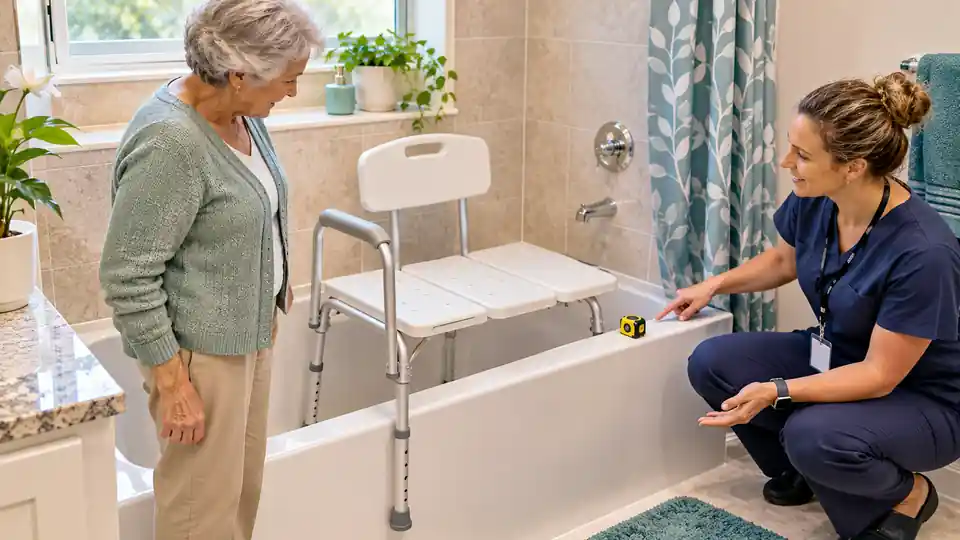
Most conventional transfer benches have a long seat, four adjustable legs, non-slip feet and often a backrest and handgrip. Two legs stand on the bathroom floor; the other two stand inside the tub. The seat spans the bathtub wall so the user can move across while seated.
This is different from a freestanding shower chair that occupies only the shower or tub floor. A chair generally requires the user to get across the bathtub rim before sitting down. A transfer bench moves the sitting step to the outside of the tub.
The Department of Veterans Affairs includes a tub transfer bench with a back among bathroom-safety adaptations in its home-safety booklet. MedlinePlus likewise recommends using a bath chair or bench for seated bathing and obtaining professional input when bathroom adaptations are unclear.
Tub transfer bench vs shower chair
| Feature | Tub transfer bench | Shower chair |
|---|---|---|
| Where it sits | Spans the bathtub rim | Usually entirely inside the bathing area |
| How the user gets in | Sits outside, shifts across while seated | Typically steps or transfers into the area first |
| Floor space | Requires room outside the tub | Usually takes less space outside the fixture |
| Best use case | Difficulty stepping over a tub wall | Standing endurance is limited, but entry is manageable |
| Common limitation | Bench can conflict with doors, curtains or narrow bathrooms | Does not itself remove the tub-wall obstacle |
A chair can be the better choice in a level-entry shower. A transfer bench is usually more relevant when retaining a conventional bathtub. Neither is automatically suitable for a person who cannot sit unsupported or shift their weight safely.
Fixed bench vs sliding tub transfer bench
Fixed transfer bench
With a fixed bench, the seat remains stationary while the user moves their body sideways across it. The model may have a textured plastic seat, drainage holes, an adjustable back and a grab handle. It generally has fewer moving parts.
The main question is whether the user can safely shift their hips while seated without twisting, sliding off the edge, or relying on an unstable surface.
Sliding transfer bench
A sliding model has a seat or carriage that travels along a rail from the outside to the inside of the tub. Some versions offer a swivel mechanism. This may reduce the sideways shuffling required, but it introduces locks, latches, moving parts and pinch points that require careful setup and operation.
Do not infer that a sliding model is safer solely because it slides. Check whether the seat locks at the required positions, whether a caregiver can operate the mechanism safely, and whether the installed arrangement fits the available bathroom space.
Swivel or rotating models
Some specialty seats rotate before moving across the tub wall. They can make it easier to bring the legs into the tub, but they are often larger and more complex than a basic bench. Check the exact rotation clearance, backrest orientation and limits on assisted transfers.
The measurements to take before buying
Do not order by the nominal “standard bathtub” label. Measure the actual installation in inches, then compare it with the specific manufacturer’s dimensional drawing.
| Measure | Why it matters |
|---|---|
| Bathtub rim height | Bench seat must clear the rim without resting on it unless explicitly designed to do so |
| Rim width and shape | Wide, rounded or unusually tall rims can interfere with the seat or legs |
| Inside tub-floor width | Inside legs must stand fully on a stable surface |
| Bathroom floor space outside tub | Outside legs, wheelchair or walker approach and caregiver may need room |
| Difference in inside/outside floor levels | Leg adjustments must accommodate the actual height change |
| Available seat-height range | Feet must contact the floor securely while the seat clears the tub rim |
| Actual seat width and depth | Must support the user and leave usable transfer space |
| Backrest and handle side | Some models are reversible; others are not |
| Shower-door track and curtain | Hardware can obstruct the bench and create water spillover |
The final assembly should be level or configured exactly as the bench instructions require. Do not improvise one-leg risers, stack blocks under the feet or assume any adjustable bench will bridge a very tall tub wall.
Check the user’s seated transfer height
Seat height matters as much as tub height. The intended user should be able to sit on the bench in a controlled way with stable foot contact or appropriate support. If transferring from a wheelchair, compare the wheelchair’s occupied cushion height with the bench and check which direction the transfer will occur.
A bench that is too high may leave the user’s feet dangling and make shifting difficult. A bench that is too low may force painful knee or hip flexion during the sit-to-stand phase. Adjustability does not guarantee a suitable range for every person.
Our accessible bathroom measurements guide explains why published ADA seat-height dimensions are useful references in covered facilities but do not automatically determine the ideal height of portable equipment in every private home.
Weight capacity: use the manufacturer rating, not the product name
A listing described as “heavy-duty” does not tell you enough. Look for the manufacturer’s stated maximum user weight, seat loading directions and any restrictions on assisted transfers. Confirm that the weight rating applies to the assembled model, not just one component.
For a larger user, a bariatric bench may offer a wider seat and a higher stated load capacity. But a wider bench can need substantially more bathroom floor space; verify both the user’s fit and the available clearance.
Do not exceed the rating. Do not let a caregiver sit or stand on the bench unless the product explicitly permits that use.
Fit around shower doors and curtains
Sliding glass doors and their tracks can be a major obstacle. The bench may need to span a rail, prevent the door from closing or leave a gap that allows water onto the bathroom floor.
Some layouts work better with a shower curtain and a curtain guard or purpose-designed seat arrangement. But replacing glass doors, removing tracks or changing the enclosure can create waterproofing and finishing work. That should be considered before the equipment is purchased.
A VA research project specifically identifies shower-curtain closure around transfer benches as a real usability problem, not merely a cosmetic inconvenience. Read the VA hinged transfer-bench research description.
Make sure the bathroom floor outside the tub can remain dry; standing water where a person approaches the bench is a slipping hazard.
How a seated tub transfer generally works
The exact method should be taught and practiced based on the person’s mobility and the bench instructions. A typical sequence for someone who can transfer independently is:
- Confirm the bench is correctly assembled, stable and positioned as directed by the manufacturer.
- Prepare the showerhead, soap and towel so the user will not have to reach awkwardly.
- Approach the outside end of the bench using the mobility aid or assistance appropriate to the person.
- Turn and sit in a controlled manner, without pulling on an unsecured towel rack or glass door.
- While seated, move toward the inside portion of the bench and bring the legs over the rim according to the user’s prescribed transfer technique.
- Stay seated for showering, with water controls and handheld shower accessible from the seated position.
- Reverse the process only when ready, with the outside floor dry and any required assistance present.
Anyone with poor trunk control, significant weakness, dizziness, recent surgery, weight-bearing restrictions or a history of falls should not attempt an unfamiliar transfer alone based on written steps. A clinician or occupational therapist can assess whether a bench, sliding device, lift or different bathing setup is appropriate and teach the movement safely.
Why grab bars still matter
A bench does not replace secure handholds. Many transfers involve a moment when the user must stabilize the body, especially when sitting down, shifting or standing up. MedlinePlus advises appropriately secured bathroom grab bars and warns that towel racks are not suitable substitutes.
The right bar location depends on the bench position and the movement being performed. Installing a bar first and buying the bench later can result in a handle that cannot be reached from the seat.
For additional planning, see our grab bar installation cost guide and grab bar positioning and height guide.
What if the bathtub is narrow or unusually shaped?
Some bathtubs have sloping floors, deep curved sides, textured bases or narrow usable floor widths. The feet of a standard bench may not rest securely in these conditions. Check that all four feet have adequate contact and that the leg geometry remains inside the manufacturer’s permitted range.
Clawfoot and freestanding tubs are especially challenging: rim width, exterior shape and distance from surrounding walls can conflict with typical bench designs. A bench marketed for alcove tubs should not be assumed compatible with every freestanding tub.
If the bench cannot stand properly without improvised supports, choose a different product or bathing arrangement.
Does a tub transfer bench work with a walk-in tub?
Usually this is not the reason to buy one. A walk-in tub already has a side door and an integrated bathing seat; the transfer path is different from a standard high-sided bathtub. A conventional bench spanning the tub rim may obstruct the door or fail to fit the enclosure.
For a walk-in tub, evaluate the door opening, seat location, threshold and whether the person can transfer safely using approved supports. Some outward-opening models are designed around lateral transfers. Our walk-in tub door types guide explains those differences.
If the goal is to avoid climbing over a conventional tub without replacing the fixture, a properly fitted transfer bench may be worth trying first. If the person needs roll-in access, a curbless shower may be a better long-term layout.
Features worth comparing when shopping
| Feature | Why it matters | Question for the seller |
|---|---|---|
| Reversible backrest | May allow use with left- or right-hand tubs | Can it be installed on either side? |
| Adjustable legs | Accommodates different floor levels | What is the permitted adjustment range? |
| Non-slip feet | Help stabilize the frame | Are replacement tips available? |
| Drainage openings | Allow water to leave the seat | Are surfaces easy to clean and dry? |
| Sliding/locking seat | May reduce sideways shuffling | Where are locks, and how is movement controlled? |
| Back and arm support | Can improve seated support for some users | Do supports interfere with the transfer direction? |
| Removable components | May help storage, delivery and cleaning | Can the device be reassembled without tools, and what inspection is required? |
| Weight rating | Sets a strict safety limit | What maximum user weight does the manufacturer specify? |
Common purchasing mistakes
- Buying only by price: the cheapest bench is not useful if its feet cannot stand safely inside the tub.
- Ignoring left/right orientation: backrest and handle placement may block the approach from a wheelchair.
- Assuming the bench is a lifting device: a basic transfer bench does not lift a person and may not be suitable when they cannot actively transfer.
- Forgetting the curtain: water can run onto the bathroom floor around the seat.
- Skipping assembly checks: an incorrectly locked adjustable leg can destabilize the entire bench.
- Using a worn secondhand unit: damaged legs, missing pins and hardened feet may make a seemingly inexpensive purchase unsafe.
Cleaning, maintenance and when to replace a bench
Rinse soap residue off the seat and allow it to dry according to the manufacturer’s instructions. Inspect the feet for wear, verify that adjustment pins and screws remain fully seated, and look for cracks or movement in the seat, frame, backrest and rail assembly.
On a sliding bench, check the locking mechanism and track exactly as the manufacturer directs. Never lubricate parts with a random product if the manual does not allow it. Replace missing or damaged structural parts only with approved components.
A bench that rocks, has a cracked seat, will not lock properly or has a damaged leg should be taken out of service until repaired or replaced appropriately.
When a transfer bench is not the right solution
Consider a different arrangement when the user cannot maintain seated balance, cannot follow or physically perform the transfer sequence, needs a mechanical lift, has a bathing routine requiring extensive caregiver assistance, or has a tub that will not safely accommodate any compatible bench.
A roll-in shower with a properly selected rolling shower chair or an appropriately designed accessible shower may be more adaptable for certain wheelchair users and caregivers. A walk-in tub can be suitable for others who can transfer to its built-in seat and prefer soaking. The correct answer depends on the actual transfer, not the product category.
An occupational therapist can evaluate transfers in the real bathroom and recommend suitable equipment. MedlinePlus recommends occupational or physical therapy referral when bathroom modifications are uncertain.
Before you order: a measurement and safety checklist
- ☐ Measure tub wall height, width and inside floor dimensions.
- ☐ Measure open bathroom floor space and approach route.
- ☐ Check tub floor shape and whether feet can sit flat.
- ☐ Compare the exact bench’s minimum/maximum seat and leg heights.
- ☐ Check the user’s occupied seated transfer height and support needs.
- ☐ Confirm maximum user weight and manufacturer-approved use.
- ☐ Confirm backrest, handle and left/right configuration.
- ☐ Test clearances around glass doors, tracks and curtains.
- ☐ Plan handheld shower and reachable controls.
- ☐ Plan secure grab bars around the actual transfer.
- ☐ Review assembly, cleaning and maintenance instructions.
- ☐ Seek OT/PT evaluation if transfer ability is uncertain.
Frequently asked questions
Can a tub transfer bench fit any bathtub?
No. Bathtub rim height, inside floor width, wall shape, available outside floor space and bench leg adjustment can make a model incompatible. Check the full dimensional drawing before buying.
Is a tub transfer bench better than a shower chair?
It is usually better suited to someone who cannot safely step over a high bathtub wall but can transfer while seated. A shower chair is often simpler in a low-entry shower or where entry is already manageable.
Do you have to lift your legs into the tub?
With many conventional benches, the user still must move their legs over the bathtub wall while seated, independently or with appropriate assistance. Some specialized equipment changes that motion. A transfer bench does not automatically remove every transfer demand.
Can a wheelchair user use a transfer bench?
Some can, depending on lateral transfer ability, bench height, clearance and assistance needs. A wheelchair user who cannot transfer independently may require professional assessment and another device.
Can I use a transfer bench in a walk-in shower?
Possibly, but a conventional transfer bench is designed to span a bathtub wall and may be unnecessarily large or awkward in an open shower. A correctly rated shower chair or wall-mounted seat may be more practical.
Does Medicare cover a tub transfer bench?
Do not assume coverage. Original Medicare generally excludes bathroom safety equipment considered convenience or noncovered home modifications; any coverage decision depends on the exact item, circumstances and benefit rules. Confirm directly with Medicare or your plan before purchase rather than relying on a retailer’s claim.
Official sources and further reading
- MedlinePlus — Bathroom safety for adults
- U.S. Department of Veterans Affairs — Home Safety Booklet
- VA Cheyenne — Therapy and equipment assembly videos
- U.S. Access Board — Bathing room accessibility guidance
Explore our bathroom safety guide, walk-in tub versus walk-in shower comparison, and accessible bathroom measurements for broader renovation decisions.