Reviewed product-selection and bathroom-safety principles against MedlinePlus guidance and the U.S. Access Board's toilet and grab-bar standards. No individual product was tested. Always use the specific manufacturer's dimensions, weight rating, fastening and maintenance instructions.
Getting off a toilet can become difficult before bathing or walking around the home becomes a problem. A person may still be able to walk independently but struggle with the final few inches of standing, particularly when the toilet is low, knees are painful or the bathroom lacks a secure surface to push against.
Toilet safety rails are one possible answer. Many models place a handgrip on either side of the seat. Some have legs that rest on the floor; others attach beneath the existing toilet seat. The differences matter. A rail that rocks, interferes with transfers or forces an uncomfortable arm position may add risk rather than reduce it.
This guide is about choosing, measuring, fitting and checking toilet support equipment in an existing residential bathroom. For building-standard measurements and wall-mounted bars, see our separate accessible bathroom measurements guide.
Which type of toilet safety rail should you choose?
Start with the transfer problem rather than a product photograph. Does the user need both hands to push up? Is the toilet too low? Is there a safe wall close enough for a structural grab bar? Does a wheelchair need to approach from the side?
| Type | How it works | Where it can help | Main limitation |
|---|---|---|---|
| Freestanding toilet safety frame | Rails on legs surround the toilet; some models have a base or crossbar | Two-sided support without drilling into the wall | Legs and frame need floor space; stability depends on exact design and surface |
| Toilet-mounted safety rails | Fasten through or around the toilet’s seat-mounting points on compatible models | Support in bathrooms with limited external floor space | Toilet shape, fastener compatibility and ceramic mounting condition must be verified |
| Raised toilet seat with handles | Adds height and provides arm support as one device | Difficulty both lowering and rising from a low seat | Changes sitting height and may complicate lateral transfers or positioning |
| Wall-mounted grab bar | Fixed to suitable structural support behind the wall | Reliable handhold when correctly located and installed | Requires suitable backing and professional mounting where necessary |
| Fold-down support rail | Wall- or floor-mounted hinged arm with a specified support system | Space-constrained transfers and some assisted-care layouts | Mounting loads and swing clearance need careful planning |
A portable toilet frame is not automatically equivalent to a wall-mounted structural grab bar. Likewise, a raised seat with two small handles may provide useful hand placement without being rated for the same loading or transfer directions as a dedicated safety frame.
Freestanding frames: what “no drilling” really means
Freestanding toilet frames can be appealing because they generally avoid wall renovation. But the lack of drilling does not make fit irrelevant. Different models have different leg layouts, adjustment mechanisms and load limits.
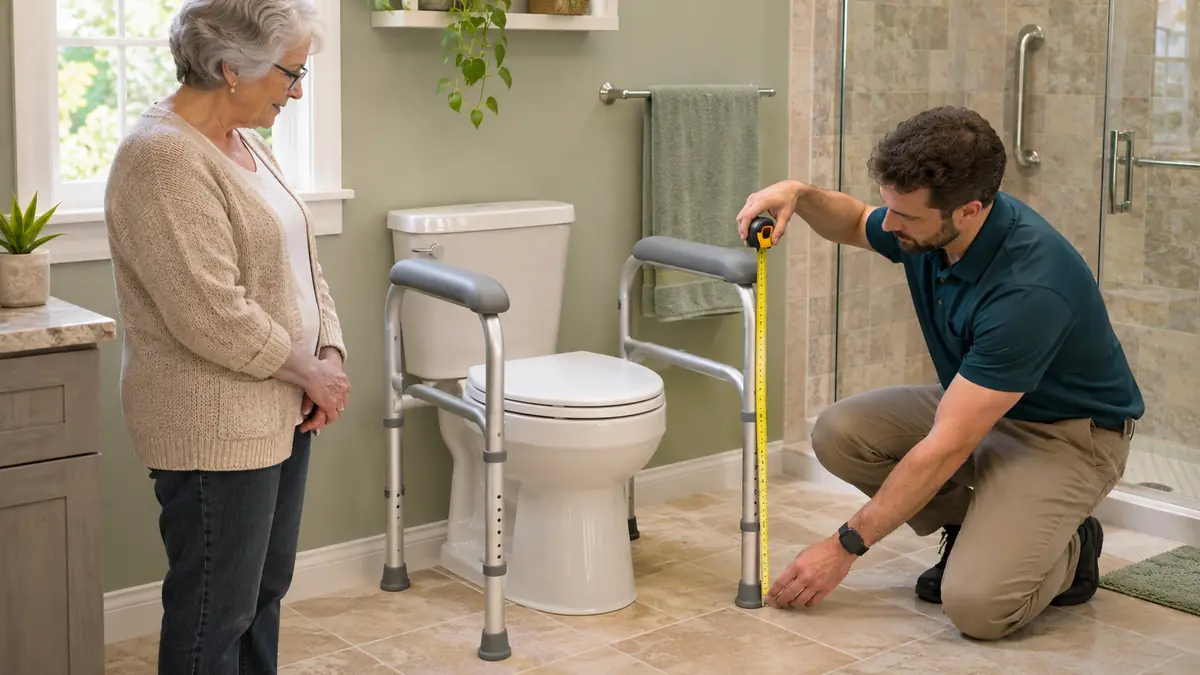
Look at the actual footprint. Some frames put four feet alongside the bowl; some incorporate a rear support bar. In a narrow bathroom, feet may clash with the vanity, a baseboard, toilet brush, heating vent or the user’s own foot placement. A frame that looks fine when empty may be awkward when someone moves forward to stand.
On a correctly assembled frame, every required contact point should be firmly positioned as instructed. A rocking frame, bent leg or worn rubber tip is a reason to stop using the device until the problem is resolved. Never wedge a frame level with books, towels or loose spacers.
Can a frame be placed over any toilet?
No. Floor footprint, toilet height, bowl width, tank position and rear clearance vary. Measure the actual toilet and compare it with the model’s dimensional drawing. Some frames are designed to straddle a standard bowl; others have cross-bracing that will not clear unusual fixtures.
Toilet-mounted rails: compatibility matters more than appearance
Toilet-mounted rails attach in or around the seat-bolt area, depending on design. They can reduce the need for wide floor-standing legs, but installation is not simply a matter of tightening two screws.
Before ordering, determine whether the toilet has exposed seat fixings or a concealed, skirted design, whether the mounting holes and supplied hardware match the rail’s instructions, and whether the existing seat can still be fastened as intended.
Inspect the ceramic fixture for damage. Never overtighten hardware or modify a rail’s bracket to force it onto an incompatible toilet. If the rail manufacturer does not identify the toilet type as compatible, ask the manufacturer or installer before purchase.
After fitting, check that the seat opens and closes properly, the frame does not shift under the permitted load and there are no loose or protruding components. Follow the manufacturer’s tightening and inspection schedule.
Raised toilet seat with handles vs toilet safety rails
This is a particularly important distinction. The rails primarily address where the hands can apply support. A raised seat primarily changes how far the hips and knees have to travel when sitting and standing. A combination product attempts to address both.
| If the main problem is… | Equipment to consider | Check before choosing |
|---|---|---|
| Difficulty pushing up from sitting | Appropriately rated safety rails or structural grab bars | Hand reach, support height, stability and user technique |
| Low seat causes painful deep knee bending | Toilet height adjustment or raised seat | Feet still contact floor and posture remains stable |
| Both low height and lack of hand support | Raised seat with handles or suitable combination of supports | Device compatibility, weight rating and transfer clearance |
| Wheelchair side transfer | Layout-specific wall/fold-down support, if appropriate | Side clearance and whether frame blocks the transfer route |
| Unable to rise without lifting assistance | Professional transfer assessment; potentially different equipment | A basic rail does not lift a person |
A seat that is too high may leave the user’s feet without good support. Raising the seat may also create a difficult gap for transfers from a wheelchair. A higher toilet is therefore not universally safer.
Published ADA height rules are often quoted in product listings. In ADA-covered facilities, the typical seat height is 17–19 inches measured to the top of the seat, with specified exceptions. That does not make 17–19 inches the correct clinical or legal requirement for every private household. Our toilet-height guide explains the distinction.
Five measurements to take before purchasing
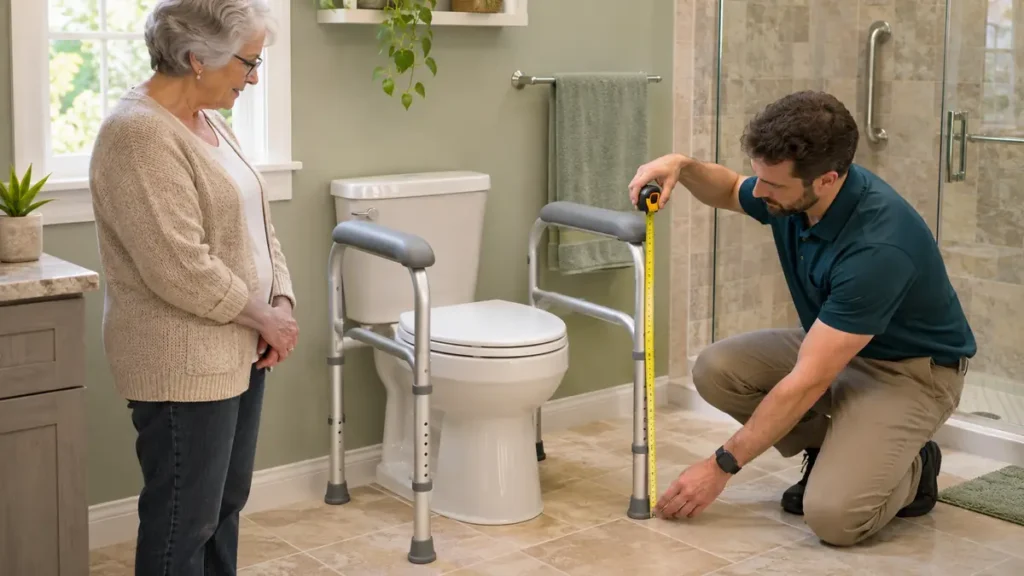
Use a tape measure on the actual bathroom, not a stock photograph of the toilet model.
- Toilet height: measure from the finished floor to the top of the existing seat. Note whether the person has stable foot contact when sitting.
- Available width: measure the clear space on both sides of the bowl, including where feet and hands must move during a transfer.
- Distance to the wall or vanity: check whether an armrest or frame leg could strike a nearby surface, door or cabinet.
- Seat mounting configuration: identify the attachment points if considering toilet-mounted rails or a raised seat.
- Approach and transfer route: check clearance for a walker, wheelchair, caregiver or other mobility aid, including a turn and a stand-to-sit movement.
Also check the product’s outside width, inside handgrip width, adjustment range, total weight rating and permitted loading directions. A description such as “adjustable to fit most toilets” is not a substitute for measurements.
How wide should toilet safety rails be?
There is no single width that works for everyone. The user’s body size, arm position and available bathroom space all matter. Rails placed too close together can squeeze the hips or prevent a comfortable push-up motion; rails too far apart can force an unstable sideways reach.
Choose a model whose stated inside clearance and handgrip positions suit the user. If the person uses a wheelchair, look beyond the seat width: a leg or armrest may obstruct the lateral transfer path even when the device fits around the toilet.
Try to evaluate hand placement at the actual starting and finishing positions of a transfer. An occupational therapist can help if the user has significant strength, balance or coordination limitations.
Weight capacity and loading direction
Product listings often advertise a maximum weight capacity, but that figure is meaningful only alongside the manufacturer’s setup and loading instructions. A frame may be designed to support downward pressure on both armrests, not a large sideways pull on one rail.
Never exceed the specified capacity. If a person tends to pull hard sideways, has frequent sudden losses of balance, or needs another person to lift them, ask a clinician whether a portable frame is suitable. It may be safer to consider professionally installed supports or transfer equipment designed for the task.
Inspect both grips, adjustment pins, bolts and floor tips. Replace worn parts with approved replacements. Do not make structural alterations, add makeshift bracing or attach a rail to other bathroom fixtures.
Toilet rails and wheelchair transfers: where conflicts happen
Many toilet frames are designed around a person approaching from the front and pushing up through both arms. A lateral wheelchair transfer can be very different. The wheelchair must be placed close enough to the toilet, the user may need a clear side approach, and support may be needed in a specific position.
A wide armrest or floor-standing leg on the transfer side can make that movement more difficult. A fold-down support or properly placed wall-mounted rail may work better in some layouts, but only after checking the wall structure and transfer technique.
Do not select a rail solely because a product page describes it as “wheelchair accessible.” Confirm the particular transfer path, wheelchair seat height, hand reach and available clearance.
Can a portable toilet rail replace grab bars?
Not necessarily. A wall-mounted grab bar is attached to a suitable support structure and should be installed under its manufacturer’s specifications. A portable frame or toilet-mounted rail has different attachment and stability characteristics.
For ADA-covered toilet rooms, the U.S. Access Board’s standards generally address side- and rear-wall grab bars under Sections 604 and 609. Portable consumer toilet rails should not be assumed to satisfy those building standards. A strictly private residence usually is not an ADA-covered public facility, though housing and local building requirements may differ.
For construction advice, see our grab bar installation cost guide. If you need to locate permanent supports around a toilet, use our accessible bathroom measurements guide.
Assembly and first-use inspection
Before anyone relies on the frame, assemble it exactly as instructed. Check that telescoping legs are locked at equal or manufacturer-specified settings, fasteners are secure and no missing parts have been substituted.
- Place all designated feet on a clean, stable surface and make sure none rests on the edge of a bathmat.
- Confirm that the rail does not obstruct the toilet seat, lid, flushing controls or access for hygiene.
- Check that the user can reach the handgrips without leaning too far forward or sideways.
- Follow the manufacturer’s stability inspection, including any permitted pre-use checks.
- Have a qualified professional assess the setup if the user is at high risk of falls or requires assistance with transfers.
Written descriptions cannot establish whether a transfer is safe for a particular person. Someone with recent surgery, dizziness, severe weakness, poor seated balance, unstable blood pressure or repeated falls should receive individualized advice from a healthcare professional before trying new toilet support equipment.
Cleaning and ongoing maintenance
Bathroom equipment is exposed to moisture and cleaning chemicals. Follow the manufacturer’s cleaning directions and dry areas where water collects. Check joints, fasteners, adjustment buttons, non-slip feet and padded grips regularly.
A loose clamp, damaged leg, cracked plastic handle or unexplained movement is a reason to stop using the rail until the cause is corrected. Do not assume a higher weight rating compensates for a missing part or incorrect assembly.
If the rail is toilet-mounted, make sure cleaning access and toilet-seat fastening remain as intended. If it is freestanding, check that routine floor cleaning does not dislodge the feet or leave a slippery film beneath them.
When a safety rail is not enough
Some users need more than a handhold. A person who cannot stand without being physically lifted, cannot safely balance while seated, or repeatedly collapses during transfers may need a different care plan and equipment assessment.
For others, a toilet’s location or the width of the bathroom can be the main obstacle. Changing the room layout, installing an appropriate permanent grab bar or choosing a suitable toilet height may solve more than adding a portable frame.
MedlinePlus advises bathroom safety adaptations such as appropriately installed grab bars and elevated seats and recommends occupational or physical therapy guidance when the right modifications are uncertain. The equipment choice should fit the person’s actual movement and surroundings.
Buying checklist: questions that prevent a bad fit
| Check | Question |
|---|---|
| Exact model dimensions | Does the rail fit the bowl, seat and available side clearance? |
| Mounting method | Is it freestanding, bolted at the seat, or structurally attached to a wall? |
| Weight rating | What load and direction of force does the manufacturer permit? |
| Handgrip position | Can the intended user reach both rails safely from sitting and standing? |
| Adjustment | Are height and width changes permitted, and how do they lock? |
| Floor contact | Do the feet rest securely without blocking the transfer route? |
| Seat compatibility | Can the toilet seat and lid operate correctly after installation? |
| Care and replacement parts | Are tips, bolts, clamps and other wear items available? |
| Returns | Can an incompatible product be returned under the seller’s hygiene policy? |
Frequently asked questions
Are toilet safety rails safe for seniors?
They can be helpful when correctly selected, fitted and used, but safety depends on the person’s mobility and the exact equipment. A portable rail is not automatically safe for someone who needs lifting assistance or applies large sideways forces.
Do toilet safety rails fit elongated toilets?
Some do and some do not. Check the actual manufacturer’s compatible seat-mounting dimensions and the bowl clearance. Do not rely on “universal fit” wording alone.
Should I choose toilet safety rails or a raised toilet seat?
Choose based on the limiting problem. Rails provide hand support; a raised seat reduces the vertical distance to sit and stand. A combination may be useful if both issues exist, but it can interfere with side transfers or leave the feet unsupported if too high.
Can I install toilet safety rails without drilling?
Many freestanding and certain toilet-mounted models do not require drilling into walls. They still require proper assembly, correct fit and manufacturer-approved attachment. No-drill does not mean no safety checks.
Are toilet safety rails ADA compliant?
Do not assume portable rails meet the wall-mounted grab bar requirements for ADA-covered toilet rooms. Building-standard compliance depends on the facility and the applicable installation rules; refer to the U.S. Access Board’s Sections 604 and 609.
Does Medicare cover toilet safety rails?
Coverage should not be assumed. Original Medicare’s durable medical equipment rules do not automatically cover bathroom safety accessories; Medicare Advantage plans can have different supplemental benefits. Verify the exact item and plan rules with the insurer before buying.
Sources and related guides
- MedlinePlus — Bathroom safety for adults
- U.S. Access Board — ADA Standards, Chapter 6 (toilets and grab bars)
- U.S. Access Board — Toilet room design guidance
For wider bathroom planning, see Bathroom Safety for Seniors, Grab Bar Installation Cost, and Tub Transfer Bench Buying Guide.