Reviewed against MedlinePlus bathroom-safety and post-hospital home-preparation guidance, Mayo Clinic bathroom fall-prevention guidance, and manufacturer product specifications. No individual chair was physically tested. Product dimensions and permitted uses must be checked against the exact model's instructions.
A shower chair can make the difference between finishing a shower comfortably and having to stand on a wet surface when your legs are already tired. But the chair itself is only part of the decision. You still need to reach it, sit down, wash, dry off and get out without encountering another obstacle.
For someone shopping for a shower chair for seniors, the most useful comparison is not a ranking of the prettiest or most expensive chairs. It is a comparison of the chair’s feet, seat, back, armrests and transfer clearance against the person and bathroom where it will be used. A sturdy-looking model may be too wide for a narrow shower; a comfortable armrest may block a sideways transfer; a seat that feels convenient for one person may leave another person’s feet unsupported.
This guide helps you make those decisions before ordering. It includes a practical measurement sheet, a worked bathroom-fit example and a first-use checklist that you can print or save.
What type of shower chair do you need?
| Type | Best starting point for | Important limitation |
|---|---|---|
| Shower stool without back or arms | People with good seated balance who need a place to rest in a small shower | No back support; hand support may be limited |
| Shower chair with backrest | People who tire while sitting or benefit from trunk support | Backrest may increase the total depth or restrict access from behind |
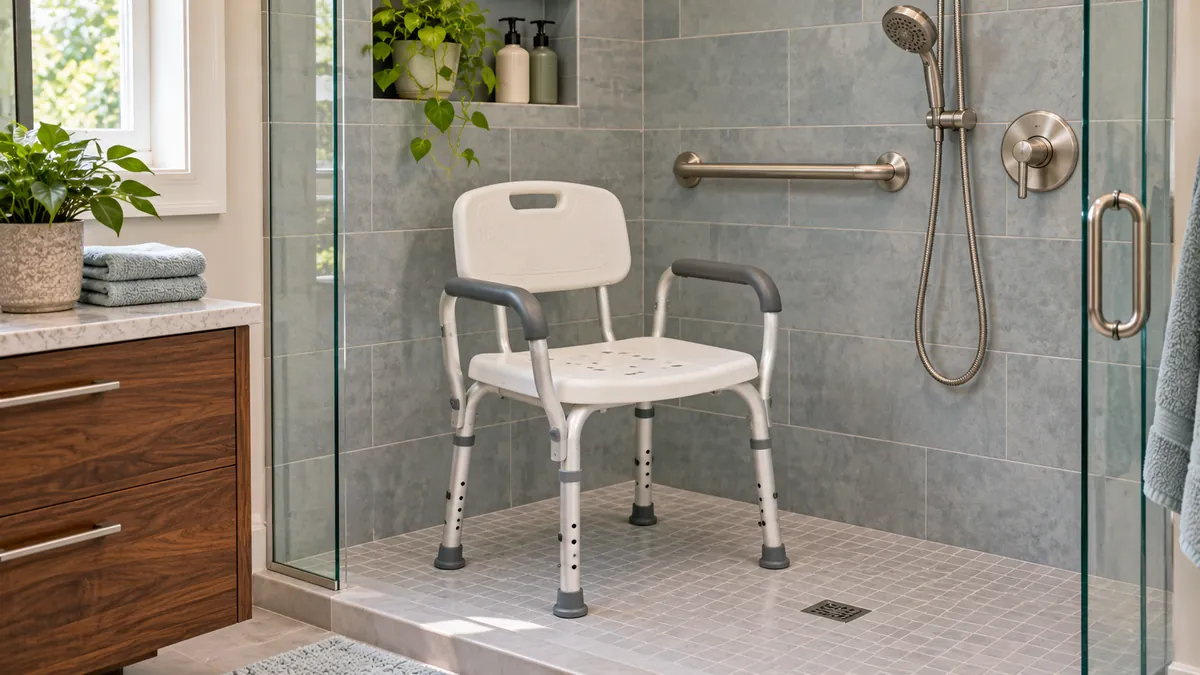
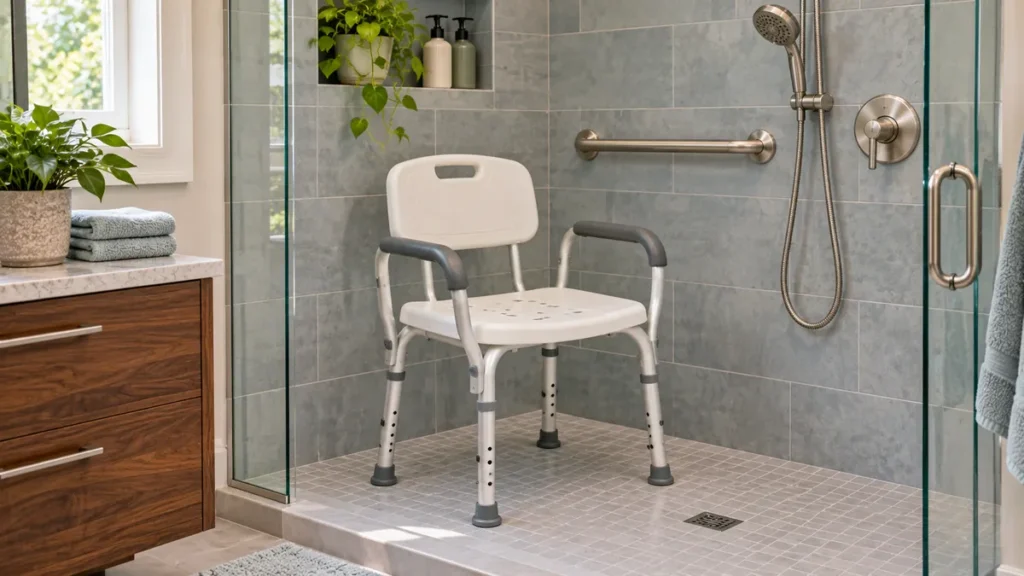
| Shower chair with arms and back | People who need suitable hand placement for sitting and rising | Arms can reduce usable seat width and obstruct side transfers |
| Folding or swivel chair | Some shared showers or layouts that benefit from controlled rotation | Hinges, locks and rotation clearance need inspection |
| Heavy-duty or bariatric chair | Users who need a wider seat or higher rated capacity | Often requires more usable floor space |
| Rolling shower/commode chair | Some people who require a wheeled, assisted bathing arrangement | Needs appropriate access, brakes, support and a suitable shower layout |
Age alone does not tell you which row to choose. A person who can enter the shower and sit independently may need a simple chair. Another person of the same age may require an assisted transfer or specialist seating because of reduced balance or strength.
MedlinePlus recommends seated bathing as one part of improving bathroom safety, together with secure support bars and a dry exit area. Read its bathroom safety guidance for the wider context.
Shower chair with arms: when armrests help and when they get in the way
Armrests can give the user a place to position their hands during a controlled sit-to-stand movement. They can also provide a useful point of contact when shifting position on the seat. However, not all armrests are rated for the same loading. Read the chair manufacturer’s instructions rather than assuming the armrests are equivalent to fixed grab bars.
Choose fixed arms when the approach is clear
Fixed arms may be practical for a person who approaches the chair from the front, turns and sits with both feet on a stable surface. Check that the arms are low enough and close enough for comfortable reach, that the person fits between them and that the shower doorway does not interfere with positioning.
Consider removable or swing-away arms when access matters
A removable or movable arm may create clearance for some sideways transfers or for a caregiver helping with hygiene. But it is only useful if the device is designed for that configuration and the transfer can be performed safely. Verify how the arm locks, whether it must be reattached before use and which loading arrangements the manufacturer permits.
For example, Drive Medical lists its 12445KD-1 shower chair with removable padded arms and an 18.5-inch width between the arms. That measurement illustrates why overall product width alone does not tell you how much sitting space is available. Manufacturer and retailer specifications can change or differ by model; confirm the current manual and label for the exact unit you order. Manufacturer product specifications.
MedlinePlus’s home-preparation guidance after hospital discharge specifically advises an armless seat when placed inside a bathtub. This is a useful reminder that the enclosure and transfer path can change the answer; do not automatically purchase a chair with arms for a narrow tub.
Seven measurements to take before buying
Use a tape measure and write down the actual dimensions in inches. Measure the usable shower, not the nominal size printed on the enclosure brochure.
| Measurement | How to record it | What to compare |
|---|---|---|
| Usable floor width | Measure between walls or obstructions at floor level | Outside width of chair feet, not seat width |
| Usable floor depth | Measure from the back wall to the entry or door track | Leg depth and room for the user’s feet |
| Clear entry width | Measure the open doorway at its narrowest point | Chair width, mobility aid and approach space |
| Threshold height | Measure the change in level at the shower entrance | Whether the user can reach the chair safely |
| Seat height | Measure from the finished floor to the top of a comfortable seat for the user | Manufacturer’s adjustment range and real foot contact |
| Inside armrest width | Measure the user’s seated width and needed clearance | Actual usable space between arms |
| Reach from the seat | Map the locations of the controls, hose, soap and grab bar | Whether the user can operate them without standing or overreaching |
Take a second measurement of the shower floor near the drain. Sloped pans, curved bathtub bottoms, built-in shelves, raised edges and uneven flooring can reduce the area where the chair’s feet can stand as directed. Do not count a section of floor that cannot properly support a leg.
A worked example: will the shower chair fit?
Suppose a household has a shower with 30 inches of usable width and 34 inches of usable depth. A hypothetical chair has feet measuring 22 inches across and 20 inches front to back. Its inside armrest width is 18 inches. These dimensions are illustrative, not recommendations or minimum accessibility clearances.
The chair appears to fit on paper: the floor has 8 inches more width and 14 inches more depth than the footprint. But that does not establish a safe setup. If the glass door opens inward, it may strike an armrest. A person may need more than the remaining space to place their feet and turn. One leg may sit close to the drain depression. The backrest may put the handheld shower out of reach.
Now suppose the user’s comfortable seated width is 19 inches. The chair’s 18-inch arm clearance is already too narrow even though the frame fits inside the shower. A larger chair, a different arm configuration or another seating arrangement is needed.
The lesson is to check three separate things: the chair fits the room, the person fits the chair, and the transfer fits the remaining space. Passing the first check does not mean the other two have passed.
What is the right shower chair height?
A height-adjustable chair allows the seat to be matched to the user rather than forcing everyone to use the same height. The appropriate setting depends on leg length, joint movement, strength, posture and transfer method. A lower setting may be difficult to rise from; a higher setting can leave the feet without adequate support or interfere with a wheelchair transfer.
For a person who can sit and stand independently, check whether they can sit with stable foot support and reach the armrests without an awkward posture. For a wheelchair user, compare the occupied wheelchair seat height and the receiving seat height as part of a professionally assessed transfer plan.
The ADA Standards specify certain fixed shower-seat dimensions for covered facilities, but those dimensions do not determine the correct portable chair height for every person or private home. Our accessible bathroom measurements guide explains the building-standard figures and where they apply.
Adjust the legs only within the manufacturer’s permitted range and in the prescribed configuration. All locking buttons or pins must be fully engaged. Do not build up individual legs with loose spacers or use an unapproved extension to compensate for a shower slope.
Small showers, curved bathtubs and sloping floors
Small walk-in shower
A compact stool may occupy less space than a chair with a back and arms. That does not make it suitable for someone who needs back support. Check the complete dimensions with any optional arms installed, the door swing and room for the user to turn. If a suitable chair leaves no usable transfer space, a different enclosure or professionally designed seat may be necessary.
Bathtub with a shower overhead
A bathtub often narrows toward the bottom and has rounded sides. A chair that fits across the upper rim may have feet that cannot stand fully and securely on the tub floor. Some products are expressly designed for bathing in a tub, but the exact tub shape and chair footprint still matter.
If the user cannot safely step over the high tub wall, a freestanding chair inside the tub does not remove that obstacle. Compare our tub transfer bench buying guide for a seated entry option.
Sloped or curbless shower floor
A shower floor must drain, so it is not always flat in the sense required by a chair. Check whether the manufacturer permits the proposed surface and whether the chair remains stable in its required configuration. A wheeled shower chair also needs a suitable access route and brakes used as directed. Do not compensate for rocking by wedging a leg against the wall or drain.
Weight capacity, seat width and support
Weight capacity is an important purchasing filter, not the whole safety assessment. Check the maximum user weight on the exact product label and instructions, and do not exceed it. A heavier-duty chair may have a wider frame or additional bracing, but it can also be harder to fit through an existing shower doorway.
Measure seated width and consider the person’s actual support needs. A wide seat may provide more space, while a suitable backrest may assist posture. However, if the person cannot maintain safe seated balance, a simple backrest is not a substitute for specialist seating and clinical assessment.
Ask whether the chair allows the intended arm loading, whether a caregiver can access the person without leaning on the frame and whether replacement feet, fasteners and other wear parts are available.
How to position a chair in the shower
Place the chair according to the manufacturer’s instructions, with enough room to approach it and to leave the shower. Think about the entire bathing routine before deciding on a final position.
- Controls and the handheld shower should be reachable without awkward leaning or standing.
- A properly installed grab bar should be accessible at the points where support is needed.
- Shampoo, soap and towels should be within a safe reach or placed by a caregiver.
- Door tracks and glass panels should not block access to the chair.
- The route to the dry bathroom floor must remain clear after bathing.
A showerhead slide rail or towel rack is not automatically a weight-bearing grab bar. A correctly positioned, structurally supported bar can provide a separate handhold for the transfer. See our grab bar installation guide for mounting considerations and quote questions.
Shower chair vs tub transfer bench vs built-in seat
The main distinction is the movement the equipment is intended to address. A chair supports seated bathing after entry. A transfer bench is designed to span a bathtub edge and enable a seated crossing, subject to fit and the person’s transfer ability. A fixed or fold-down seat can free space and form part of a permanent accessible shower, but its wall attachment and reach layout must be designed appropriately.
| Situation | Option to investigate first | Why |
|---|---|---|
| Can enter a low-threshold shower but tires while standing | Freestanding shower chair | Targets standing endurance without a major remodel |
| Cannot step over a standard bathtub wall safely | Tub transfer bench or another bathing arrangement | Changes the entry movement rather than only providing a seat inside |
| Shared shower with limited space for a chair | Appropriate folding chair or professionally installed fold-down seat | May reduce permanent floor obstruction |
| Wheelchair access or substantial caregiver assistance | Assessment of a rolling chair and accessible shower layout | May require a different transfer approach, doorway and drainage setup |
Mayo Clinic’s bathroom fall-prevention guide also distinguishes a shower chair used in an accessible bathing area from a transfer bench used to cross a high tub edge. If the room itself is the obstacle, compare our walk-in tub versus walk-in shower guide before purchasing equipment.
How much should you spend?
There is little value in paying for features the user cannot use safely. Compare delivered prices for the exact models that pass your measurement and support checks. A basic stool, a chair with removable padded arms and a specialist rolling shower chair are not equivalent products, so their prices should not be compared without considering their purpose.
Check whether delivery, assembly, replacement feet and return shipping are included. Bathing equipment may have hygiene-related return restrictions once opened or used; read those conditions before buying.
If a suitable seat requires permanent wall reinforcement, a wider doorway or a new shower entry, compare the cost of the full solution rather than just the chair. Our bathroom cost and financing guide covers larger projects. Ask your insurer or equipment provider about the exact item and coverage before relying on reimbursement; a prescription alone does not guarantee coverage.
First-use checklist: inspect the setup before relying on it
Use the manufacturer’s assembly instructions and pre-use checks. The following is a supplementary inspection list, not a load test or a substitute for individual transfer training.
- All legs, seat components and approved fasteners are installed correctly.
- Height-adjustment locks are engaged and the chair does not rock on the intended surface.
- Non-slip feet are intact, clean and in the required contact with the floor.
- The backrest and armrests are secured in the permitted configuration.
- The user has suitable seat width, foot support and reach to the intended handholds.
- The approach, door opening and exit route remain unobstructed.
- The showerhead and supplies can be reached without unsafe stretching.
- The user knows how to use any locking or moving components and has the assistance they need.
A person with recurrent falls, dizziness, significant weakness, recent surgery, restricted weight bearing or poor seated balance may require an occupational or physical therapist’s assessment before using new equipment. A chair does not make an unsafe transfer safe by itself. Do not use a chair that rocks, shifts, has damaged parts or cannot be installed as instructed.
Cleaning and replacement
Rinse and clean the chair as directed by its manufacturer, then allow it to dry. Pay attention to the underside of the seat, drainage openings, joints, adjustment holes and rubber feet. Use compatible cleaning products; avoid chemicals or abrasive methods that may damage the finish or grips.
Look for cracked seats, bent legs, worn feet, loose hardware, corrosion and locking mechanisms that no longer engage. Remove a damaged or unstable chair from use until it can be repaired with approved parts or replaced. After folding, transporting or reassembling a chair, repeat the manufacturer’s inspection before the next use.
Frequently asked questions
Is a shower chair with arms better for seniors?
It can be helpful for someone who benefits from arm support when sitting or standing, provided the arms are approved for that use. For a narrow bathtub or a sideways transfer, armrests may instead obstruct access. Choose according to the person’s movement and the actual space.
Can a regular shower chair be used in a bathtub?
Some models are designed for both showers and tubs. Check the manufacturer’s approved use and whether all required feet can sit securely within the tub’s usable floor. If stepping over the rim is the problem, a chair inside the tub does not solve that entry difficulty.
Can a shower chair stand on a sloped shower floor?
Only if the exact chair and surface are compatible with the manufacturer’s setup instructions and the chair is stable. Do not use improvised spacers to level the legs or rely on a wall to prevent tipping.
Should a shower chair have a backrest?
A backrest may assist a person who benefits from additional seated support. A stool without a back may suit someone with good seated balance and a small shower. Poor trunk control or substantial support needs may require specialist equipment and professional assessment.
Can a wheelchair user use a standard shower chair?
Some wheelchair users can transfer to a stationary chair, while others need a rolling shower chair or another setup. The chair must fit the individual’s transfer technique and the shower’s access and clearance. Ask an occupational therapist to assess uncertain or assisted transfers.
Is a shower chair the same as an ADA shower seat?
No. Fixed seats in ADA-covered shower compartments have specified installation and construction requirements. A portable consumer chair is not automatically an ADA-compliant fixture. The correct seat for a private home also depends on the person and any applicable housing or local requirements.
Sources and related bathroom safety guides
- MedlinePlus — Bathroom safety for adults
- MedlinePlus — Getting your home ready after the hospital
- Mayo Clinic — Guide to preventing falls in the bathroom
- U.S. Access Board — Bathing room design guidance
- Drive Medical — Shower chair with back and removable padded arms, product specifications
Explore Bathroom Safety for Seniors, Tub Transfer Bench Buying Guide, Accessible Bathroom Measurements and Bathtub Grab Bars to plan the rest of the bathing area.