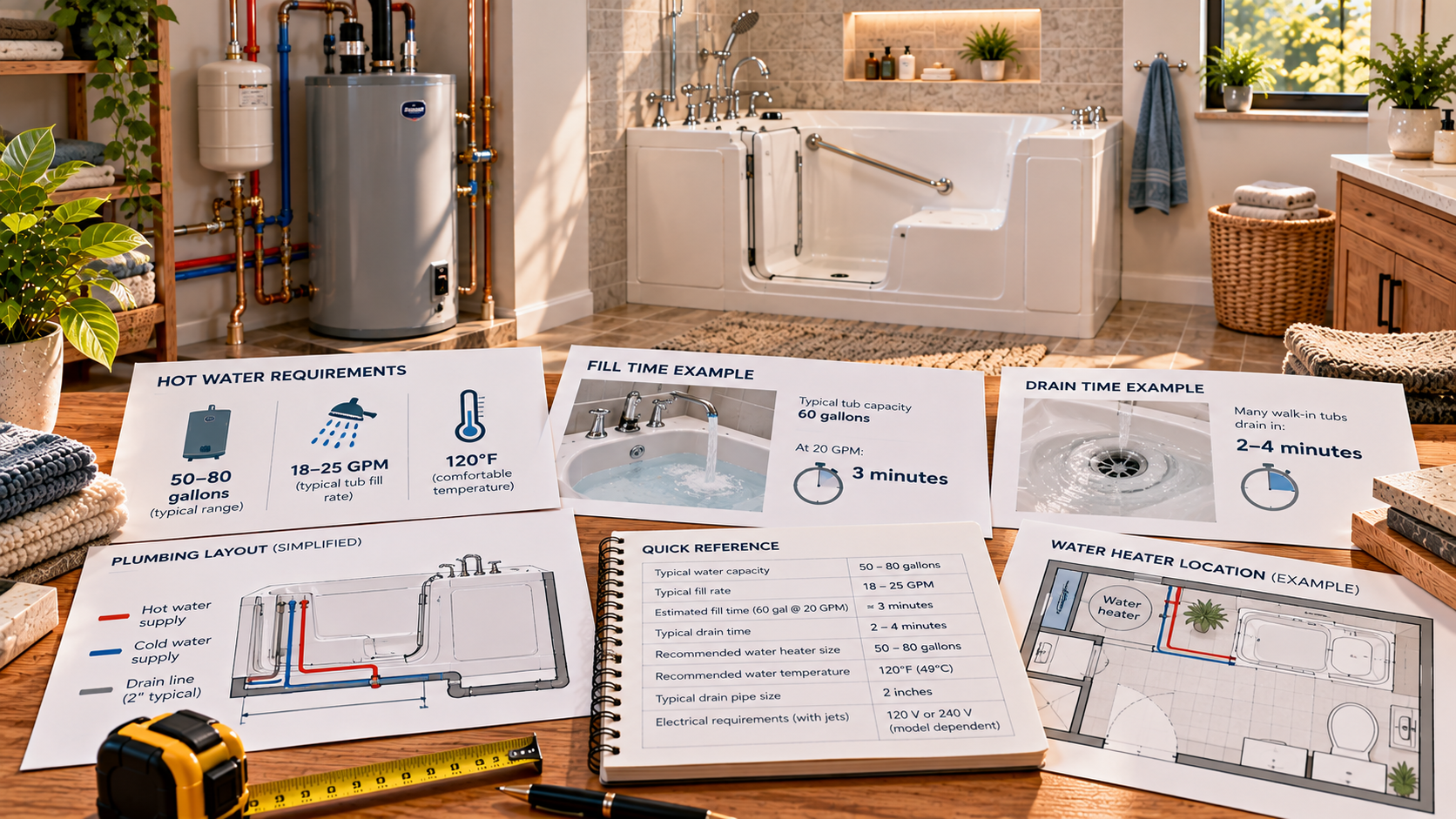
Research-based guide using current manufacturer fill, drain, capacity, faucet-flow and water-heater guidance from KOHLER, Safe Step, American Standard and Ella's Bubbles. Actual performance depends on the exact tub and the home's plumbing.
A walk-in tub can fit the bathroom perfectly and still be frustrating to use if the hot-water system cannot support it.
This is one of the least glamorous parts of buying a walk-in tub—and one of the most important.
Unlike a normal bathtub, the user usually:
- enters the tub while it is empty;
- closes the watertight door;
- sits down;
- waits while the tub fills;
- bathes;
- waits for the water to drain;
- opens the door and exits.
That makes hot-water volume, fill rate and drain time part of the accessibility experience, not just plumbing details.
The three numbers you need before buying
Before comparing brands, find:
- Occupied water volume of the exact tub;
- Real hot-water delivery rate at the bathroom;
- Drain system and expected drain time.
If a dealer cannot tell you those three numbers for the model being quoted, the quote is not complete enough.
How much water does a walk-in tub use?
There is no single number.
Current manufacturer information illustrates the range:
- Ella says many standard tubs use roughly 30–75 gallons per bath once occupied, depending on model and bather displacement.
- Safe Step currently says an occupied tub typically needs roughly 50–70 gallons on its U.S. product guidance.
- American Standard lists compact examples around 45 gallons and larger models higher than that.
The most useful figure is occupied capacity, not empty-tub capacity.
Why occupied capacity is lower
The bather displaces water.
A large adult may reduce the amount of water needed more than a small adult, so the same tub can use a different number of gallons for different users.
That is why “this tub holds 80 gallons” does not automatically mean you need 80 gallons of hot water.
Does a walk-in tub need a 50-gallon water heater?
Sometimes. Not always.
KOHLER currently says its Belay is designed around a standard 50-gallon water heater, while also warning that the heater’s age and condition affect performance.
That is useful guidance for the Belay, but it should not be generalized to every walk-in tub.
A compact 45-gallon tub, a 60-gallon tub and a large specialty tub can place very different demands on the home.
Tank size is only one part of the answer
Two homes with identical 50-gallon heaters can deliver very different bathing experiences because of:
- incoming cold-water temperature;
- water-heater thermostat setting;
- heater age;
- gas vs electric recovery rate;
- distance from heater to tub;
- pipe size;
- simultaneous showers, laundry or dishwasher use;
- mineral scale in the heater;
- actual faucet flow rate.
A simple way to think about usable hot water
The tub is not filled with 100% hot water from the tank. Hot water mixes with incoming cold water at the faucet.
That means a 50-gallon heater can sometimes produce more than 50 gallons of comfortably mixed bath water.
But how much more depends heavily on temperatures.
“60-gallon tub = 60-gallon heater” is too simplistic. Ask the installer to calculate the expected mixed-water volume for the tub, heater setting and local incoming-water temperature.
Why winter can expose an undersized system
Incoming water can be much colder in winter.
When that happens, more hot water is needed to achieve the same bathing temperature.
A setup that seems fine during warm weather can become marginal in winter, especially in colder states.
This is another reason the dealer should not judge water-heater adequacy from tank size alone.
Gas vs electric water heaters
The important difference for a walk-in tub is often recovery rate.
A heater with strong recovery can begin replacing used hot water while the tub is still filling. A slower-recovery system contributes less during the same period.
Ask:
- tank capacity;
- first-hour rating;
- recovery rate;
- heater age;
- whether the unit is operating to specification.
The first-hour rating can be more informative than nominal tank size when evaluating a large bath.
What about tankless water heaters?
A tankless heater can work well if it can supply the required flow rate at the required temperature rise.
That last phrase matters.
A tankless system rated for a high GPM under mild conditions may deliver less when incoming water is very cold.
For a fast-fill walk-in tub, confirm:
- maximum hot-water GPM;
- temperature rise used for that rating;
- whether other fixtures can run simultaneously;
- whether gas/electrical service is adequate.
How long does a walk-in tub take to fill?
Fill time is governed mainly by:
water needed ÷ actual flow rate
For example:
- 60 gallons at 10 GPM ≈ 6 minutes;
- 60 gallons at 15 GPM ≈ 4 minutes;
- 60 gallons at 20 GPM ≈ 3 minutes.
Those are simple theoretical examples. Real-world performance may be slower because flow changes, pressure drops and the faucet may not sustain its maximum rating.
Current manufacturer fill-rate examples
Safe Step
Safe Step’s current Rapid-Fill page says its faucet can deliver about 20 gallons per minute with an average home’s ½-inch supply line and that the current design fills up to 20% faster than previous versions.
Its current guidance also says the user sits in the tub while it fills.
American Standard
American Standard currently lists a 16.5 GPM flow rate on several current Premium and Luxury walk-in tub models with fast-fill faucets.
A 45-gallon compact model at the full theoretical 16.5 GPM would take under three minutes, but real-world flow can differ.
Ella’s Bubbles
Ella’s current support guidance says its:
- 2-piece faucet is designed around 16 GPM;
- 5-piece faucet around 18 GPM;
under ideal 60 PSI conditions.
Ella says real homes commonly see fill times around 7–15 minutes depending on tub size and water-supply configuration.
KOHLER
KOHLER describes the Belay as fast-filling but does not publish one universal fill-time figure on its current FAQ because performance depends on the home’s pipe capacity and flow rate.
Why faucet rating and actual fill rate are not the same thing
A faucet rated at 20 GPM cannot force a weak plumbing system to deliver 20 GPM.
Actual performance can be limited by:
- ½-inch vs ¾-inch supply lines;
- low municipal pressure;
- well-system pressure;
- old galvanized pipe;
- partially closed valves;
- long pipe runs;
- temperature-mixing restrictions;
- the water heater itself.
Ask the installer to measure actual hot and cold flow at the bathroom rather than estimating fill time from the faucet brochure.
Why fill time is an accessibility issue
The bather is already inside the tub while it fills.
A long wait can be uncomfortable for someone who:
- gets cold easily;
- has poor circulation;
- has low body weight;
- has pain when sitting still;
- becomes anxious waiting in an enclosed tub.
Heated seats, heated backrests and handheld showers can improve comfort, but they do not make a weak plumbing system faster.
How long does a walk-in tub take to drain?
This varies even more by design.
Some tubs rely mainly on gravity. Others use a powered quick-drain system.
The critical point is that the user normally remains inside until the water level is below the door.
American Standard Quick Drain
American Standard currently says its patented Quick Drain system on many models can pump water out in less than two minutes and requires no additional plumbing on those product configurations.
That is a manufacturer claim for the equipped models, not a guarantee for every installation.
Ella dual gravity drains
Ella currently uses dual 2-inch gravity drains on many tubs.
The company says a properly connected tub with a suitable 2-inch drain line typically empties in two minutes or less.
Ella also publishes an internal field-test result of 52 seconds under favorable conditions, while explicitly explaining that actual homes depend on pipe size, venting and drain condition.
That distinction is useful: best-case test result and normal planning expectation are not the same thing.
Safe Step Quantum Quick Drain
Safe Step currently says its Quantum Quick Drain is 38% faster than previous drain models.
The company does not currently give one universal number for every installation, and its current guidance notes that drain condition affects performance.
KOHLER drain time
KOHLER also emphasizes fast draining but currently states that fill and drain times vary with the home’s pipe capacity and flow rate.
For a quote, ask the dealer for an expected drain time based on your actual plumbing.
Why a “fast drain” can still be slow in your house
The tub can release water faster than the house drain can carry it away.
Drain performance can be limited by:
- small drain pipe;
- poor venting;
- partial clogs;
- old cast-iron pipe;
- long horizontal drain runs;
- improper slope;
- using only one of multiple drain outlets;
- local plumbing restrictions.
What to ask about the drain before installation
- What drain system does this exact model use?
- Gravity or powered pump?
- What pipe diameter is recommended?
- Does the existing drain meet that requirement?
- Will both drain outlets be connected if the tub has two?
- Is venting adequate?
- What real-world drain time does the installer expect?
- What happens if the drain backs up?
Fill + drain time is more useful than either number alone
If a tub takes eight minutes to fill and four minutes to drain, the user spends roughly 12 minutes waiting inside the tub around the actual bathing period.
A different tub taking four minutes to fill and two minutes to drain cuts that wait in half.
For someone who bathes several times per week, that difference can matter more than an extra set of jets.
Our pre-purchase hot-water worksheet
| Item | Your home | Quoted tub |
|---|---|---|
| Occupied water use | — | _____ gal |
| Water-heater tank size | _____ gal | Requirement: _____ |
| First-hour rating | _____ | — |
| Heater age | _____ years | — |
| Actual hot flow at bath | _____ GPM | Faucet rating: _____ GPM |
| Expected fill time | — | _____ min |
| Drain pipe size | _____ | Required: _____ |
| Expected drain time | — | _____ min |
| Heated seat/back | — | Yes / No |
When should you upgrade the water heater?
Consider a heater upgrade when:
- the existing tank is clearly smaller than the tub’s practical hot-water demand;
- the heater is old and recovery is weak;
- the tub would routinely exhaust hot water before the desired level;
- other household demand cannot realistically be scheduled around bathing;
- the dealer can demonstrate the need with actual calculations.
Do not replace a functioning heater just because a generic walk-in tub article says “you need 50 or 80 gallons.”
When can you avoid an upgrade?
You may be able to keep the existing heater if:
- the chosen tub has modest occupied capacity;
- the user’s displacement reduces fill volume substantially;
- the heater has strong recovery;
- the house has good flow;
- bath time can be scheduled away from laundry/dishwashing;
- the installer confirms adequate real-world performance.
Common planning mistakes
- Using empty-tub capacity instead of occupied capacity.
- Matching heater gallons directly to tub gallons.
- Ignoring winter incoming-water temperature.
- Assuming a 20 GPM faucet means the house delivers 20 GPM.
- Ignoring supply-pipe diameter.
- Buying the largest tub without checking hot-water demand.
- Comparing drain claims without checking the house drain.
- Ignoring how long the user will sit while filling and draining.
- Paying for hydrotherapy before solving hot-water limitations.
Which setup should different buyers investigate first?
| Situation | Priority |
|---|---|
| Gets cold easily | Fast fill + heated seat/back + fast drain |
| Older 30–40 gallon heater | Choose lower-capacity tub or assess heater upgrade |
| Large specialty tub | Hot-water calculation before ordering |
| Old plumbing | Measure real flow and inspect drain before quote |
| Tankless heater | Confirm GPM at required temperature rise |
| Well water | Check pressure, pump capacity and sustained flow |
Questions to ask the dealer before signing
- What is the occupied water capacity of this exact model?
- What is the empty water capacity?
- What faucet flow rate is published?
- What flow rate did you measure in my bathroom?
- What fill time do you expect here?
- What size supply lines are required?
- Is my water heater adequate?
- How did you calculate that?
- What is my heater’s first-hour rating?
- Do you recommend a heater upgrade?
- What drain system does the tub use?
- What drain pipe size is required?
- Will existing venting support the drain?
- What drain time do you expect here?
- Does the tub include a heated seat or backrest?
- Are plumbing upgrades included in the quote?
- Is a water-heater upgrade included or separate?
Our verdict
A walk-in tub’s water system should be evaluated before you fall in love with the tub.
For most buyers, the key question is not “Do I have a 50-gallon heater?” It is:
Can my home deliver enough mixed hot water, quickly enough, to fill this exact tub comfortably—and can my drain empty it quickly enough for the user to exit without a long wait?
That is the number-driven question worth answering.
Related guides
- Walk-In Tub Dimensions & Bathroom Fit Guide
- Walk-In Tub Door Types
- Walk-In Tub Buying Guide 2026
- Kohler Walk-In Tub Review
- Safe Step Walk-In Tub Review
- American Standard Walk-In Tub Review
- Ella’s Bubbles Walk-In Tub Review
Frequently asked questions
What size water heater do I need for a walk-in tub?
It depends on the exact tub, occupied water use, heater recovery, temperature settings, incoming water temperature and household demand. Some current models are designed around a standard 50-gallon heater, but that is not a universal rule.
Will a 40-gallon water heater work with a walk-in tub?
Possibly for a lower-capacity tub and favorable conditions, but it should be calculated rather than assumed. Larger tubs may exhaust a 40-gallon system before reaching the desired level or temperature.
How many gallons does a walk-in tub use?
Current manufacturer examples commonly fall around 30–75 gallons when occupied, depending on model and user displacement. Empty-tub capacity can be significantly higher.
How long does a walk-in tub take to fill?
It depends on water volume and actual flow. Some fast-fill systems advertise very high faucet rates, while Ella currently says real-world fills commonly take around 7–15 minutes across different homes and tub sizes.
How fast does a Safe Step tub fill?
Safe Step’s current Rapid-Fill page says its faucet can dispense about 20 GPM with an average ½-inch household supply line. Actual fill time depends on tub volume and home plumbing.
How fast does American Standard Quick Drain work?
American Standard currently claims that Quick Drain on many equipped models pumps the tub empty in less than two minutes.
How fast does an Ella walk-in tub drain?
Ella currently says tubs connected correctly to a suitable 2-inch drain line typically empty in two minutes or less using dual gravity drains.
Can I open a walk-in tub door before it drains?
No. The water must be below the door opening before the watertight door is opened. Follow the exact manufacturer’s operating instructions.
Does a bigger tub always need a bigger water heater?
Not automatically, but larger occupied water volume increases demand. Heater recovery and mixed-water output matter as well as tank capacity.
Is tankless better for a walk-in tub?
It can be, if the tankless unit can sustain the required hot-water flow at the required temperature rise. A tankless system should be sized to the tub and local incoming-water temperature.
Official sources and research notes
- KOHLER — Walk-In Bath FAQs
- KOHLER — Walk-In Bath Dimensions & Fill/Drain Guidance
- Safe Step — Rapid-Fill Faucet
- Safe Step — Quantum Quick Drain
- American Standard — 28×48 Model Capacity & Flow Rate
- American Standard — Quick Drain Example
- Ella’s Bubbles — Fast-Fill Faucet Expectations
- Ella’s Bubbles — Drainage & Fill Time
Accessible Bath Advisor is an independent educational publication. Manufacturer flow and drain figures are model-specific and may be measured under favorable conditions. Verify the exact tub, actual household water flow, water-heater performance and drain system before ordering.