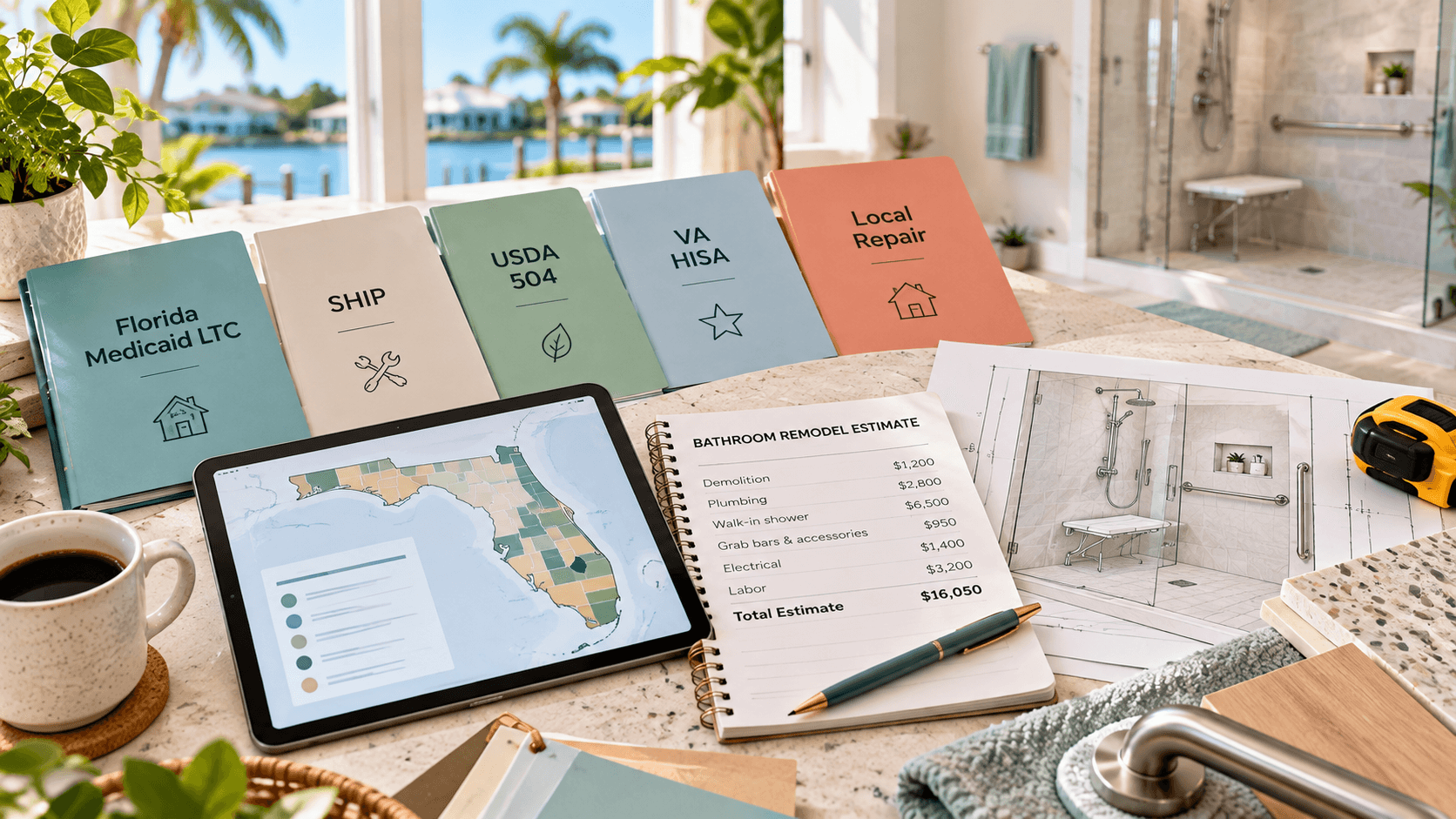
Verified against Florida AHCA, Florida Department of Elder Affairs, Florida Housing Finance Corporation, USDA Rural Development, VA, and current local government program sources. Local application windows and funding can change quickly.
Florida has one of the largest older-adult populations in the country, but finding help for an accessible bathroom can still be surprisingly difficult. The problem is not a total lack of programs. It is that assistance is spread across Medicaid long-term care, aging services, local housing funds, rural programs, Veteran benefits, and county or city repair programs.
Some programs can pay for very specific changes such as bathroom grab bars, an accessible toilet seat, or home accessibility adaptations. Others can support broader rehabilitation where bathroom work is one part of making the home safe, code-compliant, accessible, or habitable.
This guide explains the main Florida routes, which households they may suit, and where to start.
Florida programs at a glance
| Program / route | Who it may help | Bathroom-related help | How to start |
|---|---|---|---|
| Florida Medicaid Long-Term Care | Eligible LTC enrollees | Home Accessibility Adaptation, including bathroom grab bars and special toilet seats | LTC plan care coordinator / case manager |
| Florida Elder Affairs programs | Eligible older adults enrolled in certain aging programs | Home repairs, environmental modifications, adaptive alterations, security devices | Local Aging and Disability Resource Center |
| SHIP local programs | Very-low, low, and moderate-income households, depending on local plan | Emergency repair, rehabilitation, accessibility work, owner-occupied repair | Local SHIP office |
| USDA Section 504 | Qualifying rural homeowners; grants generally for age 62+ with very-low income | Health/safety repairs and accessibility modifications | USDA Rural Development Florida |
| VA HISA | Eligible Veterans / Servicemembers with medical need | Roll-in showers, bathroom access, plumbing/electrical changes | Local VA Prosthetic & Sensory Aids Service |
| Local county/city rehabilitation | Varies by jurisdiction | May include accessibility improvements, health/safety repairs, substantial rehab | County/city housing department |
1. Florida Medicaid Long-Term Care: Home Accessibility Adaptation
Florida’s Statewide Medicaid Managed Care Long-Term Care program includes a service called Home Accessibility Adaptation.
The Florida Agency for Health Care Administration describes this service as making changes to a home so the member can live and move more safely and independently.
Florida gives examples such as:
- installing bathroom grab bars;
- installing a special toilet seat;
- other home changes that support safer movement and independence.
The program does not treat ordinary major home improvement as an accessibility benefit. Florida specifically distinguishes home accessibility adaptations from general improvements such as routine carpeting, roof repair, or normal plumbing-system replacement.
Who may receive this service?
This is not a benefit that every Florida Medicaid member can automatically use. It is part of the Long-Term Care program and must be tied to the member’s needs and care plan.
Florida LTC provides home- and community-based services for eligible people who qualify for the program and need long-term-care support.
The right first contact is usually the member’s managed care plan, care coordinator, case manager, or the state’s long-term-care screening and enrollment pathway.
How to ask about a bathroom modification
“Can my plan of care include Home Accessibility Adaptation because the current bathroom creates a transfer or fall risk?”
Then describe the problem: difficulty stepping over the bathtub, unsafe sit-to-stand transfers, lack of stable support, difficulty reaching the toilet safely, wheelchair clearance problems, or the need for a safer showering arrangement.
2. Florida Medicaid disability waivers can also include environmental adaptations
Florida Medicaid operates several population-specific waiver programs in addition to the main Long-Term Care system.
For example, the developmental-disability iBudget Waiver includes Environmental Accessibility Adaptations. Florida Medicaid’s published coverage handbook describes these as physical adaptations that are medically necessary, tied to the person’s support plan, and required to avoid institutional placement or increase independence at home.
The current handbook states that approved environmental accessibility adaptations are limited to the scope described in the recipient’s plan and generally cannot exceed $20,000 over a five-year period under that benefit.
This route is specialized and applies to eligible developmental-disability waiver participants, not to older adults generally.
3. Florida Department of Elder Affairs programs
The Florida Department of Elder Affairs is another important starting point for older residents.
The department’s current housing-resource guidance says that seniors enrolled in programs such as Community Care for the Elderly (CCE), Home Care for the Elderly (HCE), Local Service Programs (LSP), or certain Older Americans Act services may be able to receive home repairs, environmental modifications, adaptive alterations, or security devices.
Availability depends on local funding, eligibility, program enrollment, and service priority.
Where to start
Florida’s Aging and Disability Resource Centers coordinate access to aging and long-term-care services.
When calling, ask specifically about home modification assistance, bathroom safety modifications, fall-prevention programs, grab-bar installation, minor home repair, Community Care for the Elderly, local SHIP programs, and nonprofit home-repair partners.
4. SHIP: one of Florida’s most important local funding systems
Florida Housing Finance Corporation administers the State Housing Initiatives Partnership (SHIP) program.
SHIP sends housing funds to all 67 Florida counties and many entitlement cities. Local governments then adopt their own Local Housing Assistance Plans (LHAPs).
This matters because SHIP is not one statewide bathroom grant. Instead, it creates a network of local programs.
What SHIP funds can support
Florida Housing lists eligible SHIP uses that include emergency repairs, rehabilitation, homeownership assistance, disaster assistance, and other locally approved housing strategies.
Local governments decide which strategies they offer, how much assistance is available, whether the money is a grant or deferred loan, and which households receive priority.
How to find your SHIP office
Florida Housing maintains a local government SHIP contact directory. The state recommends selecting your city first. If your city is not listed, select your county.
“Does your current SHIP Local Housing Assistance Plan include owner-occupied rehabilitation, accessibility modification, emergency repair, or special-needs home modification?”
5. Why SHIP is especially important for bathroom accessibility
Some county SHIP plans explicitly include accessibility features.
For example, Pinellas County’s published plan describes grants for accessibility-related modifications and lists examples such as grab bars, door widening, roll-in shower or tub, wheelchair ramp, comfort-height toilets, bath bars, and flooring modifications.
This does not mean every Florida county offers the same benefit, but it shows why reviewing the local LHAP is worthwhile.
6. Orange County Housing Rehabilitation Program
Orange County is a good example of a local Florida rehabilitation program that can include accessibility work.
The county’s Housing Rehabilitation Program is designed for eligible homeowners with life, health, safety, and code-related repair needs.
Orange County currently lists eligible work including accessibility improvements, plumbing, electrical work, HVAC, roofing, and septic work.
The assistance is structured as a 0% deferred second mortgage, not as a no-strings-attached grant.
Orange County temporarily closed the Owner-Occupied Rehabilitation Program to new applications effective September 21, 2026 so it can work through its existing waitlist. This is exactly why local-program status should always be checked before planning around funding.
7. Orange County accessibility example
Orange County also provides a useful example of what a larger rehabilitation project can accomplish.
In a 2026 county case study, a homeowner who had begun using a wheelchair received extensive rehabilitation after storm damage. The project included wider corridors and doorways plus a new accessible shower.
That case involved disaster recovery and broader housing rehabilitation rather than a standalone bathroom grant, but it illustrates how accessibility can be incorporated into a larger approved repair project.
8. Miami-Dade older-adult home modifications
Miami-Dade County currently lists an Older Adults Home Modification Grant Program within its Community Action and Human Services home-repair resources.
The county describes the service as free home modifications for qualifying older adults to help them remain safely in their homes.
Miami-Dade also operates broader home repair, weatherization, and mitigation resources.
If you live in Miami-Dade, ask specifically about the Older Adults Home Modification Grant Program, senior home repair, accessibility modifications, grab bars and bathroom safety, Rebuilding Together Miami-Dade partnerships, and current application status.
Pinellas County: accessibility help exists, but intake is currently closed
Pinellas County has a particularly relevant Independent Living Program for homeowners who need accessibility modifications. The county currently lists eligible improvements such as:
- bathroom grab bars;
- tub-to-shower conversions;
- walk-in or roll-in showers;
- ADA-approved toilets;
- door widening;
- wheelchair ramps and railings;
- other improvements intended to create barrier-free housing.
The Independent Living Program can provide an additional grant of up to $20,000 for qualifying accessibility work when used with the county’s Home Repair Program.
However, Pinellas County closed the Home Repair Program to new applications in May 2026 because of application volume. The county currently directs interested homeowners to call Housing and Community Development and join the notification/waitlist process for future reopening.
Do not treat Pinellas assistance as an open grant. The program itself remains valid, but new intake is currently closed. Check the official Pinellas County page before planning around this funding.
Orange County Housing Rehabilitation: temporarily closed
Orange County’s Owner-Occupied Housing Rehabilitation Program helps qualifying homeowners address life, safety, health and code-related problems. The county explicitly lists Accessibility Improvements among the work it can support.
Applicants generally must own and occupy the home as their primary residence, meet the program’s very-low-income requirements and satisfy the county’s property and residency rules.
Orange County temporarily closed new applications effective September 21, 2026 so staff can process the existing waitlist. Applications submitted before the closure continue to be reviewed subject to eligibility and available funding.
The county currently anticipates reopening the program on or around January 18, 2027, although that date can change.
Monitor the Orange County Housing and Community Development page or call 407-836-5150 for the current reopening status.
Miami-Dade Older Adults Home Modification Grant Program
Miami-Dade now has one of the clearest local bathroom-accessibility programs in Florida.
The County’s Older Adults Home Modification Grant Program provides free, low-cost and high-impact home modifications for qualifying low-income older adults to reduce falls and help them remain safely at home.
Miami-Dade received approximately $1.997 million in HUD funding for a grant term running from April 15, 2025 through April 15, 2028. The County’s approved program is intended to assist at least 160 income-eligible residents age 62 or older.
Examples identified by Miami-Dade include:
- walk-in showers;
- grab bars;
- handrails;
- anti-slip treatments;
- accessible faucets;
- accessible thermostats;
- motion-sensor lighting;
- other low-cost modifications selected through an individual assessment.
The program also uses occupational-therapy assessment to help identify appropriate modifications.
How to start
Miami-Dade currently lists the Older Adults Home Modification Grant Program under Community Action & Human Services → Home Repairs. Eligibility and participant selection remain subject to County intake procedures and available places.
Unlike a generic repair program, this funding was specifically awarded for low-cost accessibility modifications for older adults, including bathroom-safety work.
Palm Beach County SHIP: funded, but verify current intake
Palm Beach County continues to use State Housing Initiatives Partnership (SHIP) funds for owner-occupied housing assistance.
For FY 2026-2027, the County approved approximately:
- $2 million for Owner Occupied Housing Rehabilitation;
- $1.569 million for Emergency Repairs.
The County also states that special-needs households can be assisted through Owner-Occupied Housing Rehabilitation and Emergency Repairs strategies.
This confirms that the strategies are funded, but it does not mean applications are continuously open. Palm Beach homeowners should check the current Housing & Economic Development intake before relying on the program for a bathroom project.
Funding amounts, application windows, eligible repairs and assistance structure vary by Florida county and participating city. Always use the Florida Housing local-government lookup to find the correct SHIP office for your address.
10. USDA Section 504 in rural Florida
USDA Rural Development’s Single Family Housing Repair Loans & Grants program is active in Florida.
For eligible rural homeowners, the current standard program offers:
- up to $40,000 in loans;
- up to $10,000 in grants;
- up to $50,000 combined;
- a 20-year loan term;
- a fixed 1% interest rate.
Grant applicants generally must be age 62 or older, own and occupy the home, meet very-low-income requirements, and live in an eligible rural area.
USDA’s program handbook allows Section 504 grant funds to be used to remove health and safety hazards or to remodel a dwelling to make it accessible and usable by a household member with a disability.
11. VA HISA for Florida Veterans
Eligible Florida Veterans and Servicemembers can use the federal Home Improvements and Structural Alterations (HISA) benefit.
VA says eligible improvements can include roll-in or barrier-free showers, conversion from a bathtub to a seated shower, accessible bathroom sinks or counters, doorway widening, grab bars and handrails, and necessary plumbing and electrical work.
VA currently lists a lifetime benefit of up to $6,800 in certain qualifying circumstances.
VA guidance also makes an important distinction: HISA does not cover walk-in sit-down hydrotherapy, jetted, spa, or Jacuzzi-style tubs.
Which Florida route should you check first?
| Your situation | Start here |
|---|---|
| Medicaid LTC enrollee | Long-Term Care plan / Home Accessibility Adaptation |
| Older adult already receiving aging services | Local ADRC / Department of Elder Affairs program |
| Low-income homeowner | Local SHIP office / county housing department |
| Person with developmental disability in iBudget | Support coordinator / Environmental Accessibility Adaptations |
| Rural homeowner age 62+ with very-low income | USDA Section 504 |
| Veteran with medically necessary bathroom need | VA HISA |
| Miami-Dade older adult | Older Adults Home Modification Grant Program |
| Not sure what exists locally | ADRC + local SHIP office |
What bathroom work may qualify?
Programs are more likely to approve work that solves a defined accessibility or safety problem. Examples can include grab bars, accessible toilet modifications, roll-in shower, seated shower conversion, door widening, accessible faucet controls, wheelchair clearance, plumbing associated with an approved accessibility change, and flooring changes needed to reduce a hazard.
Luxury finishes and unrelated remodeling are much less likely to qualify.
Describe the need, not the product
Less useful:
“I want a luxury walk-in tub.”
Better:
“The resident cannot safely step over the current tub wall and needs a lower-entry bathing solution, stable seated bathing, and support for transfers.”
This gives the assessor or program room to approve the most appropriate solution.
Documents to collect before applying
- photo ID;
- proof of age;
- proof of disability or medical need;
- Medicaid information;
- proof of income;
- proof of homeownership;
- mortgage/property-tax status;
- lease and landlord authorization if applicable;
- photos of the current bathroom;
- contractor estimates;
- medical or occupational-therapy recommendations;
- insurance documentation for repair programs;
- Veteran documentation for HISA.
Do not start work before approval
Many Florida programs require eligibility review, inspections, authorization, or an approved contractor process before construction.
If you plan to use Medicaid, SHIP, USDA, VA, or a local repair program, do not assume work completed before authorization will be reimbursed.
Florida homeowners vs renters
SHIP, USDA, and most owner-occupied rehabilitation programs are primarily homeowner programs.
Medicaid home accessibility services can sometimes apply in rental housing when the adaptation is authorized and the required property-owner permission is obtained.
Grant, deferred loan, or benefit?
| Type | Example |
|---|---|
| Medicaid benefit | Authorized Home Accessibility Adaptation |
| Grant | Some local accessibility programs or USDA Section 504 grants |
| Deferred loan | Many county owner-occupied rehabilitation programs |
| Local SHIP strategy | Could be grant, deferred loan, or another structure depending on the LHAP |
Do not assume a program called “assistance” is a grant.
How to search your Florida county or city
- [county] SHIP owner occupied rehabilitation
- [city] SHIP home repair
- [county] accessibility modification program
- [city] senior home repair Florida
- [county] housing rehabilitation accessibility
- [city] bathroom modification grant
Florida application checklist
- Identify the unsafe movement in the bathroom.
- If enrolled in Medicaid LTC, contact the plan care coordinator.
- If age 60+, contact the local ADRC.
- Find the local SHIP office and check its current LHAP.
- Ask whether owner-occupied rehabilitation or accessibility funding is open.
- If rural, check USDA property and income eligibility.
- If a Veteran, contact VA HISA before signing a contract.
- Get estimates only when the program requests them.
- Separate essential accessibility work from cosmetic remodeling.
- Wait for written authorization before beginning construction.
Red flags in Florida “free bathroom” ads
- The company says every Florida senior qualifies.
- The ad does not identify an actual public program.
- The “grant” is really financing.
- The salesperson says Medicaid or Medicare automatically pays for walk-in tubs.
- The company requests banking or Social Security information before explaining eligibility.
- You are pressured to sign a remodeling contract before benefit approval.
- The website uses official-looking seals but is only a private lead form.
Related Florida bathroom-planning guides
- Bathroom Accessibility Grants by State — national funding overview and state directory.
- Bathroom Remodel Cost & Financing 2026 — compare public assistance and financing routes.
- Bathroom Safety for Seniors — identify the modification that solves the actual problem.
- Walk-In Tub Cost 2026 — understand the full project cost before applying.
- Walk-In Tub vs Walk-In Shower — compare accessibility and long-term suitability.
Frequently asked questions
Does Florida have bathroom remodel grants for seniors?
Florida does not have one universal statewide bathroom grant. Eligible residents may receive help through Medicaid Long-Term Care, aging programs, local SHIP-funded rehabilitation, USDA Section 504, VA HISA, or county and city home-repair programs.
Can Florida Medicaid pay for bathroom modifications?
Florida Medicaid’s Long-Term Care program includes Home Accessibility Adaptation. Florida specifically identifies bathroom grab bars and special toilet seats as examples of eligible adaptations when they are authorized for an enrolled member.
Can Florida Medicaid pay for a walk-in shower?
The program authorizes home accessibility adaptations based on functional need and the care plan. A shower-related modification may qualify when appropriate, but the program does not promise a particular product or remodel to every member.
What is SHIP in Florida?
SHIP is the State Housing Initiatives Partnership. Florida Housing distributes funds to counties and participating cities, which create local plans for housing assistance such as repair, rehabilitation, emergency repair, and other approved strategies.
Can SHIP pay for accessibility modifications?
Yes, some local SHIP plans explicitly include accessibility modifications. The exact benefit depends on the county or city Local Housing Assistance Plan and current funding.
How do I find my Florida SHIP office?
Florida Housing maintains a local government contact directory. Select your city if listed; otherwise select your county.
Can USDA help Florida seniors with bathroom accessibility?
Yes. Section 504 can provide loans and grants to qualifying rural homeowners. Grant funds may be used to remove health and safety hazards or make a home accessible for a household member with a disability.
Does VA HISA cover walk-in tubs?
<
VA HISA can support medically necessary access to essential lavatory and sanitary facilities, including examples such as roll-in showers, accessible sinks or counters, and plumbing or electrical work required by an approved modification. The current VA guidance specifically excludes spas, hot tubs and Jacuzzi-type upgrades. Do not assume that purchasing a particular walk-in tub will be reimbursed: the modification must be medically justified and approved through the HISA process before work begins.
Does Miami-Dade have home modification help for older adults?
Miami-Dade currently lists an Older Adults Home Modification Grant Program offering free home modifications for qualifying older adults, subject to current program eligibility and availability.
Are Florida home-repair programs always open?
No. Local programs can close when funds are exhausted or waitlists grow. Orange County, for example, temporarily closed new Owner-Occupied Rehabilitation applications in September 2026.
Official sources and verification
- Florida AHCA — Long-Term Care Services
- Florida AHCA — LTC Recipient FAQs
- Florida AHCA — iBudget Waiver
- Florida Department of Elder Affairs — Housing Resources and Assistance
- Florida Housing — SHIP
- Florida Housing — Current Local Housing Assistance Plans
- Florida Housing — Local SHIP Contacts
- USDA Rural Development — Section 504 in Florida
- U.S. Department of Veterans Affairs — HISA
- Orange County — Housing Rehabilitation Program
- Miami-Dade County — Home Repair and Older Adult Services
Accessible Bath Advisor provides general educational information and does not guarantee eligibility, funding, approval, or reimbursement. Florida Medicaid, SHIP, aging, USDA, VA, county, city, and nonprofit programs can change funding, eligibility, and application status. Confirm current terms with the administering agency before beginning work or signing a remodeling contract.