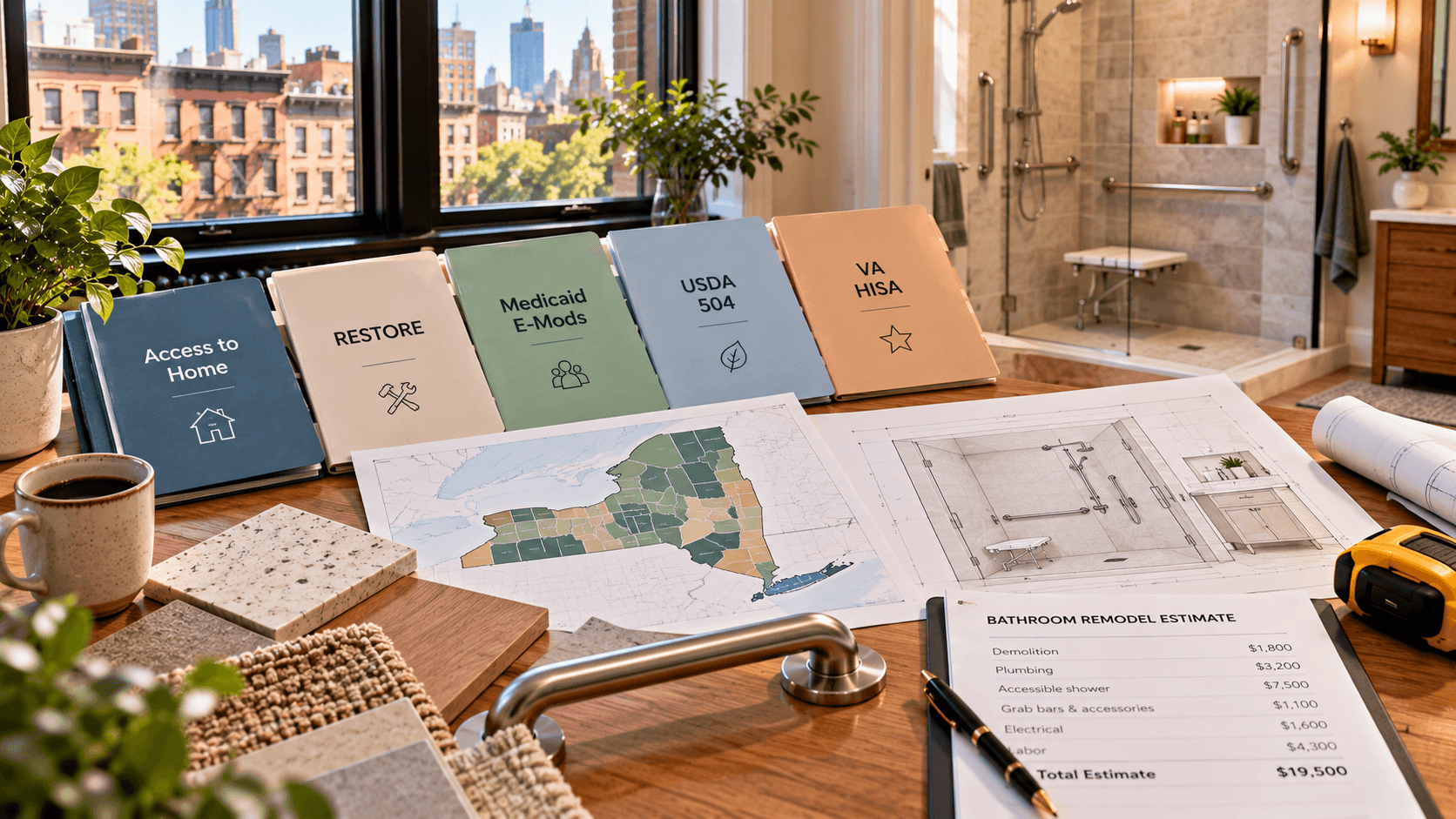
Verified against New York State Department of Health, New York Homes and Community Renewal, USDA Rural Development, and VA sources current in October 2026. Program administrators, funding rounds, and local availability can change.
New York is one of the more promising states for home accessibility assistance because several programs explicitly recognize bathroom modifications rather than treating them as an incidental type of repair.
That does not mean every applicant qualifies or that the state will buy a specific walk-in tub. Most programs start with a functional need: difficulty entering a tub, unsafe transfers, wheelchair access, inability to reach fixtures, or a health-and-safety problem that could force someone out of the home.
This guide explains the main New York routes and how they differ.
New York programs at a glance
| Program / route | Who it may help | Bathroom-related help | How to start |
|---|---|---|---|
| Access to Home | Low-income people with disabilities; includes seniors with age-related disabilities | Bathroom changes, door widening, ramps, lifts, other accessibility modifications | Local program administrator funded by NYS HCR |
| Access to Home for Medicaid Members | Eligible Medicaid members with disability-related accessibility needs | Accessibility modifications and retrofits | Local participating administrator / Medicaid-related referral |
| Medicaid E-Mods / CFCO / waiver services | Eligible Medicaid members with assessed ADL/IADL need | Roll-in showers, accessible tubs, grab bars, faucet controls, plumbing/electrical work | Care manager / person-centered plan |
| RESTORE | Eligible homeowners age 60+ with emergency health/safety repair needs | Emergency accessibility modifications and plumbing repairs | Local program administrator |
| USDA Section 504 | Qualifying rural homeowners; grants generally age 62+ with very-low income | Health/safety repairs and accessibility work | USDA Rural Development New York |
| VA HISA | Eligible Veterans / Servicemembers with medical need | Roll-in showers, bathroom access, sink/counter changes, plumbing/electrical work | Local VA Prosthetic & Sensory Aids Service |
1. Access to Home
New York’s Access to Home program is one of the strongest state-funded accessibility programs we have found so far.
New York Homes and Community Renewal describes it as a state-funded program that provides grants to make accessibility modifications to existing homes occupied by low-income people with disabilities.
Current 2026 program guidance says eligible participants generally include people with disabilities whose household income is at or below 80% of Area Median Income. Veterans with qualifying service-related disabilities may be eligible at higher income levels under the related Access to Home for Heroes program.
What can it pay for?
New York HCR’s program materials identify accessibility work such as:
- wheelchair ramps;
- lifts;
- widened doorways;
- changes to bathrooms to allow wheelchair access;
- kitchen adaptations;
- first-floor bedroom or bathroom relocation;
- other modifications recommended by accessibility professionals.
Current administrative guidance allows up to $25,000 per unit for eligible Access to Home modifications, depending on the approved scope of work.
The 2024-25 annual report shows completed projects including ramps, doorway widening, and accessible bathrooms, with project costs ranging from under $880 up to the $25,000 program maximum. The average reported completed project cost was $15,354.
How homeowners apply
This is important: individual homeowners do not usually apply directly to HCR as if it were a statewide rebate.
New York funds municipalities and nonprofit Local Program Administrators (LPAs), and those organizations enroll eligible households in their service areas.
That means your practical task is to find the current Access to Home administrator serving your county or municipality.
2. Access to Home for Medicaid Members
New York also funds a related program specifically for qualified Medicaid members.
HCR’s recent annual reporting shows that Access to Home for Medicaid Members operates alongside the main Access to Home and Access to Home for Heroes programs.
The structure is similar: local administrators coordinate accessibility modifications for eligible households rather than sending unrestricted cash directly to the homeowner.
3. New York Medicaid Environmental Modifications
New York Medicaid has several pathways for Environmental Modifications (E-Mods). The exact authority depends on the member’s program, but the core concept is consistent: physical changes to a home that are necessary for health, welfare, safety, independence, or prevention of institutionalization.
New York Department of Health guidance for Community First Choice Option lists examples including:
- ramps;
- lifts;
- widened doorways;
- roll-in showers and accessible tubs;
- grab bars and handrails;
- water-faucet controls;
- electrical accommodations;
- plumbing accommodations.
The modification has to be connected to an assessed Activity of Daily Living, Instrumental Activity of Daily Living, or health-related need and reflected in the person’s plan of care.
New York also uses E-Mods in waiver programs
New York’s current Children’s Waiver guidance likewise includes roll-in showers, accessible tubs, grab bars, widened doorways, and plumbing/electrical accommodations. In 2026 the state updated that waiver and continued E-Mod services under 1915(c) authority.
The Non-Medicaid? No—other Medicaid waiver populations such as NHTD and TBI also use Environmental Modification services when the work is necessary to support community living.
Important limit and authorization rules
Under CFCO guidance, agreements above $15,000 per year require additional state approval, and the limit can be exceeded when supported by medical necessity and proper authorization.
Do not interpret that as a universal guaranteed $15,000 benefit. It is an authorization threshold within a specific Medicaid service framework.
New York Medicaid E-Mods must be tied to an approved person-centered plan and authorized through the appropriate program. Work started without the required evaluation and approval can be at risk of non-payment.
4. New York Social Care Networks can also support home accessibility
New York’s Medicaid Social Care Network framework includes medically necessary home accessibility and safety modifications for certain eligible Medicaid managed-care members who have identified health-related social needs.
The state’s current service description includes examples such as:
- ramps;
- handrails;
- grab bars;
- pathways;
- electric door openers;
- doorway widening;
- bathroom facilities;
- non-skid surfaces.
This is another reason to ask a Medicaid care manager about the member’s specific program rather than assuming there is only one E-Mod pathway.
5. RESTORE: emergency repairs for older homeowners
New York’s Residential Emergency Services to Offer (Home) Repairs to the Elderly (RESTORE) program is designed for emergency repairs that remove hazardous conditions threatening the health or safety of eligible older homeowners.
Current 2026 program guidance includes accessibility modifications among eligible emergency activities when the condition meets the program’s emergency threshold.
Examples of eligible work include:
- accessibility modifications;
- serious structural repairs;
- stairs and entry/egress repairs;
- failed heating systems;
- plumbing repairs;
- electrical hazard repairs;
- other urgent health-and-safety conditions.
RESTORE is not a general remodeling program
RESTORE does not pay for ordinary cosmetic remodeling or non-emergency upgrades.
The local administrator has to document a condition that creates an immediate health, safety, or habitability threat.
New York increased the maximum project amount to $20,000, and the current 2026 manual reflects the program’s emergency-repair focus.
A sudden need for disability modifications following a medical condition or procedure can qualify when it meets the emergency criteria.
6. Access to Home vs RESTORE
| Question | Access to Home | RESTORE |
|---|---|---|
| Main purpose | Accessibility for people with disabilities | Emergency health/safety repair for older homeowners |
| Bathroom work | Yes, when required for accessibility | Yes, if it meets emergency criteria |
| Typical trigger | Disability/accessibility need | Immediate hazardous condition |
| Current maximum | Up to $25,000 per unit under current program guidance | Up to $20,000 per project |
| How delivered | Local program administrator | Local program administrator |
7. USDA Section 504 in rural New York
USDA Rural Development currently lists New York’s Single Family Housing Repair Loans & Grants program as open and accepting applications on an ongoing basis.
Standard current terms include:
- maximum loan: $40,000;
- maximum grant: $10,000;
- maximum combined assistance: $50,000;
- loan term: 20 years;
- fixed rate: 1%;
- grants generally limited to homeowners age 62+ with very-low income.
The applicant must own and occupy the property, meet county income limits, and live in an eligible rural area.
Loans can be used to repair, improve, or modernize the home or remove health and safety hazards; grants must be used to remove health and safety hazards.
8. VA HISA for New York Veterans
Eligible New York Veterans can use the federal Home Improvements and Structural Alterations (HISA) benefit for medically necessary changes to a primary residence.
VA lists eligible purposes including:
- access to essential lavatory and sanitary facilities;
- roll-in showers;
- accessible bathroom sinks or counters;
- plumbing changes needed for approved home medical equipment;
- electrical changes needed for approved home medical equipment.
The current lifetime HISA amount is up to $6,800 in certain qualifying service-connected circumstances.
HISA does not pay for spas, hot tubs, Jacuzzi-type upgrades, or unrelated new construction.
9. New York City residents: where to start
New York City residents should still check the statewide programs above, but administration can differ from upstate counties.
Useful starting points include:
- NYC Aging for older-adult service navigation;
- Medicaid care managers for E-Mod eligibility;
- local Access to Home administrators serving New York City;
- Veterans Affairs for HISA;
- nonprofit accessibility organizations and housing rehabilitation providers.
For older residents, NYC Aging can also help identify local support and benefits resources even when it does not directly fund the bathroom project.
10. Upstate New York residents
Upstate residents may have additional access to rural USDA assistance and smaller municipal rehabilitation programs.
Start with:
- your county Office for the Aging;
- your municipality or county housing department;
- the Access to Home administrator in your service area;
- USDA Rural Development if the property is in an eligible rural area;
- Medicaid care management if the resident receives HCBS.
Which New York route should you check first?
| Your situation | Start here |
|---|---|
| Person with a disability, low income | Access to Home |
| Medicaid member with documented accessibility need | Care manager / E-Mod or Access to Home for Medicaid Members |
| Homeowner age 60+ with urgent unsafe condition | RESTORE |
| Rural homeowner age 62+ with very-low income | USDA Section 504 |
| Veteran with medically necessary bathroom need | VA HISA |
| Not sure which local administrator serves you | County housing agency / Office for the Aging / HCR-funded local provider |
What bathroom work should you request?
Describe the barrier rather than the product.
Less useful:
“I want a walk-in tub.”
Better:
“The resident cannot safely step over the existing bathtub wall, needs seated bathing, stable grab support, and enough clearance for safe transfers.”
The approved solution might be:
- a roll-in shower;
- an accessible tub;
- grab bars;
- a transfer bench;
- door widening;
- faucet-control changes;
- accessible sink/counter changes;
- plumbing or electrical accommodations.
Documents to gather before applying
- photo ID;
- proof of household income;
- proof of disability or medical need;
- Medicaid information where relevant;
- proof of homeownership or lease;
- landlord permission if required;
- photos of the current bathroom;
- measurements of the tub, shower, doors, and clear space;
- occupational-therapy or medical recommendations;
- contractor estimates if requested by the program;
- Veteran documentation for HISA.
New York application checklist
- Define the accessibility or emergency problem.
- If the resident has Medicaid, ask the care manager about E-Mod services.
- Check whether Access to Home is available through a local administrator.
- If age 60+ and there is an urgent health/safety condition, ask about RESTORE.
- If rural, check USDA property and income eligibility.
- If a Veteran, contact VA HISA before signing a contract.
- Get any required professional accessibility assessment.
- Wait for written approval before construction.
- Keep copies of scopes, bids, approvals, and receipts.
Red flags in New York “free bathroom” ads
- The ad never names Access to Home, RESTORE, Medicaid, USDA, VA, or a local public program.
- It says every senior automatically qualifies.
- It promises a specific walk-in tub before an assessment.
- The “grant” is actually financing.
- The company asks for a same-day remodeling contract before program approval.
- It uses official-looking logos but redirects to a private lead-generation form.
Related New York bathroom-planning guides
- Bathroom Accessibility Grants by State
- Bathroom Remodel Cost & Financing 2026
- Bathroom Safety for Seniors
- Walk-In Tub Cost 2026
- Walk-In Tub vs Walk-In Shower
Frequently asked questions
Does New York have grants for bathroom accessibility?
Yes. Access to Home is a state-funded accessibility program delivered through local administrators. Medicaid Environmental Modifications, RESTORE, USDA Section 504, VA HISA, and local housing programs may also help depending on eligibility.
How much can Access to Home provide?
Current New York program guidance allows up to $25,000 per unit for eligible accessibility modifications, depending on the approved scope and local administration.
Can Access to Home pay for bathroom changes?
Yes. New York program materials explicitly identify bathroom changes for wheelchair access and other accessibility modifications as eligible activities.
Can New York Medicaid pay for a roll-in shower?
Yes, in qualifying Medicaid environmental-modification programs when the shower is medically or functionally necessary and approved through the person’s plan of care.
Can New York Medicaid pay for an accessible tub?
New York E-Mod guidance includes accessible tubs as an example. Approval depends on assessed need, program rules, prior authorization, and whether a less intensive solution would meet the need.
What is RESTORE?
RESTORE is New York’s emergency home-repair program for eligible older homeowners. It can fund accessibility modifications when they address an immediate health or safety threat.
What is the current RESTORE maximum?
Current New York law and 2026 program guidance allow up to $20,000 per eligible emergency repair project.
Can rural New York homeowners use USDA Section 504?
Yes. The New York program is currently open. Eligible rural homeowners may qualify for loans up to $40,000, grants up to $10,000, or up to $50,000 combined.
Can Veterans use HISA for a bathroom remodel in New York?
HISA can fund medically necessary bathroom access such as roll-in showers, sink/counter accessibility, and related plumbing or electrical work, subject to VA eligibility and approval.
Should I start the remodel before approval?
No. Access to Home, Medicaid E-Mods, RESTORE, USDA, and VA programs can require prior review or authorization. Starting early can jeopardize eligibility for payment.
Official sources and verification
- New York Homes and Community Renewal — Access to Home
- New York HCR — Access to Home Program Manual 2026
- New York HCR — Access to Home Annual Report
- New York HCR — RESTORE Program Manual 2026
- New York Department of Health — Environmental Modifications Guidelines
- New York Medicaid — Social Care Network Home Accessibility Services
- USDA Rural Development — Section 504 in New York
- U.S. Department of Veterans Affairs — HISA
Accessible Bath Advisor provides general educational information and does not guarantee eligibility, funding, approval, or reimbursement. New York State, Medicaid, local, USDA, and VA program rules and funding can change. Confirm current terms with the administering agency before beginning work or signing a remodeling contract.